






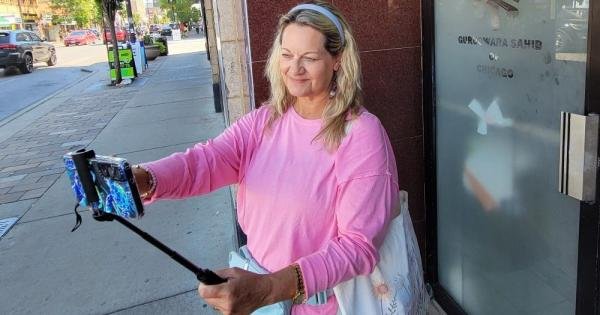
Rev. Vicki Garlock spent 30 days in September moving across Chicago, entering churches, mosques, temples and other sacred spaces. By the end of the month, she had visited 185 places of worship, setting a Guinness World Records title for the most visited in a single month.
The previous benchmark stood at 76 and was raised mid-attempt to 111 after another participant set a new mark. Garlock exceeded that revised threshold by a wide margin.
Her stops included more than 40 Catholic churches and institutions, reflecting Chicago’s historical identity as a center of American Catholicism which she said stood out both for their architectural scale and their role in neighborhood life.
“What struck me most about those 40 Catholic churches was it really showed how resilient Catholicism in general is,” she said. “What I could literally see almost in real time, was how the Catholic Church is adapting and continues to adapt to the needs of the city, to the neighborhood and to the people who live there.”
She cited examples of historically Polish parishes that now serve predominantly Hispanic congregations, reflecting demographic changes within the city.
Beyond physical structures, Garlock, who attended a Catholic high school, observed the social functions of these spaces, including outreach programs and services for vulnerable populations. Many churches, she noted, operate food distribution efforts and other forms of community support. These activities align with her broader aim of highlighting what she describes as the constructive role of religion in public life.
Her visits took place during a period of heightened public attention to immigration enforcement in Chicago.
She said she encountered individuals directly affected by immigration concerns, particularly within Catholic communities serving Hispanic populations. “There was, at that point, always a story,” she said, recounting conversations with parish staff and congregants about family decisions and church attendance patterns.
The record attempt in September required strict adherence to guidelines set by Guinness World Records. Each visit had to be documented with a time-stamped photograph and video of the exterior, along with a signed verification form from a local witness. Garlock was not allowed to use private vehicles. For her, this meant relying entirely on Chicago’s public transportation system and walking several miles daily.
She logged more than 350,000 steps, took over 65 bus rides and a similar number of trips on the city’s elevated train system.
Garlock, who was raised Lutheran, was ordained at Jubilee! Community, a nondenominational church in Asheville, North Carolina. She has a doctorate in psychology and previously taught at Warren Wilson College in North Carolina. Her career shifted after the birth of her second child, when she developed a curriculum designed to introduce children to a range of religious traditions.
That work led her beyond academic study into direct observation. “I realized that in order to really learn about lived religion, what religion actually looks like in people’s everyday lives, that I needed to get out of my office and stop reading sacred texts and actually see what happens in sacred spaces,” she told the National Catholic Reporter. Beginning in the early 2010s, she started visiting houses of worship across traditions, often attending services and learning through direct engagement.
The idea to attempt a world record came more recently. After reading about a previous record holder in India, Garlock decided to pursue the challenge herself. She started preparing early last year and selected Chicago for its density and diversity of religious institutions. Then she mapped out a preliminary route.
Garlock documented the monthlong effort through daily posts on social media with her organization, World Religions 4 Kids, which produces educational materials aimed at improving religious literacy among children and communities.
Initial expectations were modest. Garlock arranged appointments at approximately 85 locations, enough to surpass the original record of 76. However, on Sept. 5 — four days into her attempt — she received an email from Guinness informing her that the record had been broken and reset at 111. “So all I could do was try to figure out how to get 112,” she said.
The shift required a change in strategy. Rather than relying solely on scheduled visits, Garlock began approaching additional sites without prior confirmation. She targeted locations that had not responded to earlier outreach and appeared in person, often during active services. “What I realized is that if you just show up where people are, they will be enthusiastic and they will sign your form,” she said.
Each visit required interaction with at least one person willing to verify her presence. These witnesses were not limited to clergy. “I met custodians. I met security people. I met administrative assistants. I met all kinds of people,” she said. The process involved brief explanations to establish credibility and request cooperation.
Garlock’s route remained largely concentrated in downtown Chicago due to transportation constraints. While the city offers significant religious diversity, some communities — particularly Hindu and Muslim congregations — are more heavily represented in suburban areas. Without access to a private vehicle, these locations were difficult to reach within the time and cost limits of the project, she said.
Despite these limitations, the range of traditions included in the final count was broad.
Garlock visited Christian churches across multiple denominations, as well as Jewish synagogues, Buddhist temples, Islamic centers and other religious spaces. She also attended more than 20 services, including Orthodox Jewish worship, Catholic Masses, Buddhist meditation sessions and Islamic prayers.
Security considerations varied across traditions. Synagogues and some other institutions maintained visible security measures, including guards and restrictions on photography. In these cases, Garlock adapted her documentation to comply with site-specific requirements.
When she finished the visits, Garlock chose to hold her award ceremony outside Madonna Della Strada Chapel at Loyola University Chicago, on the shore of Lake Michigan.
She described the project as both a professional investment and a continuation of her ongoing work in interfaith education.
“For me, this is what I do,” she said. “I consider it an investment in my personal work, and I consider it an investment in what those of us in the multifaith space in general are trying to do all the time.”
She said the experience showed the diversity not only between religions but within them. “As I often say to people, if there are 8 billion people on the planet, then there are 8 billion different faith stories,” she said.
“Humans are really good at creating sacred places for themselves,” she said. “And they do it in all sorts of different ways.”
Source:
www.ncronline.org