







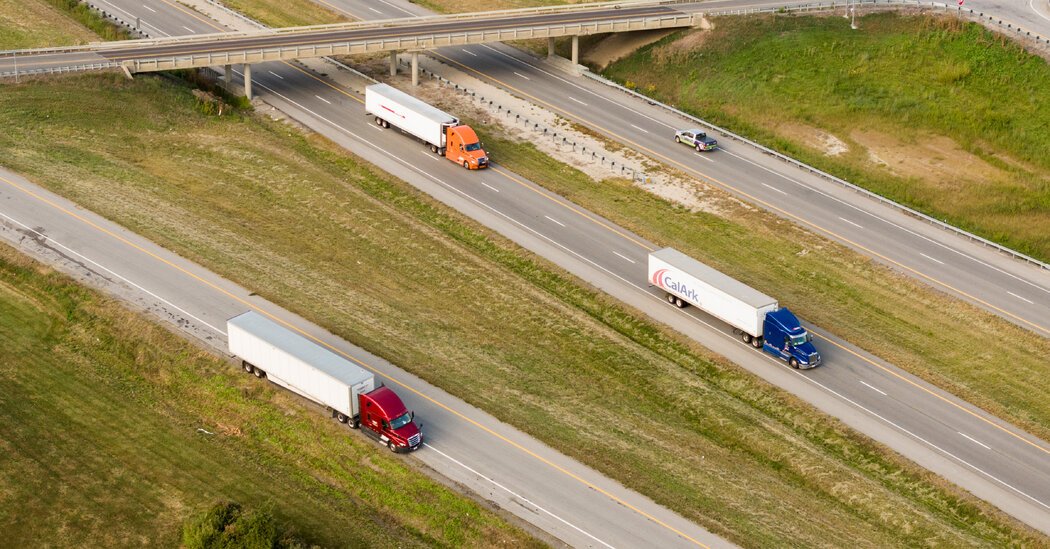
The American trucking industry, which moves nearly three-quarters of the nation’s goods, has devolved into a dangerous, dysfunctional system that threatens every driver on the road, whether you’re in an 18-wheeler or the family S.U.V.
Consider a tragedy that took place on the Florida Turnpike last August. An inexperienced semi truck operator was accused of making a reckless, illegal U-turn, causing a minivan to slam into its side. Three people in the minivan — a 37-year-old woman, a 54-year-old man and the 30-year-old driver — were killed in the collision. (The driver has pleaded not guilty to multiple charges.)
Federal investigators later revealed that the truck driver, who had entered the country illegally, was issued a commercial driver’s license, or C.D.L., in California. A federal rule change, made in 2019 at the behest of the trucking industry, had allowed him to bypass the standard background and driving history checks required of Americans to obtain a C.D.L.
After the crash, regulators tested his English language proficiency and road sign recognition: He answered only two of 12 verbal questions correctly and identified just one of four signs, according to the Department of Transportation.
This wasn’t just a one-off error; it reflects a systemic failure that is killing thousands of ordinary motorists and their passengers. In 2023, 5,472 people died in crashes involving large trucks — a level of loss that would be unthinkable if it occurred in our skies.
The discrepancy in how we value human life based on the mode of transport is staggering. When the Boeing 737 Max crisis claimed 346 lives across two crashes, it triggered a global grounding of aircraft and brought the company to its knees. This was a necessary, indignant response to a failure of safety oversight.
We reach that same death toll on our interstates every 24 days — a 737 Max-scale catastrophe each month. We have allowed ourselves to become numb to carnage on our highways that we find intolerable in our skies.
This collapse is the result of a decades-long policy experiment that prioritized cheap and fast over safe and sustainable. For years, a powerful narrative promoted by special interest groups like the American Trucking Associations has dominated discussions of highway safety in Washington. These groups have claimed that there is a perpetual truck driver shortage, and have used that idea as a justification for sourcing labor less expensively.
The shortage was always a mirage. While industry groups warned in 2021 that they needed at least 80,000 new drivers to meet demand, the number of active motor carriers registered with the Federal Motor Carrier Safety Administration actually surged — climbing from roughly 500,000 to more than 900,000 in the past decade.
This engineered expansion of truckers triggered what became known in the industry as the Great Freight Recession. As hungry new entrants flooded the market, shipping rates plunged between 2022 and 2025, and cutting corners became a survival strategy. Hundreds of trucking companies couldn’t survive in that depressed market, including Carroll Fulmer Logistics, a 71-year-old Florida firm with 400 trucks and about 600 employees that shut down last year.
Carroll Fulmer’s demise is a classic instance of the consequences of regulatory capture, when the line between the checker and the checked effectively disappears. We’ve seen this movie before: when the Federal Aviation Administration famously allowed Boeing to “self-certify” upward of 96 percent of the work on the 737 Max, leading to a culture of concealment that proved lethal.
Transportation Secretary Sean Duffy has taken a harder line than his predecessors on aviation safety, conditioning Boeing’s production expansion on demonstrated safety improvements and directing the F.A.A. to prioritize safety-related audits over delivery speed.
In trucking, however, regulatory capture took an even more insidious form: It was used to aggressively deregulate labor. During the implementation of the 2022 Entry-Level Driver Training rule, a new standard designed to expand the pool of truck drivers, the A.T.A. fought to ensure that driving schools could self-certify their compliance with federal standards. The lobby has also pushed to lower the interstate driving age to 18 — think about it: teenagers driving 18-wheelers — and supported the expanded licensing of foreign drivers. These efforts would flood the market with the most inexperienced and vulnerable labor possible.
The industry lobby also pushed for this honor system despite the fact that its safety regulator lacked the ability to conduct meaningful audits. The result was a race to the bottom that flooded our roadways with graduates of C.D.L. mills — schools that check a box on a website and then teach the test in as little as three weeks, with no minimum requirement for behind-the-wheel hours.
In February, after more than 1,400 sting operations, Mr. Duffy moved to shut down more than 550 of these sham training schools from the national registry. He’d already dismissed the A.T.A.’s shortage story. “I do not buy the idea that there are not enough American truck drivers,” he said in late 2025.
Reversing this trend is the goal of a bill called Dalilah’s Law, which is named for a 5-year-old who was severely injured in an accident in 2024, currently moving through Congress. The bill seeks to restore license integrity, shut down the self-certification loopholes for C.D.L. mills and mandate English proficiency for safety-critical communication. It does not address other issues. For instance, 22 percent of trucks are not roadworthy, according to government data, and should be taken off the road. The regulator lacks the budget to enforce its own regulations.
Closing these loopholes isn’t just about safety. Or being anti-immigrant. Trucking has long been one of the few remaining paths to the middle class that don’t require a four-year degree. It is a vital engine of upward mobility, particularly for minority communities and legal immigrants: Approximately 18 percent of drivers are Black, and 23 percent are Hispanic. If we restore meaningful barriers to entry, wages will naturally rise, making the profession once again attractive.
The scale of the prior neglect is best measured in the Federal Motor Carrier Safety Administration’s budget. In 2010, the agency had approximately $1,100 in oversight funding for every registered carrier. Today, that figure has plummeted by 40 percent when adjusted for inflation and for the 85 percent explosion in the number of fleets. We have asked a skeleton-crew agency to keep track of a million-piece puzzle.
We need the agency to be able to do its job and protect everyone on our highways. Deregulation might be in vogue today, but co-opted regulation shouldn’t be part of it. Not in airlines, or trucking or banking or any other sector. America’s supply chains are essential, but they cannot safely depend on a system engineered for volume at the expense of vigilance. The cost of cheap freight is simply too high when it’s paid in human lives.
Craig Fuller is the founder and chief executive of FreightWaves, a provider of new and high-frequency data covering the logistics and global supply chain markets.
The Times is committed to publishing a diversity of letters to the editor. We’d like to hear what you think about this or any of our articles. Here are some tips. And here’s our email: letters@nytimes.com.
Follow the New York Times Opinion section on Facebook, Instagram, TikTok, Bluesky, WhatsApp and Threads.
Source:
www.nytimes.com