







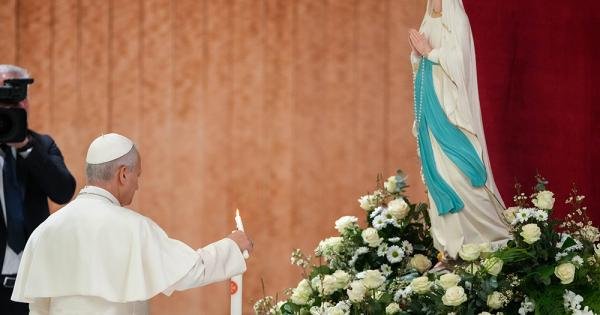
On a rainy September morning at the start of this school year, Bishop Miege High School in Roeland Park, Kansas, celebrated the unveiling of its new Our Lady of Lourdes grotto, located directly across from the school’s student entrance.
Archbishop William Shawn McKnight of Kansas City, Kansas, blessed the stonecut grotto with holy water from Lourdes, France. He stood under an umbrella, surrounded by faculty, deacons, altar boys, and a girls’ choir singing songs to Our Lady.
Interim President Joe Schramp called the grotto “a place of peace to all who visit.” Alumnus Terry Dunn expressed the hope that students would stop there at the beginning and end of each day to say a Hail Mary.
Dunn’s ties to Bishop Miege High School are personal. Family members have noted that multiple generations of Dunn graduates have passed through Miege.
The Dunn family, owners of JE Dunn Construction, a privately held company that is also employee-owned, has long been a visible and generous presence in Kansas City’s civic and Catholic life. The company donates about 10% of its pre-tax net income to nonprofit organizations.
(Disclosure: Three of my children graduated from Miege, and my wife and I have a grandson in attendance.)
Another face of JE Dunn Construction is visible about 18 miles south of Bishop Miege, where it is a general contractor in the expansion of a major U.S. nuclear weapons plant.
Where grasslands once fed cattle, the U.S. Department of Energy is doubling the size of an existing plant, euphemistically called the Kansas City National Security Campus. It is operated by Honeywell Federal Manufacturing & Technologies and produces some 80% of all non-nuclear components of U.S. nuclear weapons.
The ambitious expansion project, known as the Kansas City Non-Nuclear Expansion Transformation, or KC NExT, is a multi-phase effort expected to add roughly 2-2.5 million square feet of manufacturing and office space — an area roughly the size of 45 football fields. According to public records, the expansion, outlined in 2024 contracts, is needed to meet rising demand for new and renewed nuclear arsenal components.
Federal documents place the overall program cost at $6.4 billion over the next several years.
JE Dunn reported $6.5 billion in total revenue in 2024, ranking it among the nation’s largest general contractors. It served as a general contractor when the original Kansas City National Security Campus was built in the 2010s and is now involved in the current expansion.
The federal government does not disclose contractor-specific amounts. Still, given the scale of both the original campus and the ongoing expansion, JE Dunn’s role is clearly substantial — likely involving contracts worth hundreds of millions of dollars, though no precise figure has been made public.
In its public materials, JE Dunn avoids explicit reference to nuclear weapons when describing its work at the Kansas City site, instead using broader terms such as “national defense” and “non-nuclear, high-tech electronic components.”
The Miege grotto and the weapons plant expansion do not inhabit separate moral worlds. They share the same metropolitan map, touch many of the same families, and unfold under the same church leadership. And taken together, they are just one example of the many complex moral calculuses facing Catholics living out their faith today, especially when it comes to the rapidly changing technological advances associated with issues of war and peace.
Decades ago, church bishops and theologians gave what they described as a limited moral acceptance to the U.S. nuclear defense system. That justification, however, has been eroding in recent years under several popes, to the point that Pope Francis condemned both the use and even the maintenance of nuclear weapons as immoral.
For all Catholics, but especially those working in and on behalf of the U.S. nuclear weapons industry, this has been an evolving moral matter — but one with a seemingly clear direction: church leadership that condemns both the use and the maintenance of nuclear weapons systems.
In 1983, the U.S. bishops’ pastoral letter “The Challenge of Peace” allowed nuclear deterrence only as a strictly limited and temporary arrangement on the way toward progressive disarmament. Even earlier, Pacem in Terris, Pope John XXIII’s encyclical, warned that peace cannot rest securely on stockpiles of weapons capable of annihilating humanity. Pope John Paul II spoke of deterrence as something that might be tolerated only as an interim step toward disarmament, while Pope Benedict XVI emphasized that authentic security must be built on trust and justice rather than fear.
Recent popes have gone further. Pope Francis stated plainly that both the use and possession of nuclear weapons are morally unacceptable. Pope Leo XIV has sharpened that position, warning against the “illusion of security” rooted in deterrence and calling for renewed efforts toward disarmament.
He has also become increasingly explicit in his concern about those who profit from war and the economic structures that depend on permanent preparation for it. He said recently in Cameroon that “The masters of war pretend not to know that it takes only a moment to destroy, yet often a lifetime is not enough to rebuild.”
Some will continue to see this as a necessary tension in a dangerous world. Others will hear in the church’s teaching a call to deeper change. That discernment will not be resolved in a single moment.
But it should take place openly and honestly.
The situation in Kansas City is not unique. According to one estimate, more than 1 million Americans work in defense-related work, and there are many other industries whose practices, methods or goals might be at odds with part of church teaching. Nuclear weapons, of course, pose a unique threat, and that’s partly why Pope Leo and his predecessors have highlighted the deep moral questions about the manufacturing of these bombs. Individual Catholics, especially those who profit from the nuclear weapons industry, are being invited by the pope to deep discernment about their role in upholding these structures and systems. The grotto at Bishop Miege offers a place to begin that conversation — with God, with one another, and within our own consciences. In that quiet space, the question is not theoretical: What kind of peace are we willing to build, and what are we willing to accept in its name?
How we answer will shape more than our opinions. It will shape the world these students inherit.
Source:
www.ncronline.org