








Driving an electric vehicle on a road trip can be challenging enough in the United States. Would it be even possible in a country like Costa Rica? I decided to find out.
Costa Rica has done more than most countries to promote electric vehicles, including passing a law in 2018 that required electric utilities to install fast chargers every 50 miles on national highways. That and tax breaks have made Costa Rica a pioneer in electric vehicles. Now, almost one in five new cars sold in the country is electric, a phenomenon I had come to report on.
The utilities typically installed only one charger at each location. Often the chargers don’t work, according to reviews on apps like PlugShare.
Costa Rica is one of the most prosperous and stable countries in Latin America, but in rural areas many roads are still unpaved. Some areas, including the one I visited, didn’t get electricity until the 1980s.
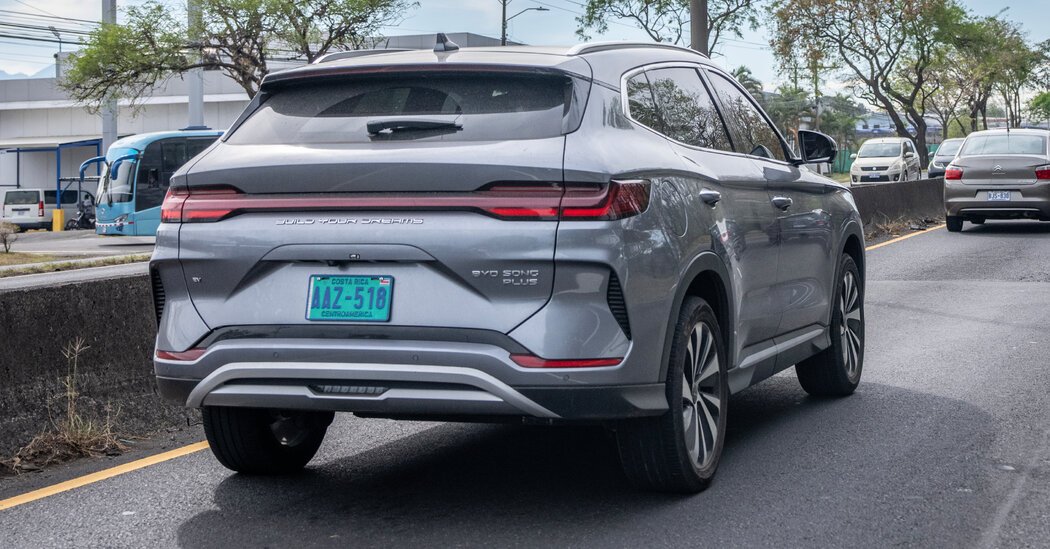
I rented a BYD Yuan, sold as the SF1 in Costa Rica, from Green Circle Experience, a firm that organizes tours to hotels and resorts that follow sustainable practices.
The SF1, a small but capable sport utility vehicle that sells for about $30,000, is popular in Costa Rica. Costa Ricans are buying electric vehicles at three times the rate of people in the United States in part because of the availability of such inexpensive Chinese models, which the United States effectively bars with huge tariffs.
Green Circle designs itineraries that include hotels with chargers. My three-day rental and two-night stay cost a little over $700.
The people at Green Circle encouraged me to visit a small hotel on the Pacific coast named Hacienda Barú, about 120 miles from San José, the capital. They thought I should meet the hotel’s founder, who is also Jack Ewing. (No relation, as far as I know.)
When I got the car in San José the dashboard estimated it could travel 400 kilometers, or about 250 miles, before running out of juice.
San José sits at 3,800 feet above sea level, so the first part of the drive was steeply downhill. The car was barely using energy.
It was a warm day, and I drove with the windows open because I couldn’t figure out how to turn on the air-conditioning. Like the dashboards of many Chinese cars in Costa Rica, the buttons and video display had Chinese characters. That’s because it was brought to Costa Rica from a dealership in China — making it what the industry calls a gray-market import. If it had been a regular import — sold by BYD to a Costa Rican dealer — the manufacturer would have made sure the controls were in Spanish. (Eventually, I figured it out.)
I arrived at the coast after about two hours with more than an 80 percent charge. Then the road flattened out, passing beach towns and miles of palm oil plantations.
It was slow going on mostly two-lane roads where the speed limit is 50 miles per hour and traffic often backed up.
The car’s battery registered a 50 percent charge when I arrived at Hacienda Barú, a collection of bungalows surrounded by rainforest. That meant I would need to recharge to return, uphill, to San José.
Hacienda Barú has a charger that could refill the battery in four or five hours, but I couldn’t get it to work. Eric Orlich, the director of Green Circle Experience, solved the problem in a way that illustrates the ingenuity required of electric vehicle owners in Costa Rica.
We inched my BYD close enough to run a charging cord through a window and into a standard electrical outlet. By morning the battery was more than 80 percent full. Then a hotel employee got the charger working so I could fill up the rest of the way.
I chatted with the other Jack Ewing, who is retired but had come for a visit. Pausing from a game of dominoes, he told me how he had moved to Costa Rica from Colorado in the 1970s to manage a cattle ranch.
“I fell in love with the rainforest,” he said.
Gradually Mr. Ewing allowed nature to reclaim pasture, converting the ranch into a resort where guests can catch glimpses of coatis, monkeys, peccaries, sloths and the occasional puma. Without really meaning to, he helped invent eco-tourism, now a significant industry.
Mr. Ewing didn’t have much to say about electric vehicles, but one reason the Costa Rican government supports the cars is to enhance the country’s appeal to ecologically minded tourists.
On my way back, I met Aramis Pérez, an engineering professor at the University of Costa Rica and one of the country’s leading experts on electric vehicles.
He had plugged his battery-powered Toyota into the only fast charger in Dominical, a nearby village popular with surfers. The car was drawing juice, he said, but he couldn’t tell how much because the car’s software couldn’t communicate with the charger. And the display on the charger didn’t work.
It was a lesson in the challenges of driving electric vehicles in Costa Rica.
Mr. Pérez has managed projects for the government including one that helped airport taxi drivers shift to electric vehicles. He hopes to get a contract to assess the state of the nation’s charging system. “For now we do it for free,” he said.
I followed Mr. Pérez as he performed inspections, noting flaws and opportunities for improvement. In the city of Quepos, for example, the charger was in a hospital parking lot. There was no place to eat or get coffee, Mr. Pérez noted, but it was safe.
The charger was designed to serve two vehicles, but the parking spot was big enough for only one. The charger display screen was in English. “The good thing is, it’s working,” Mr. Perez said.
Costa Rica’s charging infrastructure is expected to get better because a new law allows businesses other than utilities to sell electricity. The utilities supported the law even though it ends their charging monopoly. Marco Acuña, chief executive of Grupo ICE, the country’s largest utility, said it didn’t matter whether he was selling power to consumers, or to charging station operators.
“We can sell the hamburger or we can sell the cow,” he told me.
I made it back to San José without needing a fast charger. That’s the biggest reason driving electric in Costa Rica is possible, if not always easy. I charged at night, while I slept. In a small country, that’s usually all you need.
Source:
www.nytimes.com