



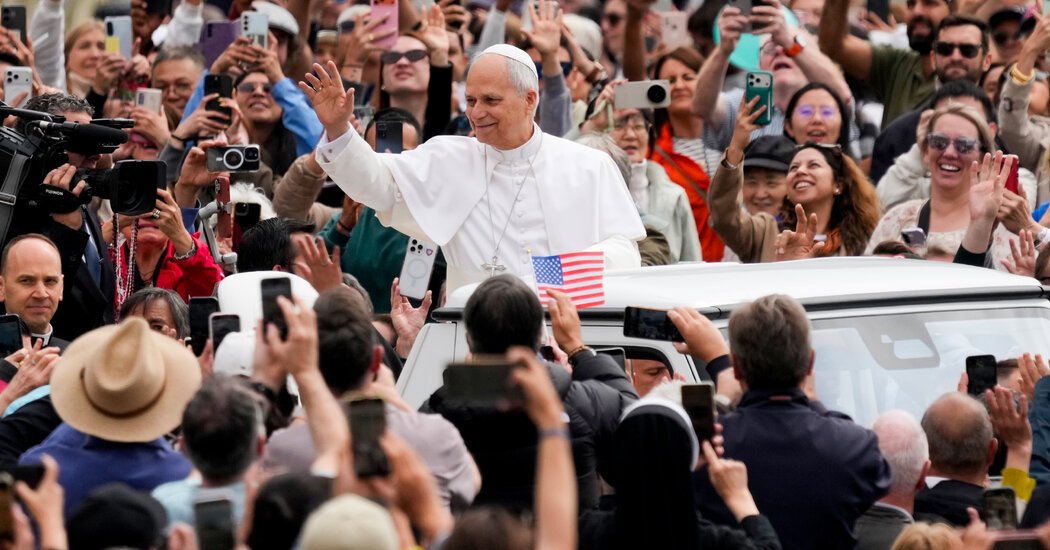
For decades, the unspoken assumption at the Vatican was that there could never be a pope from the United States.
With Americans as both Holy Father and leader of the free world, the thinking went, the United States would wield too much influence in both the geopolitical and spiritual realms. The cardinals who elected new pontiffs were previously concerned that an American pope might take orders from the U.S. government, similar to fears within the American political establishment last century that a Roman Catholic president might show more fealty to the Vatican than to Washington.
The Chicago-born Robert Prevost, who became Leo XIV a year ago this week, has defied those assumptions, showing a willingness to challenge the United States on several fronts, most recently on Tuesday when the pope disputed claims by President Trump that he endorsed Iran’s possession of a nuclear weapon.
For some Catholics, Leo’s American identity has even become one of his greatest assets: It has allowed him to soothe divides between Catholics in the United States as well as act as a stronger counterweight to perceived American military overreach.
When Secretary of State Marco Rubio meets Leo in Rome on Thursday, it will come against the backdrop of Leo’s criticism of the U.S.-Israeli-led war in Iran. Leo has also said he has “no fear” of the Trump administration even after repeated attacks by the U.S. president. And Leo has strongly encouraged American bishops to support immigrants in the face of a crackdown.
“I think in many ways, he’s not a U.S. pope,” said Jaisy A. Joseph, a theology professor at Villanova University in Pennsylvania, Leo’s alma mater.
Leo was elected not so much for his American pedigree as for his global experience. He spent two decades working as a missionary and then as a bishop in rural Peru. He holds a Peruvian passport and speaks Spanish and Italian fluently. As head of the Augustinian religious order, he traveled extensively before heading one of the most important departments at the Vatican. The cardinals who elected him to the papacy last year came from a more geographically diverse area than any previous conclave, and Leo’s experience outside the United States has endeared him to Catholics who see his birthplace as incidental to his papacy.
“Even if he is American, I see him as a pope for everybody,” said Sister Jane Kimathi, a Kenya-based director at the Pan-African Catholic Theology and Pastoral Network.
“He is American in name,” she added, but “he knows the life of Africa.”
Leo’s bridge-building skills, scholars and clerics say, are particularly useful given the changing profile of the Catholic church. There are 1.4 billion Catholics, three-quarters of whom live in the southern hemisphere, and the religion is expanding much faster in Africa, Asia and Latin America than in Europe or the United States.
Those trends were reflected in Leo’s choice to visit four countries in Africa this spring.
Leo is “someone who is going to have a much richer and I think more expansive view of world politics,” said Cardinal Blase Cupich, archbishop of Chicago. “He cares about the planet, he cares about humanity in general, not just how things play in the Western world or even in the United States.”
Nevertheless, Leo’s American background bolsters his leadership. As a native English speaker, he can communicate directly with a much broader audience than previous popes who did not speak the language so well.
At a time when the United States is no longer automatically considered the guardian of the world order, Leo’s American roots also give him the credibility to “speak into the crisis in American leadership in the world,” said Austen Ivereigh, a longtime Vatican watcher and biographer of Pope Francis.
Just as John Paul II became a powerful critic of communism in his native Poland at the height of the Cold War, Leo is condemning violent conflict at a time when the U.S. government is waging a costly and destabilizing war in the Middle East. “To have an American pope who could speak to that and be listened to and be taken seriously and have credibility,” said Mr. Ivereigh, can be “seen as an advantage.”
Leo’s identity as a pope coming from a superpower nation, said George Weigel, a Catholic theologian, “gets him the deserved attention he might not otherwise get,” even if it would be a mistake to view him as “some kind of global geopolitical referee saying, ‘Here are the good guys, here are bad guys.’”
In the United States, Leo’s background makes him more relevant, according to Kathleen Sprows Cummings, a historian at the University of Notre Dame. Americans “are paying more attention because he’s one of our own,” she said.
That scrutiny began the moment Leo stepped onto the balcony in St. Peter’s Square last May. Stephen K. Bannon, a Catholic former aide to Mr. Trump, soon told Politico that Leo was the “worst pick for MAGA Catholics,” calling him the “anti-Trump pope.”
Leo’s American heritage makes him ideally placed to navigate such opposition, analysts and clerics say: It helps him understand the deep political divisions in the U.S. church that for years have split families and congregations, priests and bishops.
“He understands the culture of the United States in a way that others could not, who have not been born and raised and lived here,” said Bishop Michael F. Burbidge of the diocese of Arlington, Va.
That understanding, coupled with his tranquil and at times cipher-like personality, has also helped him calm a global church that was sometimes shaken up by Pope Francis’ more charismatic but mercurial style. “There had been a civil war going on for more than 10 years,” said Marco Politi, a veteran reporter on Vatican affairs. “And Leo is seen like a weaver who weaves again a broken robe.”
In short, Leo has a set of identities and experiences that has caused Catholics of many backgrounds — both in the United States and beyond — to see themselves reflected in him.
Like many Americans, he has roots and family connections that span national borders and political boundaries. He is descended from Creole people of color from New Orleans. One of his brothers supports Mr. Trump and even met the president at the White House. Leo grew up in Chicago, but served as the bishop of Chiclayo, a city in northern Peru.
“People think that Pope Leo is a mirror who reflects Chicago, Chiclayo, conservative, progressive,” said Emilce Cuda, secretary of the Vatican’s Pontifical Commission for Latin America. “Each person presents the pope as a mirror of themselves.”
Source:
www.nytimes.com