






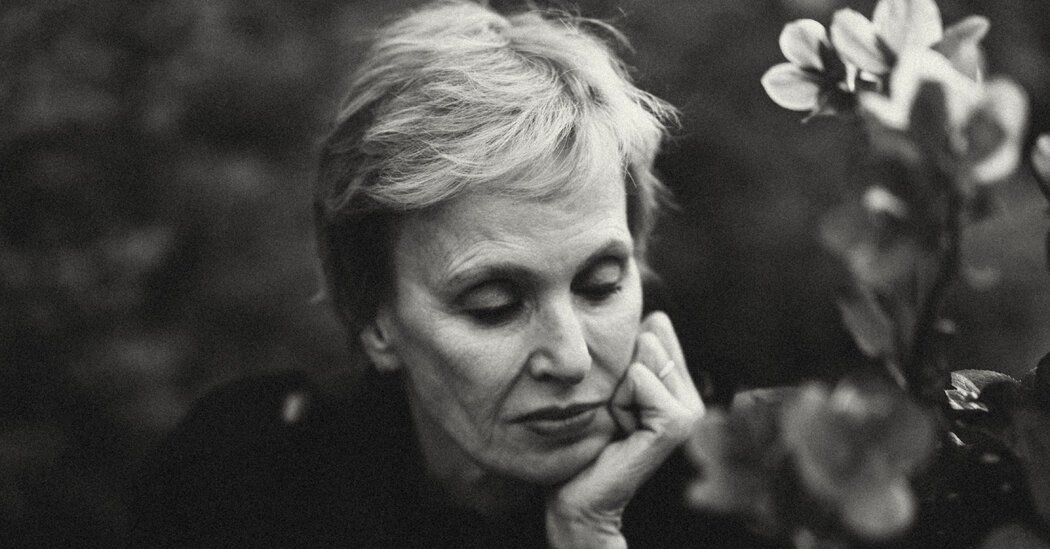
Siri Hustvedt was halfway through a new novel, about a writer tasked with completing his father’s unfinished manuscript, when her husband, the novelist Paul Auster, died from lung cancer.
Continuing that story in his absence felt impossible. They were together for 43 years, the length of her career. She’d never published a book without his reading a draft of it first.
Two weeks later, in the Brooklyn townhouse they shared, she sat down and wrote the first two sentences of a new book: “I am alive. My husband, Paul Auster, is dead.”
“It was the only thing I could write about,” she said.
She wrote about her feelings of dislocation: how she vividly smelled cigar smoke, even though Auster had quit smoking nine years before; how she woke up disoriented on his side of the bed and got into the bath with her socks still on; how she felt a kind of “cognitive splintering” that bordered on derangement. She had lost not only her husband, but also the person she had been with him. She felt faded and washed-out, like an overexposed photograph.
Those reflections grew into “Ghost Stories,” Hustvedt’s memoir about her life with and without Auster. Partly a book about grief and its psychological and physiological side effects, it’s also a revealing and intimate glimpse into a literary marriage — the buoyant moments of their early courtship, their deep involvement in each other’s work, their inside jokes (“I’ll have the lamb for two for one”).
She also writes publicly for the first time about the tragedies the family endured several years ago, when Auster’s son, Daniel, who struggled with addiction, took heroin while his infant daughter Ruby was in his care, and woke up to find she wasn’t breathing. He was later charged with criminally negligent homicide, after an examination found that her death was caused by acute intoxication from opioids. Soon after he was released on bail, Daniel, 44, died of a drug overdose.
A few months later, Auster started to come down with fevers, and doctors later discovered he had cancer. He reacted to the news as perhaps only a novelist would — lamenting that dying from cancer would be such an obvious, unsatisfying ending to a life marked by so much tragedy.
“He said so many times, it would make for a bad story,” Hustvedt said. “It was so predetermined, almost, and he hated predictable stories.”
Tall and lanky with short blond hair, Hustvedt, who is 71, met me on an April afternoon at the elegant, art and book-filled townhouse in Park Slope where the couple lived for 30 years. She took me to the sunlit second floor library, where Auster spent his final days, surrounded by his family and books. “He loved this room,” Hustvedt said.
“I’ll show you his now quiet typewriter,” she said, leading me down to Auster’s office on the ground floor, which felt as tranquil and carefully preserved as a shrine. A desk held a small travel typewriter, an Olivetti, and next to it, his larger Olympia. “Click clack, it really made noise,” Hustvedt said.
Auster rose to fame in the 1980s thanks to postmodern novels like “City of Glass” and “Moon Palace,” which explore the mysteries and unreliability of memory and perception. Hustvedt gained renown for heady and cerebral literary novels that include “The Blazing World,” “What I Loved” and “The Summer Without Men.”
They were each other’s first readers, sharpest editors and biggest fans. They even shared characters — Auster borrowed Iris Vegan, the heroine of Hustvedt’s 1992 novel “The Blindfold,” and extended her story in his novel “Leviathan,” published the same year. (Critics and readers assumed she had used his character, not the other way around.)
“We were very different writers and always were, and that was part of the pleasure in the other’s work,” Hustvedt said.
Friends of the couple who have read “Ghost Stories” said they were moved by Hustvedt’s loving but not hagiographic portrait of her husband.
Salman Rushdie, who visited Auster just a few days before he died, said Hustvedt’s vivid portrayal of Auster — who was witty, warm and expansive, always ready with a joke — captured a side of him that was rarely reflected in his public image as a celebrated literary figure.
“He’s very present on the page,” Rushdie said. “They were so tightly knit, and Paul was Siri’s greatest champion. They were deeply engaged in each other’s work.”
Hustvedt was 26, a budding writer who had just published a poem in the Paris Review, when she met Auster, 34, after a reading at the 92nd Street Y. He was wearing a black leather jacket, smoking, and she was instantly smitten.
They went downtown to a party, then to a bar in Tribeca, and talked all night. He was married to the writer Lydia Davis, but they had separated. He showed her a photo of his and Davis’s 3-year-old son, Daniel. They kissed as she was about to get into a taxi, and he went home with her to her apartment on 109th Street.
Shortly after they began seeing each other, Auster broke it off and told her that he had to return to his wife and son. She won him back with ardent, unabashed love letters that she quotes in “Ghost Stories”: “I love you. I’m not leaving yet, not until I am banished.”
In 1982, a few days after Auster’s divorce, they got married. They were so broke that guests had to pay for their own dinners.
Their writing careers evolved in parallel, but Auster’s fame eclipsed Hustvedt’s. She often found herself belittled by interviewers who asked her what it was like to be married to a literary genius, and whether her husband wrote her books.
“People used to ask me what my favorite book of Paul’s was; no one would ever ask him that,” Hustvedt recalled.
When Hustvedt complained about the disparity, Auster joked that the next time a journalist asked what it was like to be married to him, she should brag about his skills as a lover.
The slights persisted even after Hustvedt had established herself as a formidable literary talent. “One imagines that will go away, but it didn’t,” she said. She’s sometimes felt reduced to “Paul Auster’s wife” even after his death: At a recent reading, a fan of his work asked if she took comfort in reading his books in his absence, as if the real loss was the death of the literary eminence, not the man she loved.
She felt the weight of his reputation acutely when Auster died, and news of his death spread online just moments after he stopped breathing, before the family had time to tell people close to him.
The shadow Auster’s fame cast over the family became especially pronounced when scandal and tragedy struck.
In “Ghost Stories,” Hustvedt details a side of Auster’s personal life that he closely guarded: his relationship with Daniel, whose drug use and shiftiness was a constant source of worry. As a teenager, he stole more than $13,000 from her bank account, her German royalties. In 2000, Auster and Hustvedt learned that Daniel had forged his transcripts from SUNY Purchase after he had promised to re-enroll; he hadn’t, and kept the tuition money.
After each breach of trust, she and Auster forgave him.
“I have to leave the door open, just a crack,” Paul said about Daniel, Hustvedt recalls in “Ghost Stories.”
She writes about rushing to the hospital in Park Slope, where Daniel’s daughter was pronounced dead: “It’s the image of her small, perfect dead body in the hospital on Nov. 1, 2021, that forces itself on me.”
The shock of Ruby’s death, followed by Daniel’s arrest and overdose, was made even more unbearable by the media frenzy. Auster and Hustvedt were hounded by reporters, and made no comment.
“We were not in a position to speak about it when it happened, it was all so shocking and overwhelming and trying to deal with your feelings was more than enough,” Hustvedt told me.
But she felt she had to write about Daniel and Ruby in “Ghost Stories” because their lives and deaths were a crucial part of the family’s story, yet had been reduced to lurid tabloid fodder, she said.
“It would not have been possible to write this book and pretend that these horrible things didn’t happen,” she said. “I also didn’t want the horrible things to overwhelm the book, and that’s a tricky thing, because it’s so horrible, you feel it has to be there, but it isn’t the whole story.”
Before he died, Auster told Hustvedt he wanted that story to be told.
“I didn’t feel that I was betraying him,” she said.
Auster and Hustvedt’s daughter, Sophie Auster, a musician who lives in Brooklyn, said reading her mother’s memoir was painful, but she also felt her father’s voice and presence in its pages.
“Opening the book was extremely difficult for me, but you just sink in,” she said. “She doesn’t let you sit in the sorrow for too long. There’s a lot of life and a lot of joy.”
Hustvedt found it strange to write “Ghost Stories” without sharing drafts with Auster, her habit throughout her career. But often, his voice popped into her head.
“I kind of heard him in my ear, saying things like, ‘That’s a wavy sentence, straighten that thing out,’” she said.
After finishing the memoir, Hustvedt went back to the novel she’d been working on when Auster died. She realized she had to rewrite the first half entirely.
“I am starting from the beginning,” she said. “Not that the story is going be different. But I’m different.”
Alexandra Alter
Books reporter
What I found fascinating about this memoir was Hustvedt’s exploration of the psychological side effects of grief. It’s also an intimate and moving glimpse inside a famous literary marriage, revealing how she and Auster influenced one another.
Read all comments
Source:
www.nytimes.com