





The head of 14 Greek airports including Corfu has warned that Europe’s new smart border system will not work in its current form and needs to be completely “overhauled”.
Alexander Zinell, chief executive of Fraport Greece, said the EU’s new entry-exit system had “fundamental flaws” by forcing passengers to carry out lengthy checks at airports, leaving some waiting on the tarmac in intense heat.
Greek police have suspended all biometric checks on UK citizens that make up the vast majority of the non-EU tourists that pass through his airports, which include Rhodes, Crete and Mykonos. The exemption, which will last for the summer, is the only thing preventing it from “collapse”, he said.
“These are just temporary fixes, the system needs to be overhauled,” he told the FT. “It needs a new version, an update, and probably a reconfiguration in order to allow people to register before they fly, before they get on a plane, before they go to the airport.”
The EES began rolling out last October but has led to long queues and disruption since it was fully switched on in April.
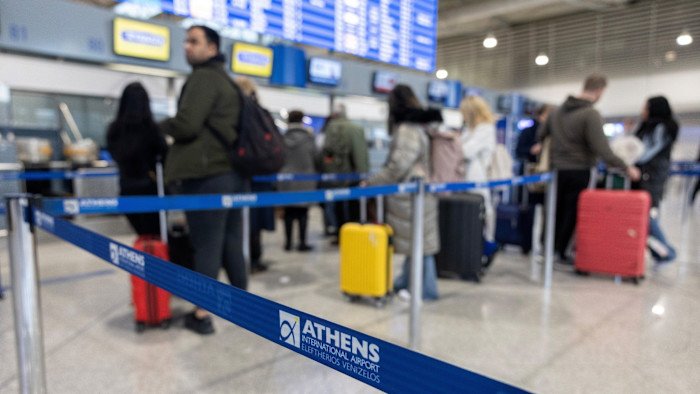
Passengers have queued for hours, there have been widespread technical problems with automated booths, while Zinell said “many” planes had been forced to leave behind passengers who were stuck waiting to be processed.
Queueing at some of its sites has been so bad, gazebos have been erected to provide shelter from the sun to people waiting on the tarmac to be processed, he said. The airports have designated “queue walkers” who fast-track vulnerable people from the lines. “It is very unpleasant for passengers, and even dangerous,” Zinell said.
European Commission president Ursula von der Leyen conceded last week there were “technical problems” with the system, which includes automated booths where passengers provide fingerprints and have a photo taken.
Zinell said his airports — which process hardly any passengers in winter and millions during July — are not equipped for long waiting times.
“Our facilities are designed for typical standard processing times. Once you extend these times, you get queues. It’s very simple,” he said. “If you quadruple the average time, it means that you need four times the space.”
He said it was “absurd” for airports to build more buildings for an electronic system that can in theory be done online.
“The UK, Canada, US, they all have similar systems. I think most countries nowadays require you to preregister before you fly. And that makes sense.”
Plans by the EU to roll out a US-style pre-authorised travel system have been delayed until next year given the current difficulties with the EES and pending more technical tests.
“We fully support [the EES] at the airport because it’s a matter of security,” Zinell said. “But the system needs to be designed in a way that fits into processes at the airport. Unless this is changed, unless the process time, through whatever means, is brought down significantly, we will face these issues.”
Under existing rules agreed by member states, the exemptions — such as those for UK citizens — will not be allowed from September.
Zinell said this approach is “denying reality” by refusing to show any leeway. “I am more worried now about what’s going to happen after the summer and next summer,” he said.
“If we had a situation where nothing changes and people had to wait for four hours, it’s just not workable.”
Multiple EU nations including Germany and France have called for the exemptions to be extended beyond September, according to a letter seen by the FT.
“Experience to date has shown that significant difficulties arise under exceptional circumstances, and these risks should not be underestimated,” warned the letter, which was also signed by Italy, Greece, Portugal, the Netherlands, Malta and Switzerland, which is not an EU member but is part of the passport-free Schengen travel area.
Ending flexibility in September “is a source of serious and legitimate concern, shared not only by member states, irrespective of their level of preparedness, but also by the transport sector as a whole,” it added.
The Commission has so far resisted calls to fully suspend the system or to extend the exemptions.
“The system doesn’t work if you have full suspension in one or the other entry or exit points . . . you constantly need to reconcile entry and exit,” a commission official said. Otherwise, the official explained, people whose exit is not registered could be considered overstayers and barred from entering the next time.
An extension of the current exemptions, which allow border guards to only register personal details without image or fingerprints, was not planned at the moment, the official added.
Additional reporting by Laura Dubois
Source:
www.ft.com