








Unlock the Editor’s Digest for free
Roula Khalaf, Editor of the FT, selects her favourite stories in this weekly newsletter.
The writer is author of ‘H-Pop: The Secretive World of Hindutva Pop Stars’
For over a decade now, India’s Prime Minister Narendra Modi has governed the world’s largest democracy with a formula: sustained religious mobilisation combined with the promise of economic progress and acche din (the good days). For 12 years, it mostly worked like magic.
Now, India’s Gen Z — the world’s largest at more than 370mn — is putting it to the test. For five days this week, tens of thousands of young Indians have hit the streets across the country, mounting the biggest challenge Modi has faced in his premiership.
The movement began earlier this year after authorities discovered that a medical college admissions exam in May had been compromised by leaks. More than 2mn students were asked to retake it, after having spent years and, in many cases, considerable sums of money preparing for the test. At least 12 took their own lives. A police probe into the leak found that insiders with links to the exam process were responsible.
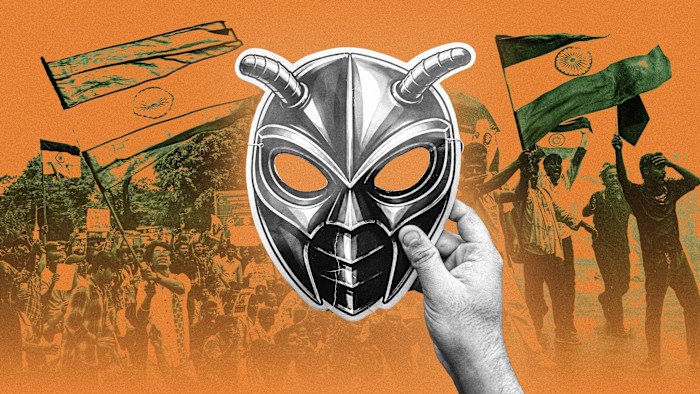
Students demanded that Education Minister Dharmendra Pradhan resign from his post after a tenure that saw repeated exam leaks across the country. Outrage was further fuelled by the Chief Justice of India’s description of the country’s unemployed youth as “cockroaches” (something he later claimed only applied to those with fake degrees).
Millions took to social media and the Cockroach Janta Party (CJP) was subsequently founded by Abhijeet Dipke. It was given a name that parodies Modi’s ruling Bharatiya Janata Party (BJP) and now has over 25mn followers on Instagram, far exceeding the BJP’s 9.4mn.
In today’s India, the idea of political accountability has largely vanished from public imagination. Modi has continuously scoffed at demands to sack his party men and ministers, no matter the circumstances. While older Indians have come to see this as normal, many Gen-Zers, facing significant and growing challenges of their own, haven’t got the memo.
India’s youth are in a bad place. Over four of every five people unemployed in the country are under 30 years of age. Worryingly, joblessness among graduates is nine times higher than among those who cannot read and write.
Meanwhile, real wages have remained stagnant. Government skill development initiatives aren’t helping — of the 16mn trained, only 15 per cent got jobs in the last decade. Even India’s famed information technology companies are laying off engineers and freezing recruitment. The sector’s Big Five hired a net 17 employees in the first nine months of the 2025-26 financial year.
As a result, many young people are forced to work jobs they are grossly overqualified for. I’ve met engineers working on construction sites as supervisors and postgraduates taking up data-entry work. Millions are now taking up poorly paid and often exploitative gig work. More than 12mn Indians are now employed in the sector, a figure that is projected to almost double within the next three years alone.
The consequences of such a precarious living are hard to summarise and ripple ever further outwards. There are men who can’t find brides since they don’t have decent jobs. Many can’t provide for their families because they can’t find employment, despite their master’s degrees.
For over a decade, these were the people Modi had carefully built his base around: he promised to provide 20mn jobs each year, build 100 new cities, improve infrastructure, eliminate corruption and create a “neo-middle class”. But 12 years in, not enough of this has materialised for young Indians.
It is perhaps not surprising then that Gen Z’s cumulative rage has now exploded on to the streets. This is an Instagram-first generation, adept at snazzy reels and memes that brim with irreverence. In Delhi, students have been mocking Modi by playing his old speeches on loudspeakers. Protests have recently turned violent, as police officers fire tear gas and mount baton charges at them.
Despite the level of uproar, there has been a muted reaction from on high. Modi has made some concessions but has failed to get rid of Pradhan and is yet to address the protesting students directly.
Even if he does so, it seems unlikely that India’s Gen Z will be in a mood to listen. The country’s streets are still ringing with critiques. The youth’s irreverence brings to light the contrast between Modi’s promises and their reality. They know that — like the roaches — their complaint is impossible to squash.
Source:
www.ft.com