








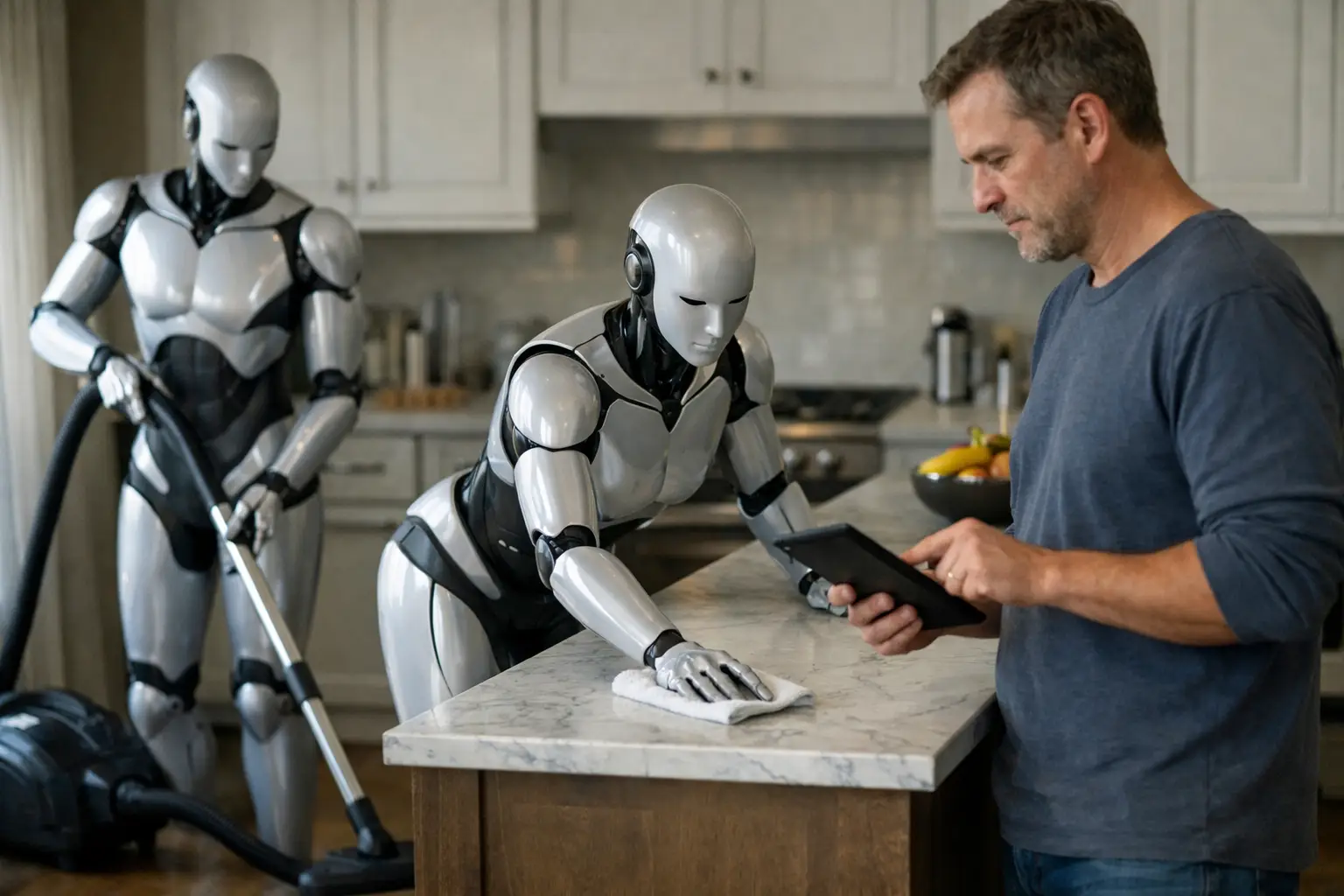
Can a $55,000 robot load a dishwasher? I invited two humanoid machines into a domestic setting to find out. The devices, produced by Tau Robotics, spent the afternoon vacuuming floors and wiping kitchen counters. While the appliances completed visible cleaning tasks, their operation was not entirely autonomous: human technicians worked behind the scenes to monitor, intervene and adjust the robots’ actions.
The robots demonstrated clear strengths at simple, repetitive chores. They navigated open spaces to collect debris with a vacuum function and performed surface wiping in straightforward layouts. At the same time, their pace, need for repositioning and occasional difficulty with clutter revealed practical limits for unmodified homes. Observers in the room provided remote inputs and manual corrections when the machines encountered obstacles or ambiguous objects.
The experience highlights two constraints that will shape early adoption. First, the purchase price — about $55,000 for the units on site — represents a steep entry cost for most households. Second, the requirement for human supervision or intervention suggests these systems currently operate as assisted tools rather than independent domestic staff. These characteristics affect where such devices might be deployed first, from controlled commercial environments to affluent early adopters, and inform ongoing work on the capabilities of humanoid robots and home automation.
The takeaway is pragmatic: the machines can perform basic cleaning tasks reliably under managed conditions, but they are not yet plug-and-play replacements for household labor. Their performance during a single afternoon of testing shows technical progress, coupled with practical trade-offs tied to cost and operational complexity. Further developments and broader testing will be necessary to determine whether future iterations can reduce human oversight and bring down the price point for wider domestic use.