
Shorouk Express 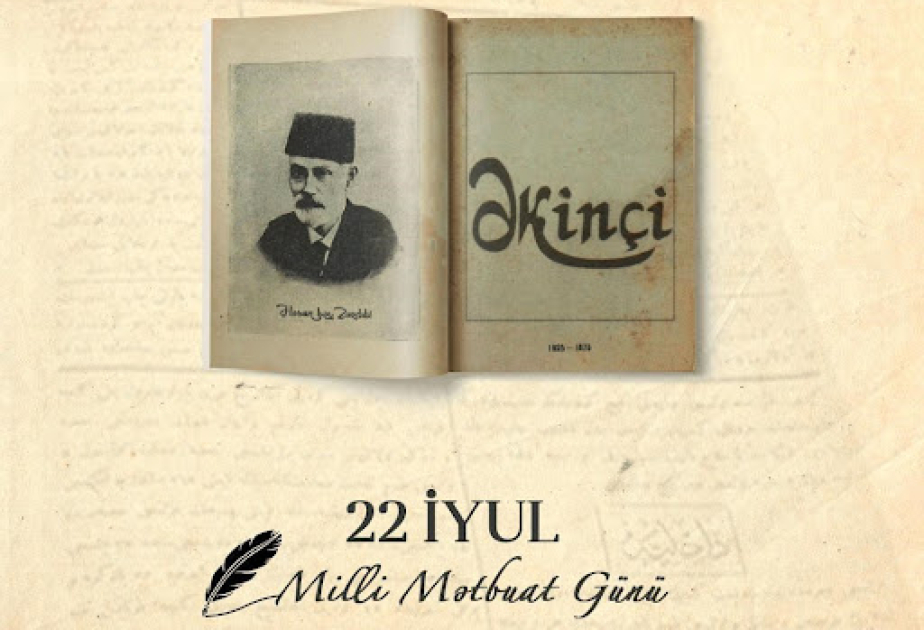
BAKU, Azerbaijan, July 22. Today marks the
150th anniversary of the Azerbaijani national press, Trend reports.
The founder, editor, and proofreader of the newspaper that made
a powerful impact across the Caucasus in the late 19th century was
Hasan bey Zardabi — a pioneering figure in Azerbaijan’s
enlightenment movement and a natural scientist. Prominent
intellectuals such as Mirza Fatali Akhundzade, Seyid Azim Shirvani,
Najaf bey Vazirov, Asgar Agha Gorani, and others also played a key
role in shaping this publication.
Although only 56 issues of Akinchi were published between July
22, 1875, and September 1877, the newspaper had a profound
influence on the emergence and development of Azerbaijan’s national
press. Dedicated primarily to educational content, Akinchi quickly
gained popularity among both intellectuals and the general public.
However, its run was short-lived. The Tsarist authorities, alarmed
by its impact on public awareness and engagement in political life,
eventually shut it down. Despite this, leading thinkers of the time
used Akinchi as a platform to promote democratic and enlightenment
ideas, contributing significantly to the country’s intellectual and
cultural development.
Since then, the Azerbaijani press has gone through periods of
decline and revival, consistently reflecting society’s perspective
on key developments.
The growth of the national media is closely tied to the name of
National Leader Heydar Aliyev. His return to power in 1993 — at the
strong urging of the people — opened a new chapter for the press in
Azerbaijan.
In 1998, Heydar Aliyev abolished state censorship, laying the
foundation for freedom of speech and press in Azerbaijan — a move
that gave major momentum to the country’s media sector.
Heydar Aliyev’s commitment to supporting the press and
journalists has been carried forward by President Ilham Aliyev.
Today, freedom of expression and media is fully guaranteed in
Azerbaijan. It’s no coincidence that the country now has a wide
range of newspapers and magazines, along with a growing digital
media landscape. The advancement of modern information technologies
has integrated Azerbaijani media into the global information
network.
In March 2009, President Ilham Aliyev signed a decree
establishing the State Support Fund for Mass Media under the
Presidential Administration. The goal of the fund was to foster an
environment of free thought, speech, and information, and to
provide support for media outlets that serve the public
interest.
The modern era has also made it necessary to improve the legal
framework surrounding media. With rapid globalization in the media
space, updating legislation became a timely and strategic move. At
President Ilham Aliyev’s direction, comprehensive work was carried
out to reform media legislation. As a result, a new law titled “On
Media” was drafted. Under a decree signed on January 12, 2021 — “On
Deepening Reforms in the Media Sector in the Republic of
Azerbaijan” — the Media Development Agency (MEDIA) was established,
replacing the previous State Support Fund. This new agency is
expected to accelerate and strengthen media reforms in the
country.
Azerbaijan’s commitment to the press is also evident in its
support for journalists: from celebrating media anniversaries and
providing financial assistance to outlets, to improving
journalists’ social protection and housing conditions.
The Azerbaijani media played a vital role in both the First and
Second Karabakh Wars, fulfilling its responsibilities with
professionalism and courage. During the 44-day Patriotic War, the
media stood at the forefront of the information battle, countering
enemy propaganda and delivering the truth about Azerbaijan to both
domestic and international audiences. That mission continues today
in the post-war period.
The media plays an active role in broadcasting every statement
and declaration made by President Ilham Aliyev — the Victorious
Supreme Commander-in-Chief — about the now-resolved Karabakh
conflict and the realities in the liberated territories.
During and after the 44-day war, journalists made significant
contributions to telling Azerbaijan’s story to the world. Their
professionalism, dedication, and swift reporting helped expose
Armenian war crimes and convey the truth about the conflict.
President Ilham Aliyev himself played a leading role in this
effort, giving more than 30 interviews to international media
outlets during the war — a crucial factor in ensuring global
awareness of Azerbaijan’s realities.
Even today, in the ongoing information war, Azerbaijani
journalists continue to distinguish themselves with their
patriotism and professionalism. During the war, many reported
directly from the front lines, while also participating in national
mobilization efforts. Several journalists were awarded medals for
their service during the Karabakh battles — a powerful reflection
of the country’s respect and trust in its media professionals.