

Shorouk Express 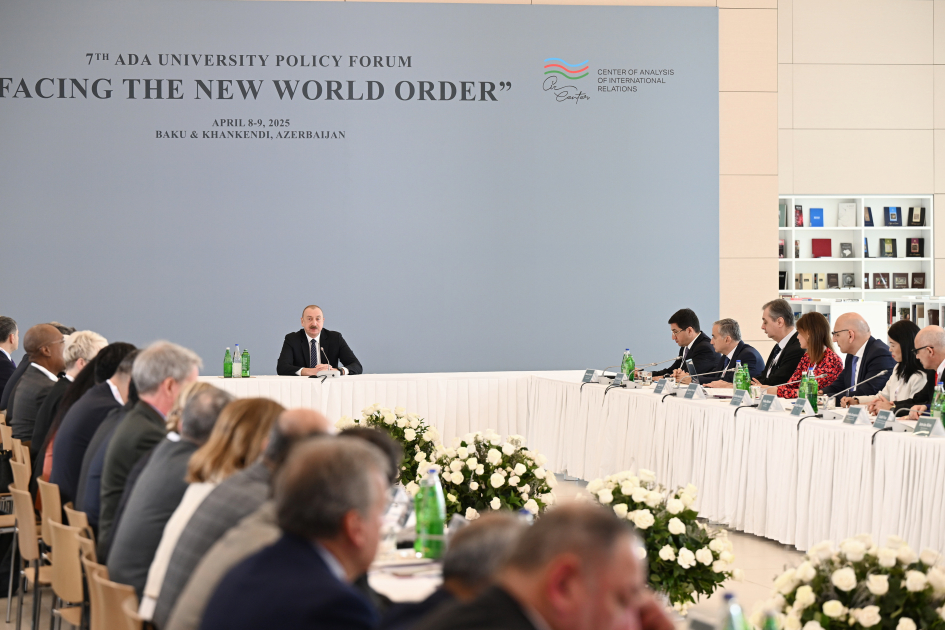
BAKU, Azerbaijan, April 10. The international
forum “Facing the New World Order,” held at ADA
University with the participation of the President of the Republic
of Azerbaijan, Ilham Aliyev, was more than a conventional policy
gathering. It functioned as a political statement, underscoring
Azerbaijan’s role as an active agent—not a passive observer—in
shaping the contours of a rapidly evolving global landscape.
Bringing together politicians, diplomats, strategists, and
academics, the forum highlighted a growing international appetite
for dialogue around global realignments. It also underscored a
broader shift: regions once seen primarily through the lens of
historical conflict—such as the South Caucasus—are now emerging as
arenas of responsibility, strategic decision-making, and
leadership.
President Ilham Aliyev’s keynote address delivered a pointed
message aimed not only at regional neighbors but at the wider
international community. His remarks outlined Azerbaijan’s
framework for normalizing relations with Armenia, specifying
conditions for a potential peace deal and presenting a
forward-looking vision for regional cooperation.
Beyond bilateral issues, the speech offered a window into
Azerbaijan’s geopolitical strategy—one that encompasses regional
transformation projects, evolving security architectures, and an
assertive response to a world in flux. As the war in Ukraine, the
breakdown of the unipolar order, and disruptions to global energy
and logistics systems reshape international norms, a central
question looms for smaller and mid-sized states: will they remain
subjects of influence, or emerge as actors in their own right?
For Azerbaijan, the answer is clear. As President Ilham Aliyev’s
appearance at ADA University made evident, the country sees itself
not on the sidelines of global change, but at its core.
Azerbaijan has played a crucial role as a mediator in regional
diplomacy, notably in the early stages of reconciliation between
Türkiye and Israel. During their first crisis, Azerbaijan actively
facilitated dialogue, helping to bridge gaps between the two
nations. Reflecting on Azerbaijan’s strong ties with both
countries, President Ilham Aliyev emphasized: “With Türkiye, we are
allies. We signed the Shusha Declaration in 2021, and formally
became allies.”
He also acknowledged Israel as a close partner, stating, “Israel
is a friendly country to Azerbaijan, and for many years, mutual
friendship have been demonstrated in difficult times for both of
us. Therefore, of course, these tensions between the two countries
are very disturbing for us, and a matter of concern.”
Today, Azerbaijan occupies a pivotal position in the evolving
Eurasian geopolitical landscape. Strategically situated between the
Caspian and Black Seas, and bordering Russia, Iran, Türkiye, and
Central Asia, Azerbaijan has long been a significant player in
regional geopolitics. Over the past two decades, it has emerged as
the region’s primary energy and logistics hub.
The Southern Gas Corridor, which includes the TANAP and TAP
projects, links the Caspian Sea with Southern Europe, playing a key
role in reducing the European Union’s reliance on Russian gas.
Baku’s port, located on the Caspian coast, has become the largest
gateway for trade between China and Europe. Additionally,
Azerbaijan serves as a critical transit point in the International
North-South Transport Corridor and the Trans-Caspian Route, which
connects India with Europe.
These accomplishments are the result of long-term strategic
foresight. Baku has built a robust network of connectivity through
key partnerships with countries such as Hungary, Italy, Georgia,
Kazakhstan, Uzbekistan, and Romania, positioning itself as a vital
hub for regional integration and cooperation.
Since the liberation of Karabakh in 2020, Azerbaijan’s approach
to post-conflict reconstruction has evolved into a unique model. It
extends far beyond mere territorial restoration and is grounded in
the concept of “positive peace” – a framework not only focused on a
ceasefire, but on fostering a sustainable, institutional order.
At the Forum, President Ilham Aliyev emphasized a crucial point:
Those who visit Karabakh today can still witness the level of
barbarity that took place there.
This statement serves not only as a humanitarian reflection on
the conflict but also as a diplomatic message—Azerbaijan has not
only emerged victorious but is also actively engaged in the process
of rebuilding. The Forum, held at ADA University, further
reinforced this vision, positioning Azerbaijan as an institutional
guarantor of peace in the region. Unlike Armenia, which seeks
external support, Azerbaijan offers an organic peace model rooted
in sovereignty, economic development, and transportation
infrastructure.
Every statement made by President Ilham Aliyev at the forum
carries strategic weight. Notably, he declared, “With respect to
the peace agreement, the ball is in Armenia’s court,” signaling to
the West that Azerbaijan has met its obligations, and the
responsibility for delaying the peace treaty now rests with
Yerevan. He also remarked, “Unfortunately, Armenian occupation of
Azerbaijan’s territory did not allow the South Caucasus to develop
as a more or less integrated region,” underlining that Armenia’s
occupation policy hindered regional integration. These remarks
reflect a shift in diplomatic reality: Azerbaijan is increasingly
taking on the role of architect in reshaping the regional
order.
The contrast between Azerbaijan’s and Armenia’s approaches
became starkly evident at the forum. Armenia remains entrenched in
a paradigm of confrontation and dependency, while Azerbaijan
promotes peace based on the mutual recognition of territorial
integrity. Armenia continues to seek external mediation from
countries like France, the EU, and the US, which diminishes its
agency in the process and intensifies its isolation. As President
Ilham Aliyev pointed out, Armenia has effectively forfeited the
chance to become a key transit hub for Azerbaijan’s energy
resources and transport routes.
Azerbaijan’s demands to Armenia are clear and grounded in
international law, centered on the recognition of Azerbaijan’s
territorial integrity and sovereignty, the renunciation of
territorial claims against Azerbaijan as stipulated in Armenia’s
Constitution, and the demonstration of genuine political will.
“On many occasions, I have already made it public what we expect
from Armenia regarding our territorial integrity and their
constitution. So it is known as soon as it is done and the peace
agreement is signed, so there’ll be no obstacle for the South
Caucasus to try to be an integrated region,” President Ilham Aliyev
emphasized.
This statement underscores Azerbaijan’s openness to peace, but
highlights that such peace must be built on a firm, principled, and
legal foundation. Azerbaijan’s vision is for new, sustainable
relations that foster genuine regional integration.
The President also addressed Armenia’s misjudgment of its
geo-economic future and its self-imposed isolation. “So, Armenia,
as a result of occupation and aggression, deprived itself from
becoming a transit country for Azerbaijan’s energy resources and
transportation routes. And all the transit – whether it’s oil, gas,
or cargo – from Azerbaijan goes through Georgia. So Armenia could
have been part of that process. It’s their fault that they
miscalculated the future development and sacrificed their economic
future, their real independence to this dream of great Armenia,”
the President stated.
This message serves as both a warning and an appeal to Armenian
society: peace and cooperation are essential for economic
development and regional stability. The longer Armenia clings to
revisionist approaches, the further it will distance itself from
the regional processes shaping the future.
Azerbaijan’s position is not only principled but also grounded
in realism.
“And being realistic, of course, we cannot imagine that we will
become friends with Armenia immediately. It is not realistic, and
even talking about any kind of economic integration is premature.
But we are ready to start taking small steps toward
confidence-building measures,” President Ilham Aliyev stressed.
This approach represents a model of strategic stability rarely
seen in the post-Soviet space. Azerbaijan’s concrete proposals to
build trust—such as exchanges for journalists and intellectuals,
cooperation on transboundary rivers, and joint efforts to address
environmental threats—are not just diplomatic gestures but
intentional steps to foster an atmosphere of trust through
practical actions. This incremental and targeted approach can lay
the groundwork for lasting stability in the region. If Armenia
adopts a rational approach, cooperation can be established between
Azerbaijan, Georgia, and Armenia in key sectors such as energy,
trade, transport, and environmental security. Such cooperation
could become part of a broader Eurasian platform, connecting the
three countries with the European Union, Central Asia, and
China.
Azerbaijan has already become a central regional hub for energy
and transport. Meanwhile, Armenia, by remaining on the sidelines of
these opportunities, forfeits both economic resources and
geopolitical influence. However, if Armenia summons the political
will to abandon its revanchist ideology, it can position itself as
an active participant in new regional integration projects.
President Ilham Aliyev’s speech was not just a diplomatic
address but a strategic blueprint for the post-war period.
Azerbaijan has made its position clear: the country is committed to
peace, but this peace must be grounded in legal principles and
aligned with reality.
While the signing of a peace agreement could serve as a historic
milestone, its successful implementation will depend on building
trust, fostering step-by-step economic cooperation, and securing
mutual political will. If Armenia responds constructively to these
calls, the South Caucasus can look forward to an integrated,
stable, and predictable future. Otherwise, Armenia risks repeating
the mistakes of its past, remaining on the sidelines of regional
development. A peace treaty between Baku and Yerevan could open new
opportunities not just for the two countries, but for the entire
region. In this scenario, the Zangezur Corridor could become a key
part of the 21st-century Silk Road; Armenia could gain access to
vital trade routes, including the Persian Gulf, the Mediterranean,
and the Caspian Sea; the influence of military blocs could
diminish, while economic collaboration would take center stage; and
new mechanisms, such as the South Caucasus Security Council or the
Infrastructure Commission, could emerge. In essence, peace would
not be an end, but a new beginning, and Azerbaijan is prepared for
this phase.
President Aliyev’s remarks at the “Facing the New World Order”
forum were not only a political statement reflecting the country’s
stance but also a clear warning. The South Caucasus has become a
battleground for competing geopolitical projects, ranging from the
European “Eastern Partnership” initiative to informal anti-Russian
and anti-Turkish alliances. Efforts to “divide” the region are a
glaring example of geopolitical double standards, where the
sovereignty of one state is treated as negotiable, while that of
another is viewed as sacred and inviolable. These attempts manifest
in various forms: the forceful promotion of “peace initiatives”
that ignore the reality of the 2020 war and the return of
territories, military support for Armenia by countries that had
previously positioned themselves as “neutral mediators,” and the
establishment of alternative platforms that exclude Baku (such as
French-Armenian alliances and initiatives for “international
control” on the Armenian-Azerbaijani border).
As President Ilham Aliyev emphasized, Azerbaijan maintains a
clear and principled stance on regional processes. “Though, there
are some in Europe, which would prefer to separate Azerbaijan not
only from this process but also to build the dividing lines in the
Caucasus, particularly in the Southern Caucasus. But these attempts
will definitely not succeed,” the head of state declared.
This statement serves as a diplomatic response to efforts aimed
at politically fragmenting the region. The forum at ADA University
is not merely a diplomatic event; it represents a new model of
regional leadership. Azerbaijan is unafraid to host discussions on
global issues within its own borders, welcoming both allies and
critics alike. This openness signals the country’s growing
self-confidence. Through these forums, Baku is fostering political
and intellectual connections with cities like Budapest, Tbilisi,
Astana, Brussels, and Beijing. The influence of intellectual elites
in shaping political decisions is on the rise, and these forums not
only communicate state policy but help define its contours. In this
sense, the forum is a clear example of “soft power”
projection—power that is realized through ideas, dialogue, and
narratives.
Historically, the South Caucasus was often seen as a peripheral
region, serving the interests of larger geopolitical powers.
However, under Azerbaijan’s independent and pragmatic approach, the
country is now emerging as a “gathering point” for new routes,
alliances, and formats. Baku is cultivating strategic partnerships
with Kazakhstan and Uzbekistan, creating an eastern axis on the new
energy and transport map of Eurasia. By activating its territorial
advantages, Azerbaijan is enhancing its role as a catalyst in the
emerging multipolar world system. Furthermore, Azerbaijan’s
connections with the European Union through Romania and Hungary are
not founded on one-sided support, but on mutual interests. In this
way, Azerbaijan is dismantling the traditional “center-periphery”
model in favor of a more dynamic and flexible network model,
defined by a multi-vector, pragmatic approach.
The forum consistently underscored Azerbaijan’s pivotal role in
the evolving logistics and energy landscape of Eurasia—a role
reinforced by the facts. In 2023, Azerbaijan exported over 8
billion cubic meters of gas to the European Union. Nearly 70
percent of the Trans-Caspian multimodal route transits through
Azerbaijani territory. The country has invested billions of dollars
in infrastructure, including the Alat port, railways, and digital
corridors. These investments firmly position Baku as a guarantor of
energy stability, a role that has become especially significant
amid Europe’s ongoing energy crisis and its reduced reliance on
Russian gas. Azerbaijan has moved beyond being a mere exporter of
raw materials to becoming a key manager of regional logistics.
The “Facing the New World Order” forum also highlighted a
shifting global reality: the idea of a universal order is no longer
viable. Countries are now seeking their own models, striving to
establish their unique security and development frameworks. In this
evolving context, Azerbaijan stands out as one of the few nations
proposing a regional order. This model is built on principles of
sovereignty, economic interdependence, historical memory, legal
legitimacy, and domestic security—not imposed from outside.
Azerbaijan’s approach is a systemic response to both the
instability within the “global West” and the imperialistic
interventions of larger powers. The country advocates for “peace
between small and medium-sized states,” reinforcing the strength
and stability of regional architecture.
Azerbaijan will not remain a passive player in the corridors of
history.
The South Caucasus is no longer the periphery of great powers,
but the frontline of modernization.
True peace can only be built on reality, not on illusion.
Azerbaijan has evolved from merely participating in global
processes to becoming a key architect of a new era in Eurasia.
Stay up-to-date with more news on Trend News
Agency’s WhatsApp channel