








Since the election of Pope Leo XIV last May, there has been widespread curiosity about how the new pope’s spirituality and leadership align with that of the late Pope Francis. A common thread between the two popes is how each has used their devotion to the Virgin Mary as a guiding light in their personal devotion.
At Georgetown University, I teach an undergraduate history seminar called “Mary Through the Ages,” which introduces students to the development of Marian beliefs, devotions, practices and representations within Christianity from Late Antiquity to the present day. In addition to written texts, we examine sculptures, frescos, paintings and other images of the most-depicted woman in the world. As a Marian scholar, I have found that three different Marian images: a Byzantine icon, an Italian fresco and a restored Madonna and Child painting from a second-hand store, can illuminate these two enigmatic popes.
The Protectress: Pope Francis’ favorite Byzantine icon
The day after Pope Francis was elected in March 2013, he quietly left Vatican City to visit the nearby Basilica of Mary Major, the site of his favorite image of Mary, the Byzantine icon “Salus Populi Romani” (“Protectress of the People of Rome”).
This sixth-century image was brought from the Byzantine Empire to Rome in 593 during the reign of Pope Gregory I for the purpose of protecting Rome during an outbreak of the plague. Housed in the oldest Marian basilica in Rome, the painting was often brought out for processions on different Marian feast days in the Middle Ages.
On March 27, 2020, in an extraordinary Urbi et Orbi (“To the City and to the World”) blessing during the COVID-19 pandemic, Pope Francis brought the “Salus Populi Romani” icon out to an empty St. Peter’s Square, where he prayed for Mary’s intercession during the pandemic.
Visits to the Basilica became a regular part of Francis’s travel itinerary, with the late pope often visiting it before or after international travel — a total of 126 times in his 12-year pontificate. In his 2025 autobiography Hope, Pope Francis wrote that he paid these visits “So that she will keep me company, as a mother, and tell me what to do, and watch over my actions. With Our Lady I can go safely.” In his 2022 last will and testament, Francis stated: “I wish that my last earthly journey conclude precisely in this ancient Marian sanctuary where I went for prayer at the beginning and end of each Apostolic Journey to confidently entrust my intentions to the Immaculate Mother and thank Her for her docile and maternal care.”
When he passed away on April 21, 2025, Francis’s choice to be buried at the Basilica of Mary Major shifted the gaze of how people think of Rome and the Catholic Church. Instead of remaining fixated on St. Peter’s Basilica and Vatican City as the center of the Catholic imagination, the funeral procession of Francis’s casket (with a procession made up of migrants, prisoners, transgender people and the homeless) ended at Mary Major. The pallbearers briefly held his coffin in front of the icon on April 26, so as to put him near the Marian icon one last time.
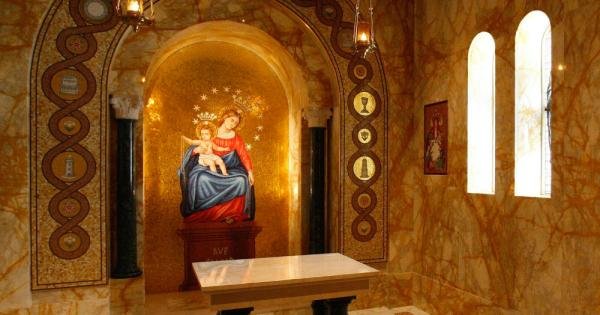
To commemorate the one-year anniversary of his passing, a plaque will be unveiled in the Pauline Chapel of Mary Major, with the inscription, “Francis Supreme Pontiff, who paused 126 times in devout prayer at the feet of the ‘Salus Populi Romani’; according to his will, rests in this Papal Basilica.”
Newly-elected Pope Leo XIV turns to Our Lady of Good Counsel
Two days after his historic election as the first North American-born pope, Pope Leo XIV left Vatican City for the first time as pope to visit the Shrine of the Mother of Good Counsel in the nearby town of Genazzano. This shrine has been run by the Order of Augustinians since the 13th century: a natural choice for the first pope to come from that religious order.
It contains a fifteenth-century fresco of Our Lady of Good Counsel. According to tradition, on April 25, 1467, a cloud descended upon the church. When the cloud vanished, a small fresco of the Madonna and Child miraculously appeared, reportedly from Albania, but “fled” in the wake of an Ottoman invasion. One priest documented over 160 miracles that occurred in the presence of the Our Lady of Good Counsel image.
This Marian shrine was of personal significance to Pope Leo XIII, the namesake of Pope Leo XIV. When, as Robert Prevost, he entered the novitiate of the Order of Saint Augustine, he did so at the Province of Our Lady of Good Counsel, in St. Louis in 1977. This led to a longstanding personal devotion to this title of Mary (Our Lady of Good Counsel). Pope Leo’s May 10th visit to the Augustinian-run Marian shrine allowed him to connect with the religious order that shaped his religious formation.
Visiting Our Lady of Pompeii to mark the first anniversary of his pontificate
When Pope Leo XIV spoke publicly on the balcony for the first time at St. Peter’s Basilica on May 8, 2025, he noted: “Today is the day of the Supplication to Our Lady of Pompeii … Our blessed Mother Mary always wants to walk with us, be close to us, she always wants to help us with her intercession and her love. So let us pray together for this mission, and for all of the church and for peace in the world.”
A year later, Pope Leo XIV is set to visit the Pontifical Shrine of the Blessed Virgin of the Holy Rosary on the one-year anniversary of election: the feast day of Our Lady of Pompeii. When he presides over Mass there, the image of “Our Lady of the Rosary” that will be behind him on the altar has its own storied history. The image is of the Madonna and Child enthroned, each handing rosary beads to St. Catherine of Siena and St. Dominic, both known for their use of the rosary as a devotional tool.
The original artist is unknown, but art historians have determined that the painting was created in the seventeenth century. Saint Bartolo Longo, the founder of the shrine, purchased the painting, which was found in poor condition at a second-hand store. Longo later recalled, “Not only was it worm-eaten, but the face of the Madonna was that of a coarse, rough country-woman.” Longo fundraised to restore the image, which is now the altarpiece of the shrine.
Unexpected arrivals
None of these works of art were originally intended to be at the churches where they now reside. “Salus Populi Romani” was from Constantinople, only to be moved to Rome. The fresco of “Our Lady of Good Counsel” was said to have been transported from Albania to Genazzano under mysterious circumstances. Finally, the image of “Our Lady of the Rosary” was found discarded in a second-hand store, and ultimately to be restored as the altarpiece in Pompeii.
Though the term “unprecedented” is often overused, it can be applicable when examining the last two papal conclaves. On March 13, 2013, the world looked on with surprise when it was announced that Cardinal Jorge Mario Bergoglio would become the first Jesuit and Latin-American-born pope. His papal name, Francis, was also unexpected: He was the first pope to choose a new non-papal name since Pope Lando in 913. As 133 cardinals gathered in May 2025 to elect Pope Francis’ successor, many considered the election of an American cardinal an impossibility. But on May 8, 2025, Cardinal Robert Prevost, a son of Chicago, IL, became the first pope from the United States.
Just like the unexpected movement of these three works of art, the historic elections of Pope Francis and Pope Leo XIV have reflected surprising turns in the history of the Church. As Pope Leo said in Genazzano last year, “As the mother never abandons her children, you must also be faithful to the Mother,” which is similar to how Pope Francis called for all to turn to Mary in times of need. Yet a constant throughout these changes has been how each pope has turned to Mary during key moments in their pontificate.
Source:
www.ncronline.org