








NEW DELHI — India has inducted a nuclear-powered ballistic missile submarine and is in the final stages of sealing an $8 billion deal with Germany for six conventional submarines as it focuses on boosting its underwater capabilities with an eye on the prospect of greater presence of Chinese vessels in the Indian Ocean.
The INS Aridhaman is the country’s third nuclear-powered ballistic missile sub (SSBN). It was inducted quietly earlier this month with Defense Minister Rajnath Singh simply posting on X, “Aridhaman isn’t just a word, it is power.”
Experts say the new vessel will enhance India’s sea-based nuclear deterrence by making it possible to have round-the-clock deployment in the ocean while others undergo maintenance or are in transit.
“For any second-strike capability to be credible, it is very essential to have at least one submarine continuously at sea to maintain sea deterrence. With three SSBNs we will be able to keep one submarine on patrol at any given time,” said retired Commodore Anil Jai Singh, a submarine specialist and vice president at the Indian Maritime Foundation.
The indigenously built vessel is more technologically advanced and capable of carrying longer range missiles compared to the two SSBNs commissioned in 2016 and 2024. It has a displacement of 7,000 tons and double the missile capacity of its predecessors, according to the Times of India newspaper. It can carry up to 24 missiles with a range of 750 to 1,500 kilometers and eight missiles with a range of 3,500 kilometers.
However, although the longer-range K-4 missiles have been tested, India has yet to operationalize them.
Experts say SSBN’s are critical for India which has a “no-first use” policy for nuclear weapons because they are the most effective for retaliatory strikes in the event of a first strike by an enemy.
“Countries like China now have the ability to take out land-based nuclear arsenals with conventional weapons. For a country like India, this knocks out the very door of deterrence, which assumed that a country’s nuclear arsenal can’t be taken out in a first strike,” retired Rear Adm. K. Raja Menon, a maritime strategist and submarine specialist in New Delhi told Defense News.“If you have a fragile arsenal, the only assured second strike weapon today is the nuclear ballistic submarine.”
A fourth SSBN is currently being built and is expected to be commissioned next year.
India is also in the final stages of approving a deal to buy six advanced stealth submarines from Germany for an estimated $8 billion, which would make it one of the country’s largest defense deals.
The Air-Independent Propulsion (AIP) submarines will be the first such platforms in India’s fleet and will enhance the Indian Navy’s long-term operational and underwater stealth capabilities.
The AIP technology allows conventional submarines to remain submerged for extended durations without resurfacing to recharge batteries, making them harder to detect by enemy anti-submarine assets. In the expansive Indian Ocean, this also enhances their ability to operate far from the Indian coastline.
The project involves German shipyard TKMS collaborating with Indian state-owned Mazagon Dock Shipbuilders Ltd. to build the vessels in India.
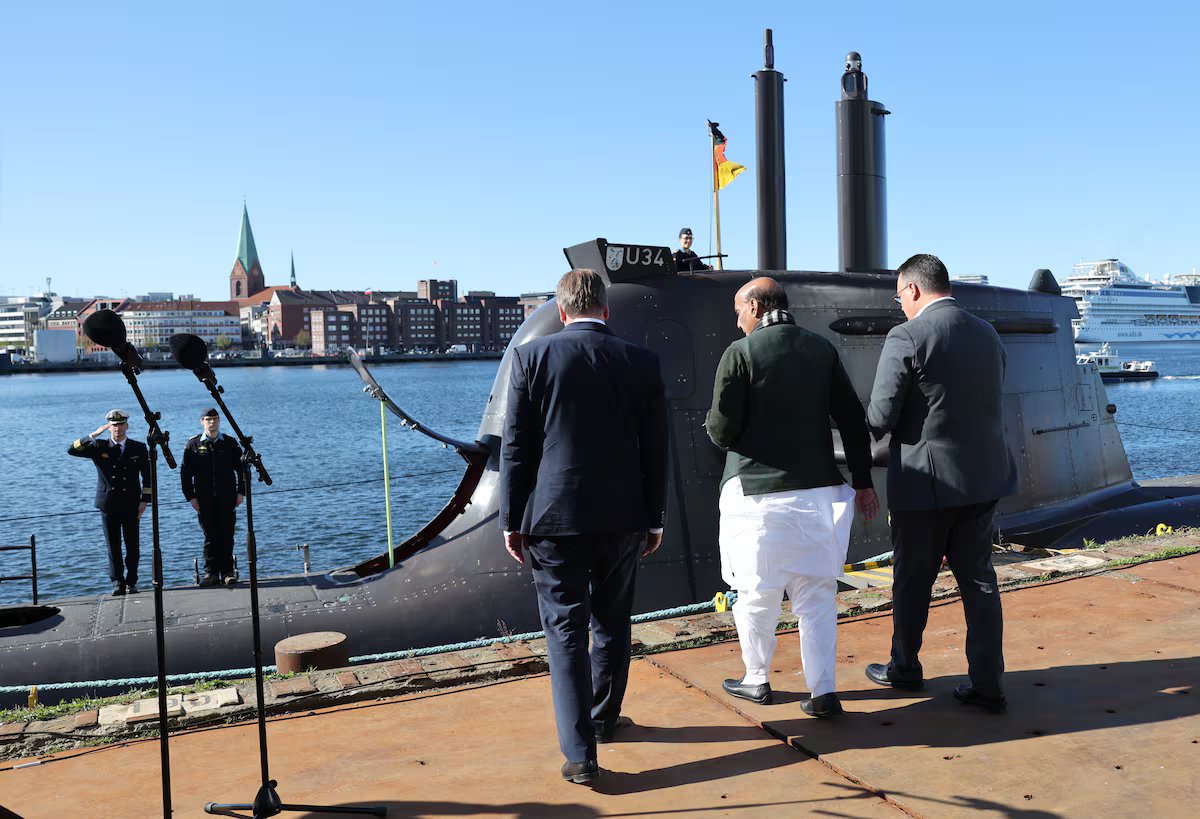
On a visit to Germany last week, Indian Defense Minister Rajnath Singh visited the TKMS facility in the port city of Kiel with his German counterpart. Following the visit German Defense Minister Boris Pistorius told reporters that he expected the deal to be signed within the next three months. “I am very, very confident that I will be able to sign it soon,” Pistorius said.
The potential deal would mark the first transfer of German submarine production technology to a non-European country. It has to be approved by India’s Cabinet Committee on Security headed by Prime Minister Narendra Modi.
Although discussions about India acquiring the submarines have gone on for years, the decision to speed it up comes amid growing geopolitical uncertainties, say analysts.
The Indian Navy is currently facing a major crunch in its submarine fleet, with several of its 17 vessels due to be phased out in the coming years. China, India’s major rival, is meanwhile estimated to have over sixty submarines, and is rapidly ramping up production of nuclear-powered submarines, according to a report from the International Institute for Strategic Studies.
India has a vast coastline of 7,500 kilometers and a central position in the Indian Ocean, which is a major seaborne trade corridor.
“We have a maritime geography which enables us to dominate the Indian Ocean, and we want to signal that we are not prepared to let anybody else dominate these waters. That is why we need to expand conventional submarines as well as aircraft carriers,” said Menon, the retired rear admiral. “So far China has not followed oceanic dominance but this is not ruled out because it is aware of its own vulnerability in the Indian Ocean, through which much of its trade passes.”
Besides focusing on submarines, India also inducted a stealth frigate INS Taragiri into the navy earlier this month. The multi-role stealth frigate with a displacement of about 6,670 tonnes is equipped with a range of supersonic surface-to-surface missiles and medium range surface-to-air missiles.
The frigate is armed with missile systems, such as the BrahMos cruise missiles as well as surface-to-air missiles, an Indian government press statement said after it was commissioned.
India will be inducting 15 warships this year – the highest number so far, India’s Chief of Naval Staff, Adm. Dinesh Kumar Tripathi, said in February. “Besides the numbers, our focus has been on sharpening critical war-fighting capabilities – particularly in anti-submarine and under-sea warfare,” he said.
Source:
www.defensenews.com