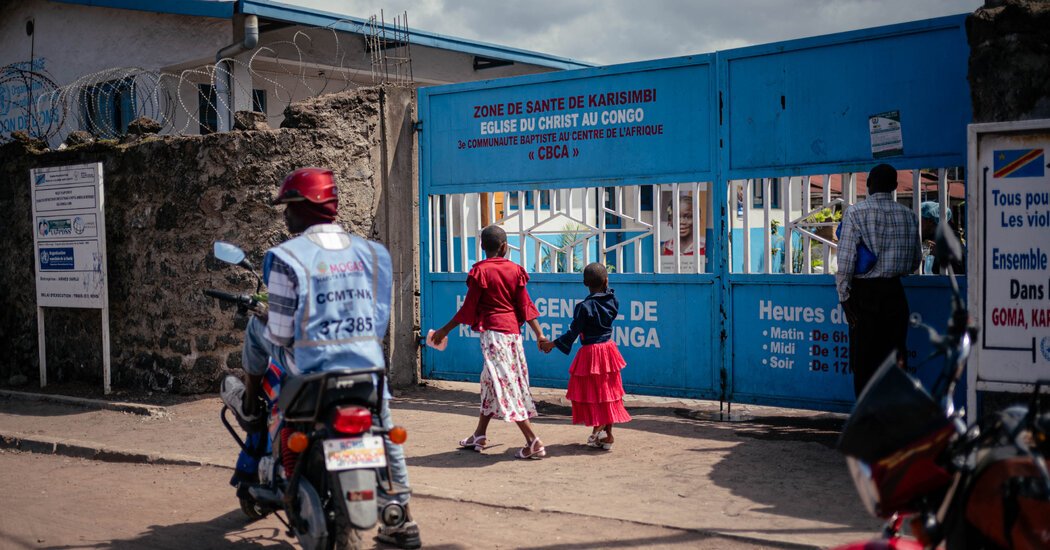
An outbreak of the deadly Ebola virus in the Democratic Republic of Congo and Uganda has prompted the World Health Organization to declare a global health emergency.
As of Sunday, the C.D.C. said there were reports of more than 330 suspected cases, including nearly 90 deaths in Congo. The outbreak was first identified in the country’s northeastern Ituri Province. Laboratory testing has definitively linked only 10 cases to the virus. Two cases have been confirmed in Uganda.
The W.H.O. declared on Saturday that the outbreak was “a public health emergency of international concern.”
Officials are working to withdraw a small number of Americans who have been directly affected by the outbreak, the C.D.C. said on Sunday.
The type of Ebola virus behind the latest outbreak, known as Bundibugyo, is rare, has fewer field tests available, and has no targeted vaccine or treatment, potentially compounding the difficulty of containing the outbreak.
Here’s what to know.
What is Ebola?
Ebola is an illness caused by a group of viruses, known as orthoebolaviruses, first discovered in 1976 in the countries now known as South Sudan (formerly part of Sudan) and the Democratic Republic of Congo (formerly known as Zaire) in a region near the Ebola River. The most common species is the Zaire Ebola virus.
Ebola outbreaks have mostly occurred in sub-Saharan Africa, according to the U.S. Centers for Disease Control and Prevention. Four of the six known species of Ebola viruses cause illness in humans and can be fatal. Among them is Orthoebolavirus bundibugyoense, leading to Bundibugyo virus disease, the form of Ebola that prompted the latest global health emergency declaration.
People with Ebola may first experience so-called dry symptoms such as fever, aches, pains and fatigue before progressing to wet symptoms, including diarrhea, vomiting and bleeding, according to the C.D.C.
Ebola diseases can be contracted through contact with the body fluids of an infected, sick or dead person and with contaminated objects like clothing, bedding, needles and medical equipment.
There is no vaccine or specific treatment for the Bundibugyo species, as outbreaks have been rare.
The Bundibugyo species was first identified in 2007 after a mysterious illness broke out in Bundibugyo District in Uganda, which borders Congo. Diagnostic samples submitted to the C.D.C. in the United States revealed the existence of a previously unknown type of Ebola virus. In 2012, another such outbreak was identified in Congo.
In January, scientists at the University of Oxford announced an effort to develop and test vaccines to protect against multiple lethal viruses, including Bundibugyo. And the W.H.O. says that “candidate products are in development” to address the species of Ebola without current vaccines.
Fatality rates during the past two outbreaks of this form of Ebola have ranged from 30 percent to 50 percent, according to the W.H.O.
The incubation period for this species of Ebola virus ranges from two to 21 days, and individuals are usually not infectious until symptoms manifest. But because the early symptoms — like fever and fatigue — resemble those of other illnesses, including malaria, early detection can be difficult.
Experts say major changes to the global health system could complicate the response to the current outbreak.
The United States withdrew from the W.H.O. in January, and the U.S. Agency for International Development, which has played a major role in containing previous outbreaks, was shuttered last year by the Trump administration. It is unclear how that might have affected the response to this outbreak. Atul Gawande, a former senior U.S.A.I.D. official, suggested on social media that the outbreak may have gone undetected for weeks because American agencies were scaled back.
There have been several deadly Ebola outbreaks in recent years.
Following its discovery in 1976, when dual outbreaks in South Sudan and Congo infected nearly 600 people and killed over 430, the virus resurfaced in several notable pre-2000 outbreaks. These included a massive 1995 resurgence in Congo that claimed more than 250 lives.
In the 21st century, there have been a number of deadly outbreaks of Ebola viruses.
2025: Last year, health officials in Congo officially declared the country’s 16th Ebola outbreak since 1976. There were 53 confirmed cases and 45 deaths. Earlier that year, Uganda also reported 12 confirmed cases and four deaths from Ebola.
2022: Uganda confirmed an outbreak that ended in early 2023, with 142 confirmed cases and 55 confirmed deaths, and cases were also reported in Congo.
2020: Congo reported 130 cases, 55 of which ended in death.
2019: A severe outbreak led to nearly 3,500 cases in Congo, with nearly 2,300 deaths.
2014: An Ebola epidemic in West Africa began in 2014 and ended in 2016. It was the largest such epidemic in history, with cases in southeastern Guinea, Liberia and Sierra Leone. More than 28,600 people fell ill and more than 11,300 died. There were also cases reported in Congo, Mali, Nigeria, Senegal, Spain, Britain and the United States.
2007: About 130 people in Uganda fell ill with the Bundibugyo virus, and more than 40 people died. In Congo, there were more than 260 cases related to the Zaire species of the Ebola virus, and more than 70 percent of cases resulted in death.
2003: Two outbreaks in the Republic of the Congo led to about 180 cases and 170 deaths.
2001: Two small outbreaks occurred in the Republic of the Congo and in Gabon, each affecting about five dozen people and resulting in the deaths of most of those who fell ill.
2000: About 425 people fell ill during an outbreak in Uganda; more than half died.
Source:
www.nytimes.com