








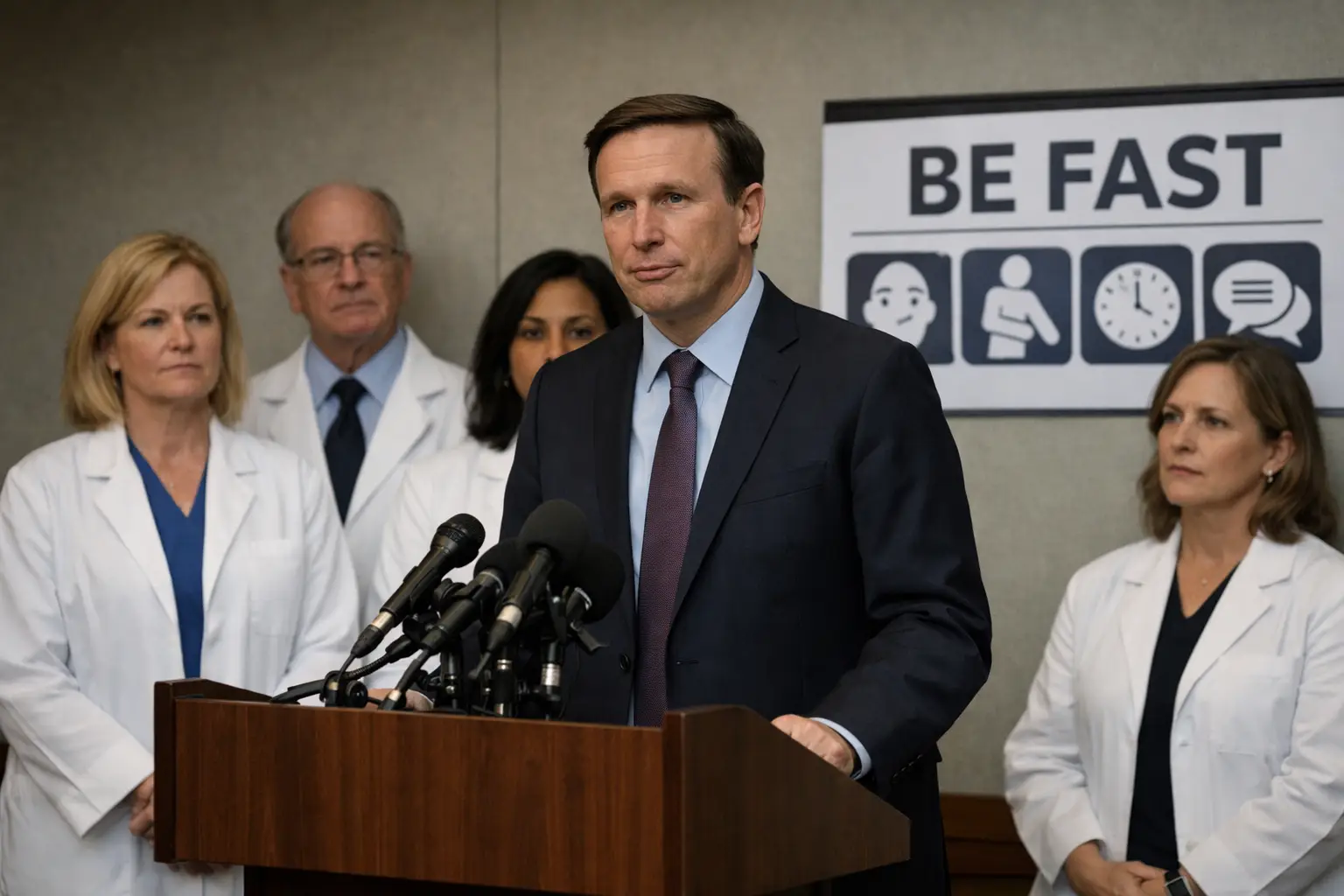
A sudden medical emergency involving Sen. Chris Murphy has brought fresh attention to the warning signs of a stroke and the urgency of acting quickly. The Connecticut Democrat suffered a stroke on Saturday and is expected to make a full recovery. His case has placed a widely used memory tool, known as BE FAST, back at the center of public health messaging: when symptoms appear, the response should be immediate emergency care.
BE FAST is designed to help people identify possible stroke symptoms in real time. The letters stand for Balance, Eyes, Face, Arms, Speech and Time. A sudden loss of balance, changes in vision, facial drooping, weakness in one arm or difficulty speaking can all signal a stroke. The final letter is the instruction that matters most: time. Medical guidance from the Centers for Disease Control and Prevention emphasizes that anyone observing these signs should call 911 without delay.
The importance of rapid action lies in the nature of stroke itself. It occurs when blood flow to part of the brain is disrupted or reduced, putting brain tissue at risk. Symptoms can begin abruptly and may be dismissed at first as fatigue, dizziness or confusion, especially if they appear to improve. That uncertainty is precisely why public health campaigns promote simple checklists. BE FAST gives family members, colleagues and bystanders a practical way to recognize that a person may need urgent medical evaluation.
Murphy’s expected recovery also highlights a broader point: outcomes can depend on how quickly care begins. The message is not limited to older adults or people with known health conditions. Stroke can appear suddenly, and the person experiencing symptoms may not be able to describe what is happening clearly. In that moment, people nearby may be the ones best positioned to notice facial changes, speech problems or weakness and to contact emergency services.
For public health officials and medical organizations, BE FAST remains a concise tool because it translates a complex emergency into observable signs. The guidance is straightforward: do not wait to see whether symptoms pass, do not attempt to drive to care if emergency services are available, and do not treat sudden neurological changes as minor. The central action is to call 911 quickly, giving patients the best chance to receive timely assessment and treatment.