








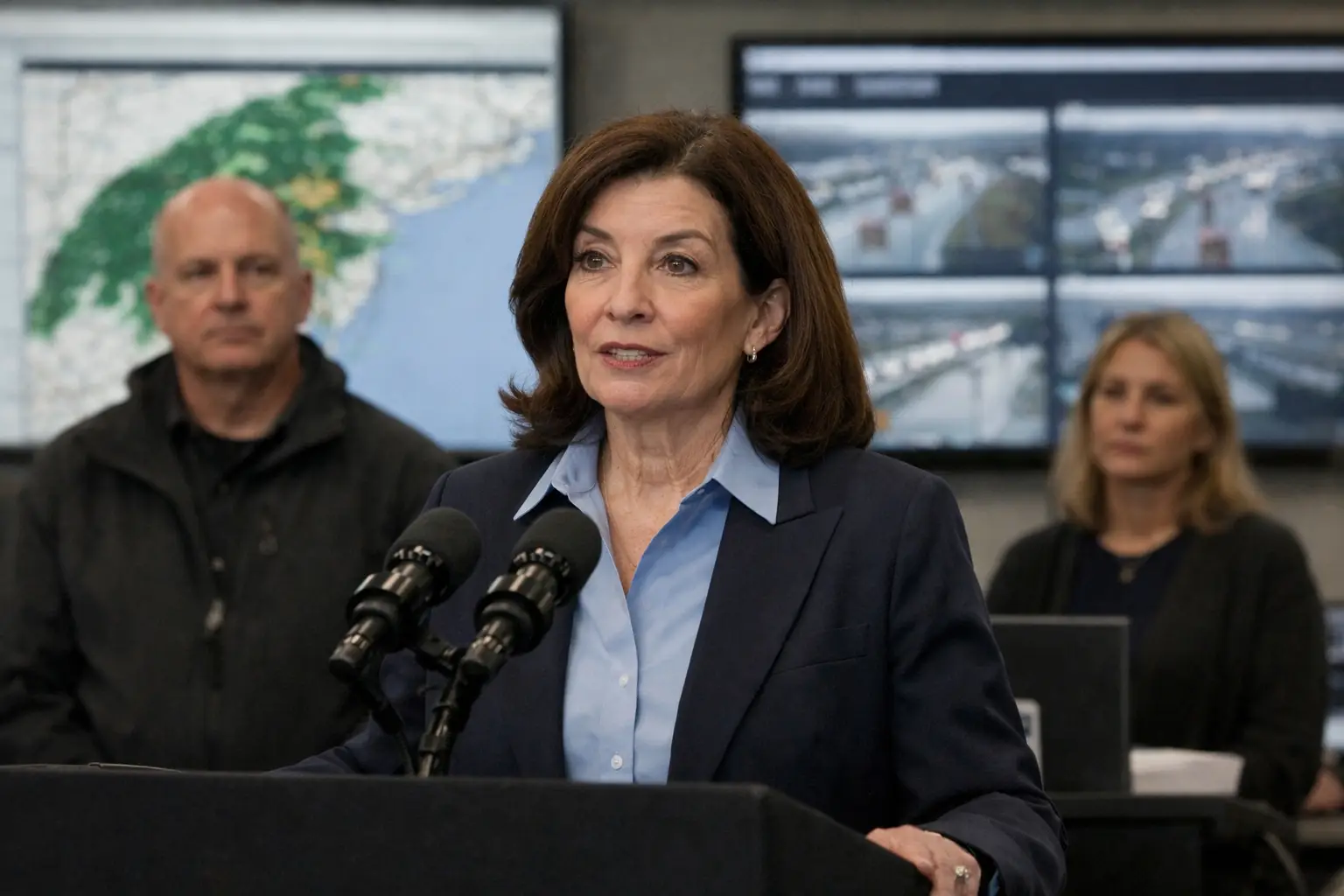
New York is bracing for a difficult holiday travel period after Governor Kathy Hochul declared a state of emergency on Wednesday for New York City and the counties of Nassau, Suffolk and Westchester. The measure comes ahead of a powerful Thanksgiving storm moving toward parts of the state, with travel already affected in the region at one of the most sensitive moments of the year for transport networks.
The declaration applies to some of the state’s most densely populated and heavily connected areas, including the city and surrounding counties that form a crucial corridor for commuters, airport passengers and holiday traffic. The timing gives the order particular weight: Thanksgiving typically concentrates road, rail and air travel into a short window, leaving little margin for disruption when severe weather approaches. For residents and visitors, the emergency status is a signal to monitor official updates and adjust plans where necessary.
Emergency declarations are a standard tool used by state governments to accelerate coordination among public agencies and local authorities before or during hazardous conditions. In this case, the action is intended to support readiness across parts of New York where the storm could complicate movement and strain public services. The affected jurisdictions include coastal and suburban areas as well as the country’s largest city, a combination that can magnify the practical consequences of delays, closures or hazardous roads.
The storm’s arrival during the Thanksgiving period places additional pressure on transportation systems that are already operating under heavy seasonal demand. Even limited weather-related slowdowns can cascade through airports, highways and transit routes when passenger volumes are high. The disruption reported before the holiday underscores the challenge for officials trying to keep essential services functioning while advising the public to remain cautious.
For state and local authorities, the priority is to maintain response capacity in the counties covered by the declaration while limiting risks linked to travel during deteriorating conditions. The emergency order does not by itself determine the storm’s final impact, but it gives officials a framework for rapid decisions as conditions evolve. In a region where millions depend on interconnected travel routes, advance preparation can be as important as the response once severe weather arrives.