









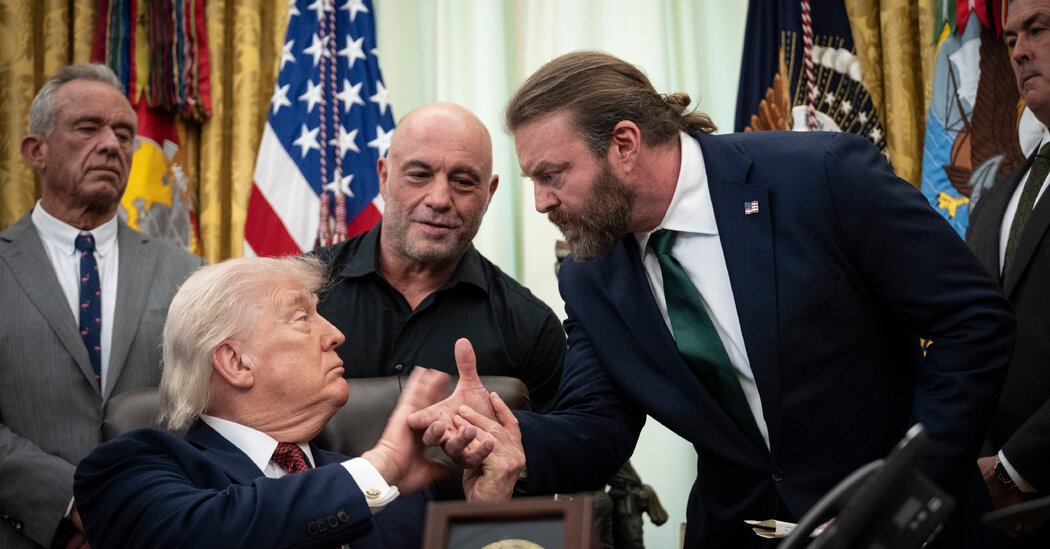
Mindbending may be just the word to describe the Oval Office ceremony on April 18, when President Trump ordered federal agencies to speed up research into the potential therapeutic uses of illegal psychedelic compounds like LSD, peyote and MDMA.
Here was a law-and-order Republican and lifelong teetotaler championing the hallucinogenic substances that a previous Republican president, Richard Nixon, had condemned as “public enemy No. 1.”
In the decades since 1970, when Nixon consigned psychedelics to the most restrictive category of federal prohibition, his absolutist, just-say-no approach was embraced by waves of conservative politicians.
They generally held to the view that psychedelics were a morally corrupting intoxicant, the indulgences of hippies, draft-dodgers and other liberal degenerates.
“As someone who has worked with psychedelics for decades, watching the White House event was a very trippy experience,” said Dimitri Mugianis, an underground practitioner who was prosecuted by federal authorities for illegally treating a heroin addict with the psychedelic drug ibogaine.
Mr. Trump’s bold efforts to soften the federal government’s stance on certain illegal drugs have been head-spinning — last month, the Justice Department, at the president’s behest, loosened restrictions on medical marijuana, too.
But experts in the field are not entirely surprised.
They note a steady easing of public opposition to psychedelics in recent years, much of it shaped by research that has chipped away at the stigma by demonstrating the drugs’ potential to treat intractable mental health conditions like post-traumatic stress disorder, depression and substance abuse.
A parade of boldface names has openly discussed having psychedelic experiences, including Aaron Rodgers, Mike Tyson, Elon Musk, Robert F. Kennedy Jr. and Sergey Brin, a co-founder of Google.
That Nixon’s war on drugs is widely seen as a failure has also helped shift attitudes.
W. Bryan Hubbard, founder of the advocacy group Americans for Ibogaine, said the opioid crisis, decades of blue-collar job loss and the nation’s unending wars also provided an opening.
“Ironically, as with the counterculture movement of the 1960s, all of this accumulated damage has produced a suspicion of power,” he said.
In the end, though, drug reform advocates found a highly effective proxy for persuading even the most calcified antidrug warrior: the American military veteran.
Haunted by their wartime experiences and facing soaring rates of self-harm, veterans have been flocking to psychedelic clinics outside the United States in recent years. Their Lazarus-like tales of recovery from PTSD and substance abuse after receiving treatment have been instrumental in eroding skepticism among Republican elected officials.
“No one is going to deny a veteran in this country,” said Michael Pollan, whose 2018 book on the resurgence of psychedelics, “How to Change Your Mind,” helped catalyze mainstream acceptance of the drugs.
“Embracing veterans was a brilliant political move that erased the liberal-left coding that psychedelics have had since the 1960s,” Mr. Pollan said.
‘Nothing Short of an Exorcism’
The pivot to veterans was the handiwork of Rick Doblin, godfather of the modern psychedelic movement and founder of the advocacy and research group MAPS, the Multidisciplinary Association for Psychedelic Studies.
Mr. Doblin’s decision nearly a decade ago to place veterans at the fore of the movement’s regulatory reform efforts prompted outrage among progressives, especially after MAPS accepted a $1 million gift from the Republican donor Rebekah Mercer, who stipulated that the money was to be spent on research benefiting veterans.
But by turning wounded warriors into apostles and rebranding the drugs as medicine, Mr. Doblin succeeded in removing psychedelics from the culture wars.
The strategy has paid dividends in recent years, as prominent conservatives have come out as converts. One was Rick Perry, a former governor of Texas, who underwent ibogaine therapy in 2023 for anxiety. He recently wrote the forward to the book “The Christian’s Guide to Psychedelics.”
In Washington, a bipartisan congressional caucus that includes a half-dozen Republicans, all of them veterans, has been working to ease federal restrictions on psychedelic research.
One of its members, Representative Morgan Luttrell, Republican of Texas and a former Navy Seal, personifies the shifting politics. Long an opponent of recreational drugs, Mr. Luttrell suffered a traumatic brain injury in a helicopter crash in 2009 that he said left him emotionally fragile.
After a succession of fellow service members shared their stories of recovery with him, many after a single session with ibogaine, Rep. Luttrell traveled to Mexico to try it.
The drug, which is made from the root of a shrub that grows in West and Central Africa, is considered the most powerful known psychedelic. One dose can lead to a hallucinatory trip lasting more than 24 hours. It can also cause a fatal cardiac arrhythmia in patients who are not properly screened and monitored.
Mr. Luttrell described his experience as extremely challenging. “It was nothing short of an exorcism,” he said later. He also said the drug helped him confront the demons that were straining his personal relationships.
He became an ibogaine evangelist and convinced his wife and his brother to undergo treatment, which can cost as much as $15,000 and is not covered by insurance.
As Mr. Luttrell and his brother, Marcus, stood beaming in the Oval Office last month, Mr. Trump confessed his own lack of familiarity with psychedelic treatments. He struggled to pronounce the word ibogaine and then jokingly asked for some.
Among the first invited to speak was Joe Rogan, the influential podcaster, who offered up a brief history of Washington’s long war on psychedelics as he stood behind the president.
“They did it to target the civil rights movement and the antiwar movement,” Mr. Rogan said of the Nixon administration. “It’s not because these drugs harm people.”
Mr. Trump nodded approvingly.
That Mr. Rogan was there, directly behind the president, highlighted yet another dynamic that has prompted the administration’s shift on psychedelics: electoral politics.
Alarmed by the erosion of support among the MAGA faithful as the midterms approach, Mr. Trump’s advisers have been looking for ways to reclaim the loyalty of Mr. Rogan and his listeners, many of whom have soured on the president over his decision to wage war with Iran.
Mr. Rogan, a vocal proponent of psychedelic therapies, largely took credit for the president’s move to ease restrictions. This year, after Mr. Perry appeared on Mr. Rogan’s podcast to discuss the subject, Mr. Rogan said he texted Mr. Trump and urged him to take action.
“Sounds great,” Mr. Trump responded, according to Mr. Rogan’s account. “Do you want F.D.A. approval? Let’s do it.”
The Oval Office audience tittered.
A ‘Miracle Cure’ Mind-Set
In a sign of how times have changed, criticism of Mr. Trump’s actions has largely come not from religious conservatives but from the left. Much of the commentary has focused on the increasing corporatization of psychedelics and concerns that any new therapy will be unaffordable to most Americans.
“This move represents a crystallization of far-right interest in the psychedelic industry and step towards oligarch monopolization of psychedelic medicine,” the leftist advocacy group Psymposia wrote on Reddit.
Other progressives were struck by the dissonance of an administration’s championing psychedelic therapy while dismantling the social safety net that many experts say is integral to recovery and healing for those struggling with mental health challenges. (The administration’s proposed budget for 2027 includes $10 billion in cuts to drug treatment, addiction research and mental health services.)
“These drugs work, but when you’re starting wars, cutting food assistance and destroying communities, they aren’t going to work that well at all,” said Mr. Mugianis, the underground practitioner.
Advocates were largely pleased by the president’s executive order, which was followed days later by an announcement that the Food and Drug Administration would buoy the applications of three psychedelic drugs. The applications will be fast-tracked as part of a pilot program that speeds the approval of drugs that serve national health priorities.
Still, even supporters said they were troubled by the overly simplistic messaging that ascribes almost magical powers to the drugs; speakers in the Oval Office used phrases like “one-and-done” to describe the drugs’ ability to heal.
What the speakers did not say was that therapies relying on psilocybin, MDMA and other psychedelic drugs often include hours of counseling before and after dosing sessions, to apply insights gained from the experience.
Many experts say that downplaying that work, and the fact that psychedelic treatments are not effective for everyone, can lead only to disappointment, especially among patients who place all their hopes on a “miracle cure” that can fail to materialize.
“Remarks that ignore the intense emotional work required is dangerous,” said Dr. Franklin King, the director of training and education at the Center for the Neuroscience of Psychedelics at the Massachusetts General Hospital.
“These drugs can open the door to continuing to work on a process that can lead them to a better place in your life,” he said. “But it’s not just like snapping your fingers.”
Source:
www.nytimes.com