



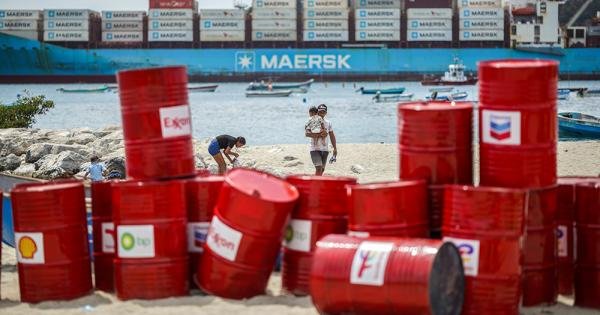
On Sunday, April 26, in the Caribbean city of Santa Marta, Colombia, Catholics gathered for Mass at the Cathedral Basilica of Santa Marta to pray for proceedings underway 6 miles down the coast to develop a just and realistic pathway to a world without fossil fuels, the main driver of climate change.
The first Conference on Transitioning Away from Fossil Fuels began April 24 in the historical coal port in northern Colombia, the South American country cohosting the gathering with the Netherlands. At the center of the talks is how to feasibly and rapidly shift away from coal, oil and gas as an energy source. When burned, the fuels release heat-trapping greenhouse gas emissions that are primarily behind the rise in extreme storms, heat waves, droughts, flooding and sea rise around the globe.
More than 50 countries, dubbed a “coalition of the willing,” are participating in two days of high-level meetings that begin today. The Holy See is expected to attend those discussions as an observer, while more than two dozen Catholic organizations have representatives in Santa Marta.
“The mood is amazing,” said Lisa Sullivan, senior program officer on integral ecology for the Maryknoll Office for Global Concerns, who attended the liturgy. “There’s a tremendous amount of hope.”
Though planned months before the U.S. and Israel war on Iran, the April 24-29 gathering comes as that conflict has bottlenecked the 20% of global oil supply that passes through the Strait of Hormuz and disrupted energy markets alongside prices of gasoline, fertilizer, food and other goods worldwide.
“I think it’s helped to bring incredible clarity to the issue, because fossil fuels are not only the cause of climate change, but of extreme insecurity, national crises, wars, et cetera,” Sullivan told EarthBeat.
The United States, which has doubled down on fossil fuel expansion under the Trump administration, was not invited to Santa Marta, along with China and other countries that have blocked international efforts to even put forward a plan to phase out fossil fuels in the decade since the Paris Agreement was adopted.
Despite those omissions, the countries gathering in Colombia represent one-third of global oil demand and one-fifth of fossil fuel production — among them, Australia, Brazil, Canada, France, Germany, Nigeria and the United Kingdom — along with numerous island states on the front lines of climate change.
The dynamic has officials with the nearly two-dozen Catholic development and missionary groups present in Santa Marta optimistic that substantial deliberations can actually take place.
“It is a space that is shifting the conversation from the if to the how,” said Madeleine Alisa Wörner, an adviser on international climate and energy policy for Misereor, the German bishops’ development organization.
“The Santa Marta Conference is a moral turning point,” Yeb Saño, board chair of the Laudato Si’ Movement, said in a statement. “As people of faith, we cannot remain neutral while the continued expansion of fossil fuels deepens the suffering of the poor, harms vulnerable communities, and endangers our common home. This is the moment to turn our faith into action, to stand with those most affected, and to help build a future rooted in justice, peace, and care for creation.”
Colombian and Dutch officials have made clear that the Santa Marta conference is a first step and a first formal attempt at a more nuanced discussion that has been almost entirely absent from the annual United Nations climate change summits. The conference in Colombia is focused on three central topics: overcoming economic dependence on fossil fuels, transforming energy supply and demand toward renewables, and increasing international cooperation.
Officials have said the gathering is intended to complement, not replace, official U.N. climate proceedings. They also stated it is not a negotiating space for a proposed treaty to phase out fossil fuels — though representatives of that effort are in attendance and an international accord has already been raised as one path forward.
Primarily, the focus will be on listening and information sharing, with the only expected outcomes to be a summary report, the creation of a scientific advisory council, and plans to continue the talks.
“We need to move forward from the discussion on whether we need to transition away or not, to the implementation phase” of how to make a global shift from fossil fuels possible, viable and equitable, Daniela Durán, an official in Colombia’s Ministry of the Environment and Sustainable Development, said in a press briefing April 9.
Under the Paris Agreement, countries committed to drastically reduce emissions to net zero by midcentury, in an effort to limit average temperature rise to 1.5 degrees Celsius (2.7 degrees Fahrenheit). But that pact did not dictate how to eliminate emissions and omitted the words “fossil fuels” altogether. In 30 years, U.N. climate conferences have only once — in 2023, at COP28 in Dubai — acknowledged the need to transition from fossil fuels.
Scientific studies have repeatedly concluded that rapid and substantial reductions in the use of fossil fuels is necessary to avert the worst impacts of climate change and maintain livable conditions for human civilizations.
Each of the past 11 years have been the hottest on record. Average temperature rise is expected to reach 2.3 to 2.8 degrees Celsius by the end of the century. That’s an improvement from 4 C forecasts before the Paris Agreement’s adoption in 2015 but well over the 1.5 C limit, which scientists project will be surpassed, if only temporarily, within the next decade.
Meanwhile, global fossil fuel production in 2030 is projected to more than double levels aligned with the 1.5 C goal. Surveys have shown nearly nine in 10 people globally want governments to take stronger actions on climate change.
“Nobody says that this is going to be easy, something that we can fix tomorrow or next year or in the next five years. This is going to take decades, right, this transition toward net zero,” Bastiaan Hassing, head of international climate policy for the Netherlands, said at the press briefing.
Catholic organizations working on climate and environmental issues have eagerly anticipated the Santa Marta conference since it was first announced in November at the COP30 U.N. climate summit in Belém, Brazil. It came as countries ultimately declined to adopt a proposal for the development of a road map to phase out fossil fuels. More than 80 countries had supported the proposal.
Ahead of the Santa Marta conference, the continental bishops’ conferences of Africa, Asia and Latin America lent their support to the efforts and called on countries to adopt a fossil fuel phaseout treaty “as a moral and political imperative.”
“A world free of fossil fuels, just and at peace, is possible and necessary,” wrote the three cardinal-presidents of the Latin American and Caribbean Episcopal Council (CELAM), the Symposium of Episcopal Conferences of Africa and Madagascar (SECAM), and the Federation of Asian Bishops’ Conferences (FABC).
A joint statement from 20 faith organizations present in Colombia made their own call for a fossil fuel treaty and pledged to educate their communities and lobby elected officials to support such an agreement.
Among the 24 Catholic organizations present in Santa Marta are CELAM, Caritas Internationalis, the Laudato Si’ Movement, Pax Christi International, CIDSE, the Pan-Amazonian Ecclesial Network and the Mesoamerican Ecological Ecclesial Network. The two-person Holy See delegation includes Msgr. In Je Hwan, chargé d’affaires of the Colombian nunciature, and Bishop Juan Carlos Barreto, president of Caritas Colombia.
A joint statement, organized by CIDSE, the European-based network of Catholic social justice organizations, and signed by more than 30 other Catholic organizations, proposed a set of guiding principles and recommendations for a just and equitable transition from fossil fuels. They included:
A shift of global finances from fossil fuels to renewable energy sources;
Minimizing the need for critical minerals;
Ensuring human rights are part of transition strategies;
Involving all stakeholders — including Indigenous and local communities and workers in the fossil fuel industry — in decision-making.
The statement was one of several that Catholic and other faith groups contributed to the 600-plus proposals submitted ahead of the conference. Officials will review those as part of the high-level segments and incorporate their recommendations into a final report.
Along with Mass on Sunday, Catholics over the weekend held a day of action, with a focus on the ways fossil fuel extraction impacts communities in three Colombian dioceses. They also joined discussions with other faith-based and civil society organizations and Indigenous communities. Some centered on a moral framework for a fossil fuel treaty.
Wörner told EarthBeat that the first days of the Santa Marta conference were refreshingly free of the debates that have stifled U.N. climate conferences. She said it was important for Catholics to be present to bring moral clarity and to help frame a transition from fossil fuels not just as an economic or technological challenge but in terms of justice, dignity and responsibility to present and future generations.
As the Santa Marta conference began Friday, the Daughters of Charity of St. Vincent de Paul in the U.S. and Canada held a virtual vigil to pray for those attending the conference and for a breakthrough to a path to bring the fossil fuel era to an end.
At one point, participants were asked to imagine what a future world would look like free of fossil fuels. Their replies stitched together a picture of clear, pristine panoramas, fewer pipelines, and electric chargers outnumbering gas pumps.
With the ongoing war in the Middle East in mind, Charity Sr. Regina Bechtle of the Bronx, New York, put forward her own vision.
“Weapons into windmills.”
Source:
www.ncronline.org