

WASHINGTON — Maritime tech startup Blue Water Autonomy and maritime drone manufacturer Saildrone have filed lawsuits against the US Navy, after the service rejected their proposals submitted through the new Medium Unmanned Surface Vessel (MUSV) marketplace that launched in March.
One of the lawsuits goes so far as to ask that the courts effectively freeze the service from moving forward with plans to complete testing and award further contracts for the MUSV program, which is a key unmanned push by the Navy.
According to an unsealed complaint, both companies claim that their proposals did satisfy Navy requirements for the marketplace. The firms allege in the complaint that the Navy itself did not adhere to guidance outlined in the service’s request for proposals (RFP) issued in March, and eliminated the firms from the competition based on “conclusions” that don’t align with the RFP.
Neither Saildrone’s Spectre MUSV and Blue Water Autonomy’s Liberty MUSV design was selected to move forward to the at-sea prototype testing phase that is expected to wrap up in October.
The lawsuits come after the Navy canceled in March its Modular Attack Surface Craft (MASC) program that sought to design and develop USVs, and instead, announced the MUSV marketplace would take its place.
However, the Navy had “evaluated Blue Water’s vessel solution through a multi-stage process and selected Blue Water’s solution” for the MASC program prior to its cancellation, according to the complaint.
Based on the Navy’s objective to use “commercial innovations to procure the next generation of autonomous vessels to support Navy operations, Blue Water and its partners, including top-tier venture capital investors such as Google Ventures, made significant financial investments in Blue Water’s solution,” the complaint said.
“But rather than allow Blue Water to test its surrogate vessel and demonstrate that its vessel met the Navy’s requirements, the Navy arbitrarily and prematurely excluded Blue Water from further consideration in the competition,” the complaint said.
As a result, Blue Water Autonomy is requesting that the court provide injunction relief to halt the Navy from finishing the at-sea testing and allocating all program funding for follow-on production contracts until the service reassesses Blue Water’s proposal “reasonably and in accordance with the RFP and existing law,” and until Blue Water finishes testing so it qualifies for follow-on production contract.
Meanwhile, Saildrone said that its Spectre design submitted to the MUSV marketplace “satisfied or exceeded every mandatory acceptability criterion,” and had received American Bureau of Shipping (ABS) certification in December 2025.
“Saildrone ordered all long-lead-time components for the first SPECTRE in late 2025, supporting fielding in fiscal year 2027,” the complaint said.
However, Saildrone said in the complaint that it learned other defense firms were selected from a public news story, and that the Navy notified Saildrone that it would not advance further — only after Saildrone asked for more details.
“RAS’s selection of other offerors underscores the need for review,” the complaint said, referring to the Navy’s portfolio acquisition executive (PAE) for robotic and autonomous systems (RAS). “RAS accepted other proposals notwithstanding design-maturity, fielding, manufacturing-readiness, or test readiness issues more significant than the issues RAS cited against Saildrone.”
Saildrone also said that the firm shared a draft complaint with the Department of Justice in June in an attempt to resolve the issue without litigation. However, the company moved forward filing a complaint after the Navy refused to reevaluate Saildrone’s proposal.
Saildrone is also seeking an injunction requiring the Navy to reevaluate its proposal consistent with the solicitation, but is not requesting that the Navy pause ongoing efforts with other firms.
“Saildrone does not seek to delay the on-water MUSV Test Event for other participants while RAS conducts a lawful reevaluation of Saildrone’s Proposal,” the complaint said. “The requested relief instead would require RAS to evaluate Saildrone lawfully and, if Saildrone is found acceptable, permit Saildrone to participate without disrupting the broader test schedule.”
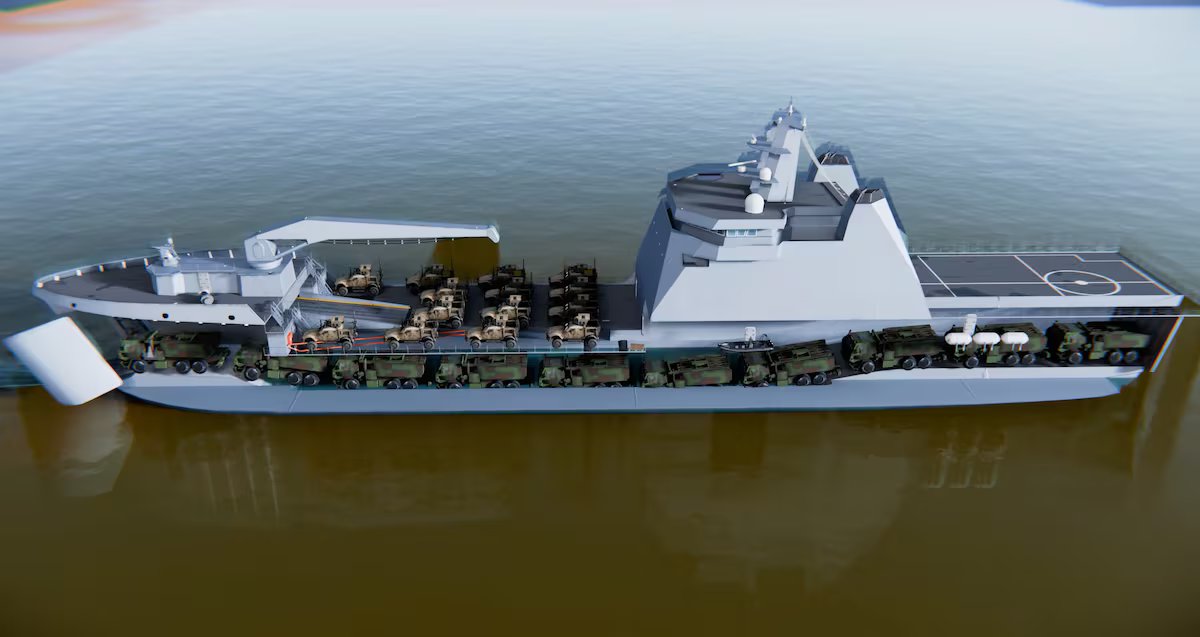
Submissions for the marketplace were supposed to hit several key requirements, including carrying at least two 40-ft shipping containers, and traveling 2,500 nautical miles at 25 knots in sea state 4 conditions while outfitted with a 25-metric-ton load on the payload deck, according to the marketplace solicitation.
It’s unclear why the Navy deemed that Blue Water Autonomy and Saildrone did not meet marketplace requirements, due to redactions in the complaint.
A spokesperson for the Navy told Breaking Defense that the service does not comment on pending litigation, and Blue Water Autonomy referred Breaking Defense to the complaint.
Meanwhile, Saildrone said that the Spectre vessel “has been in detailed design for over two years, with extensive testing and industry validation, to assure we met the MUSV requirements.”
“Our fully compliant MUSV submission to the US Navy should have qualified for advancing to the next round, in which we would participate in sea trials and develop a prototype at our own cost. Including all qualified bidders in the next phase of the evaluation leverages significant private capital to ensure the Navy has the best options to choose from, providing maximum advantage to the warfighter,” a Saildrone spokesperson said in a statement to Breaking Defense. “We support the Navy’s mission and believe there has been a misunderstanding in the evaluation of our bid.”
The lawsuits were unsealed on Tuesday, after they were originally filed at the end of June. The New York Times first reported that Blue Water Autonomy and Saildrone had filed lawsuits against the Navy.
According to Navy officials, the service nixed the MASC program because it was more of a “prototyping effort,” and the service determined there were enough mature platforms to move into production.
When asked about the Navy’s acquisition strategy for unmanned vessels shortly after the cancellation of the MASC program, Chief of Naval Operations Adm. Daryl Caudle said he could “sense the frustration” with the situation.
“I get equally frustrated with the number of times we’ve tried to start doing modules in the Navy,” Caudle said during a CSIS event in March.
Meanwhile, the Navy announced in June that seven defense firms would advance to the at-sea testing phase. Those tapped to participate include Leidos, Huntington Ingalls Industries (HII), and Saronic. Once testing wraps up, those eligible will receive $15 million and qualify for follow-on production, according to the Navy.
Funding for the marketplace is derived from President Donald Trump’s “One Big Beautiful Bill” that passed in July 2025, and included roughly $2.1 billion for MUSVs.
Source:
breakingdefense.com