









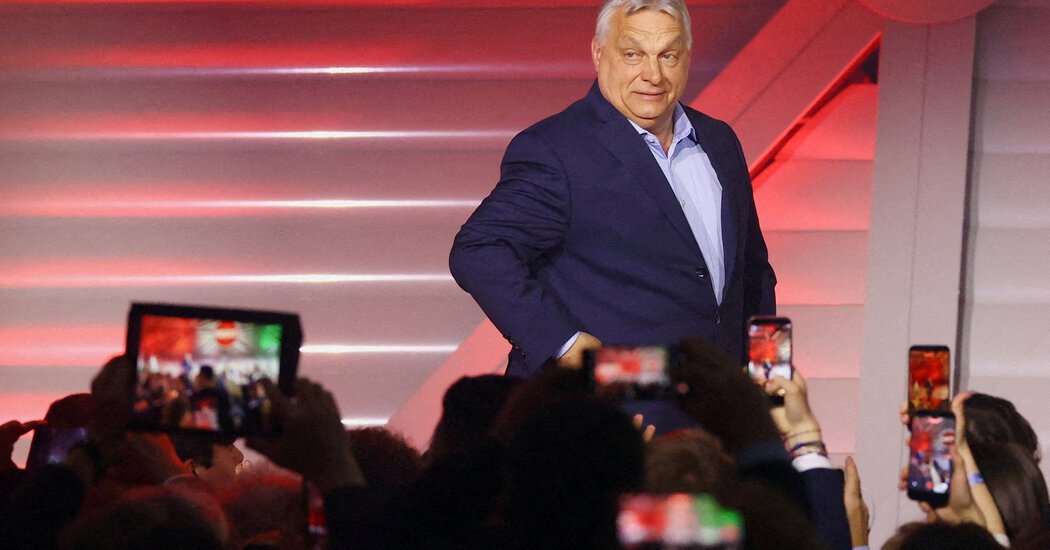
Following his party’s crushing defeat in a general election, Hungary’s outgoing prime minister, Viktor Orban, said on Saturday that he would give up his seat in Parliament and focus on rebuilding his battered “patriotic movement.”
But after 16 years in power and nearly four decades as leader of Hungary’s once invincible Fidesz party, he indicated that he would like to stay on as leader of the party, which won only 52 seats in an April 12 election, compared with 141 for Tisza, an upstart opposition movement.
“I am needed not in Parliament but in the organization of the patriotic movement,” Mr. Orban said in a video message posted on X. He added that he would surrender leadership of Fidesz’s contingent in the legislature to Gergely Gulyas, his chief of staff.
“Discussions are in full swing about renewing the patriotic camp, strengthening our parliamentary group and protecting our communities,” he said.
By surrendering his Parliament seat, Mr. Orban avoids having to submit to a large majority of legislators led by Peter Magyar, a onetime loyalist whom Fidesz vilified during the election campaign as a sex pest, a traitor and a puppet of Ukraine and the European Union. Mr. Orban has been a member of Parliament since 1990 and his decision to quit drew scorn from Mr. Magyar. “The ‘brave’ street fighter is still incapable of one thing: taking responsibility,” he said in message on Facebook.
Mr. Magyar, a conservative former member of Fidesz, is scheduled to take over as prime minister when Parliament reconvenes for its first post-election session, currently set for May 9. With more than two-thirds of the seats controlled by Tisza, Mr. Magyar commands a so-called “constitutional majority,” allowing him to undo electoral and other sweeping changes introduced during Mr. Orban’s long tenure.
Fidesz’s election rout has set off infighting in the party over how to recover, with some supporters calling for more focus on economic problems and an end to Mr. Orban’s strategy of stirring up fear and hatred of perceived political enemies at home and abroad, like the Hungarian-born American financier George Soros.
But Mr. Orban still enjoys strong support from within the party that he helped found in the 1980s as a champion of pro-European, liberal values and that he led to victory in five general elections. Fidesz, which later morphed into a nationalist party at odds with the European Union and in step with President Trump’s MAGA movement, won thumping majorities in four consecutive elections between 2010 and 2022.
“The future of Fidesz is unimaginable without Viktor Orban,” the outgoing foreign minister Peter Szijjarto told Telex, an opposition-aligned media outlet, last week.
He blamed the party’s defeat on “the behavior and activities of people who did not hold political authority.” He declined to name these people, but his remark was widely interpreted as a swipe at pro-Fidesz tycoons, some of them friends and relatives of Mr. Orban, who used their connections to win state contracts, feeding public anger over corruption, an issue that drove Mr. Magyar’s successful campaign.
Source:
www.nytimes.com