







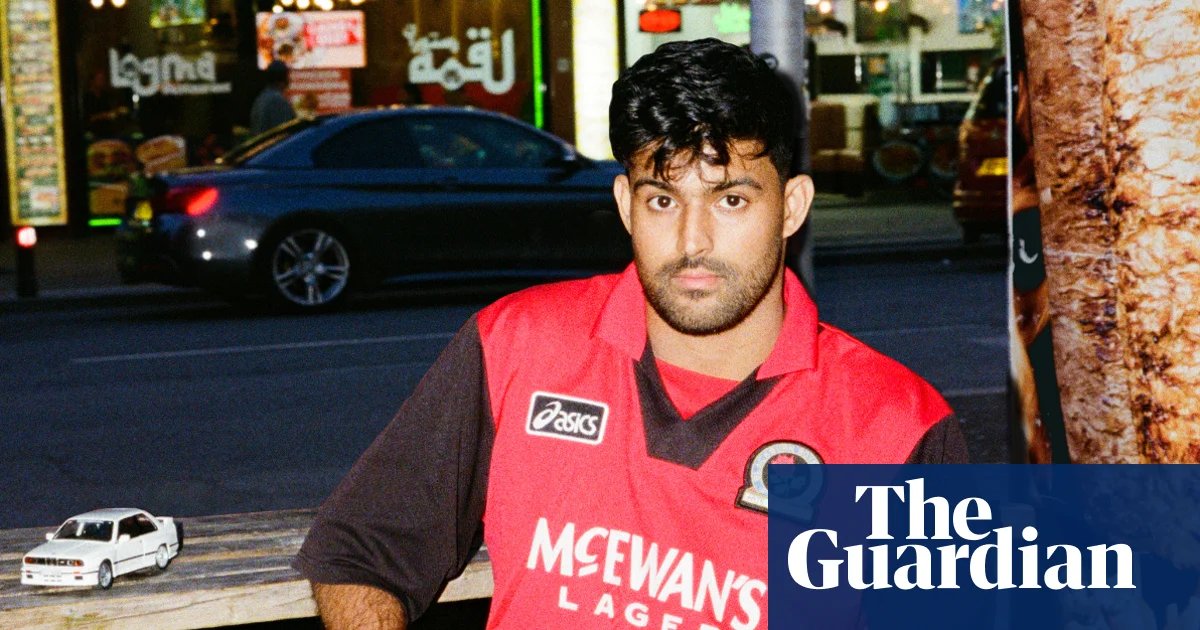
On a stretch of Manchester road known for kebabs, shisha smoke and restless energy, three young men drive towards a night that already feels like it’s slipping out of control. The premise of Wimmy Road Boyz, the debut novel by #Merky books new writers’ prize winner Sufiyaan Salam, is deceptively simple: “three boyz drive and dream of an impossible night on an endless street”. What follows is anything but.
Salam’s novel unfolds over a single evening on the Curry Mile, that dense artery of Rusholme nightlife, where a white BMW carries Immy, Khan and Haris through a series of skirmishes, side quests and emotional unravellings. It’s a book about masculinity, violence and love, but also about language – how young British men speak, perform and fail to articulate what’s really going on inside their heads.
At 28, Salam is a standard-bearer for a new generation of literary novelists. He grew up in Blackburn, a town he felt at the time was “a where dreams go to die sort of situation”, shaped by racial tensions and deep deprivation. “It’s a very racially segregated place, and the ward I grew up in had one of the highest levels of child poverty in the country,” he says. Being brown and Muslim in post-9/11 Britain, he recalls a vague but persistent sense of otherness and fear. As a teenager, he wore a backpack with flowers on it, hoping it would make him seem less threatening. But his home town also gave him “this real mosaic of human life”, a range of experiences that now feed directly into his fiction.
double quotation mark
Writing was never a thing that could be a career in the real world – you just don’t even imagine that’s a possibility
Salam studied English literature at Manchester University, but writing for a living felt out of reach. “For me, it was never a thing that could be a career in the real world,” he says. “You just don’t even imagine that’s a possibility.”
His journey to publication was in the end borne of jealousy – Salam began writing Wimmy Road Boyz after attending a friend’s book launch in 2022 and thinking: “This should be me.” A short-story version came second in the Bristol short story prize, helping him pay his rent for a month. He developed it into a novel and faced rejections from agents. But then came the #Merky books prize, which Salam won in 2024 with the first 5,000 words of the novel.
Stormzy, who founded the imprint, made a surprise appearance at the ceremony. “It’s this weird thing where you’re like, ‘man, life’s about to change now’,” Salam remembers about that day. He recalls little of his encounter with the rapper, except for one detail: “He’s way taller than me, so I look very little in the pictures,” he laughs.
The following Monday he was back at his day job, working as a script writer for a children’s TV show at the BBC in Manchester, but now with a nine month deadline to finish his novel. Around the same time, he co-wrote Magid/Zafar, a short film set in a British Pakistani takeaway, which won best British short at the British independent film awards and was Bafta-nominated earlier this year.
double quotation mark
I wanted it to feel Shakespearean on one level and a Jay-Z lyric on another. And I don’t see a contradiction between those two things
This cross-disciplinary experience is clear in Wimmy Road Boyz: part play, part poem, part rap, it features an intermission, a chorus, stage directions, passages that veer into high literary prose before snapping back into slang. Salam describes the style as a deliberate fusion: “I wanted it to feel Shakespearean on one level and then like it’s a Jay-Z lyric on another. And I don’t see a contradiction between those two things.”
His influences are wide-ranging: “It was a mixture of Trainspotting, La Haine, and Kendrick’s good kid, m.A.A.d city,” he says. He remembers reading Ulysses just before a British-Pakistani rap concert. “I still had Joyce’s prose swirling around my mind,” he says. “And I was like, ‘oh, there’s something interesting here. If the word novel means newness, then let me try and do something new with it, reinvent it.’”
Written almost entirely in lowercase – a gen Z signifier – the language is maximalist and playful, rife with hyper-niche references – esoteric internet rabbit-holes, British-Asian youth subculture. Was he concerned about alienating readers by being too specific, too culturally dense? “I realised nothing really good comes from trying to compromise or self-censor,” he says. “I don’t think when Shakespeare was writing Hamlet, he was like, ‘man, maybe I should have set this in the UK instead of Denmark’. I’ve read Philip Roth, where there’s a lot of specific American Jewish slang that I don’t really understand. But you still get what’s going on.”
The result is a novel that feels as alive – original, ambitious and chaotic – as the night it depicts. There is a sense that Manchester itself is being written into literary existence, from a young insider’s perspective. One passage describes Rusholme as “a twisted, mycelium thing … what you’d get if you let postwar industrial architecture fuck a gothic forest”.
The book also grapples with broader themes around mental health, emotional repression, male vulnerability and queerness. “I was always interested in the things you inherit from masculinity – the idea of gender as a performance, which often gets talked about with women and trans people, but less so with men,” he says.
In fact, Salam traces the novel’s origins to a night out with friends during a period of personal turmoil. “I really wanted to talk to one of the guys about it, but I just couldn’t,” he recalls. “I was thinking, I’m having fun on the surface, but if you were to open my brain now, there’s all this madness going on.” The next day, he began to wonder: what if everyone else on the night out was feeling the same thing? What if none of them could say it?
He is wary, though, of turning his characters into symbols or moral lessons. One of his guiding principles was to reject the “good immigrant” narrative – the idea that stories about minority ethnic characters must be redemptive and respectable. “There’s no point writing something like this if it isn’t going to be honest,” he says. More broadly, he wants to show that identity is only one layer among many. “These are British men who are struggling with things … and these identity markers are just textured on top of who they are.”
Salam’s thinking about identity is inseparable from his own experience of race in Britain, though. More recently, that has taken more unsettling forms, with the renewed racial tensions and far-right extremism. A few weeks before he moved to London in 2024, race riots swept across cities in the UK – an Islamic cemetery in Blackburn, where his grandfather is buried, was vandalised. Salam found out via a viral video. “It’s wild that is happening when you’re just trying to live a normal life,” he says.
The novel also sits within a wider conversation about the absence of male authors in contemporary literary fiction, and declining engagement with novels among young men. “A lot of men just don’t necessarily gravitate towards literary novels,” he says. “Maybe the last novel they ever read is The Great Gatsby in school.” At the same time, he points out, many of those same men are deeply engaged with other complex, text-driven art forms. “When the Drake and Kendrick beef was going down, so many young men were analysing those lyrics – video essays deconstructing every line – and that is basically poetry on a huge scale,” he says. “A lot of men are engaging with literary criticism … it’s just the form has maybe moved on.”
Part of his ambition with Wimmy Road Boyz is to bridge that gap, to meet young men where they are, and create a novel that feels as immediate, as dynamic, as culturally embedded, as music. “Let it be as freewheeling as a conversation with guys on a night out would be,” he says. “I wanted it to almost have the feel of a podcast episode, just without being some toxic rightwing thing.” In other words, he says: “Let it be as messy as men are.”
Wimmy Road Boyz by Sufiyaan Salam is published by #Merky. To order a copy for £14.44 go to guardianbookshop.com. Delivery charges may apply.
Source:
www.theguardian.com