






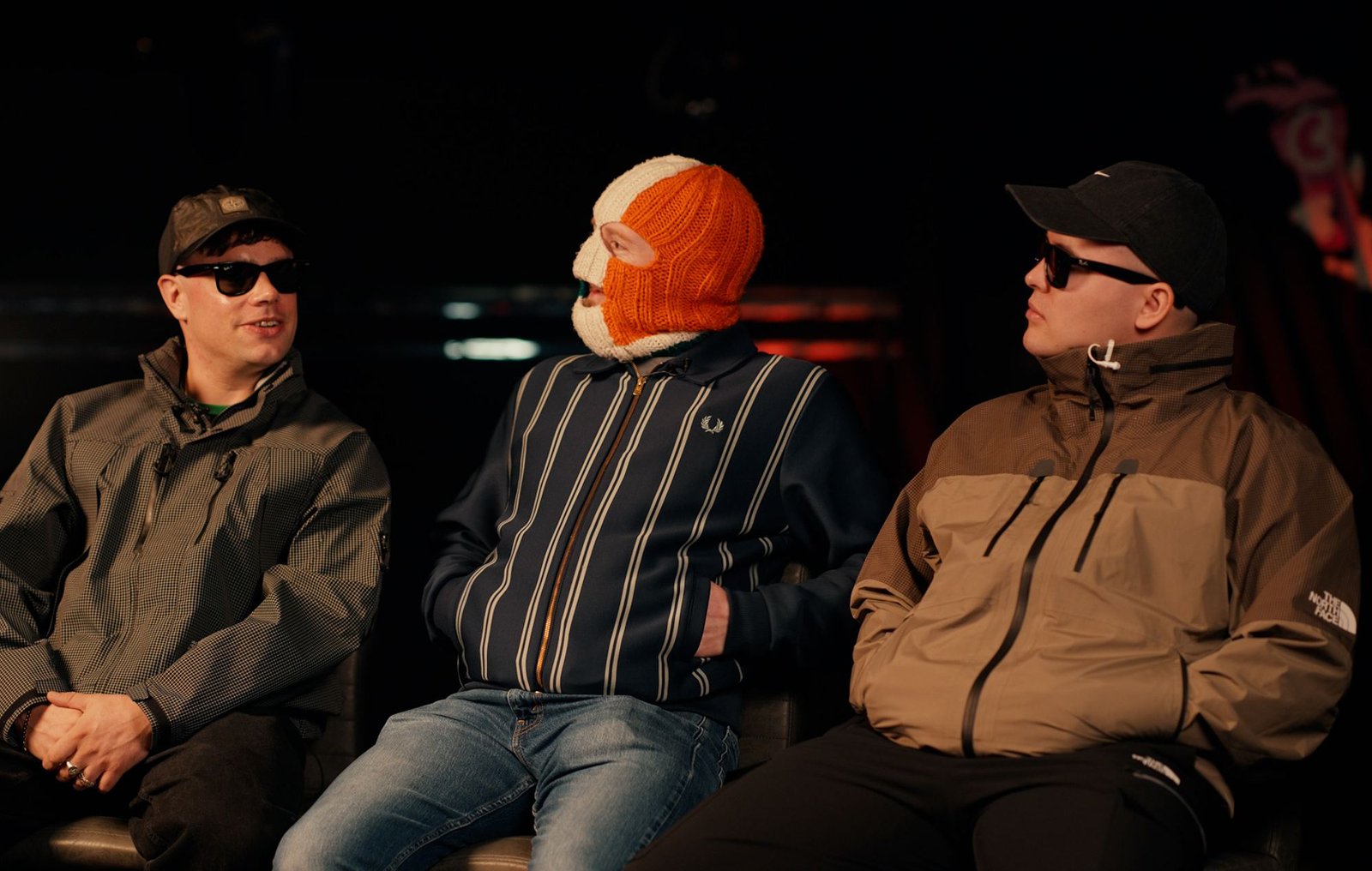
We meet Kneecap backstage at Kingston’s Circuit ahead of an intimate album launch show on St George’s Day (no reader, they do not celebrate). It’s been about a year and half since we last spoke. “A pretty uneventful few months I must say,” jokes Mo Chara, given the lifetime of headlines and controversy the Belfast rap trio have packed into that time, and the hours he spent in front of a judge for a now thrown-out terrorism charge at the hands of the UK government.
They fought the case with everything they had, and now again with their bold and ballsy new album ‘Fenian‘ – the term itself an act of defiance. “It originally came from Irish folklore,” Móglaí Bap offers. “It was a band of warriors in old Irish stories that date back 1,500 years. Then it was repurposed for several rebellions during the 18th and 19th Century, then in modern times it was used as a derogatory slur for Irish nationalists. When you call someone a ‘fenian’, you’re suggesting that they’re backwards or uncivilised. In the North or when Irish people came to London, they’d say ‘You Fenian…’.”
We assure Kneecap that swearing is acceptable on NME.
“C**t,” calmly offers the balaclava-clad DJ Próvaí. Fair enough. Now reclaiming ‘Fenian’ as a synonym for “the warrior”, Kneecap are once again showing that the most feared weapon in their arsenal is “the power of language,” as Móglaí Bap tells us, flipping how “certain language is used when you have a coloniser country and an oppressed people”.
Fresh from the hype around their stellar debut album ‘Fine Art‘ and acclaimed BAFTA-winning self-titled biopic, the band told us that they were making good progress with their sophomore record back in summer 2024, but it seems life had other plans. Their standard pro-Gaza rhetoric lead by the messaging of “Fuck Israel, Free Palestine” caught the attention of the wider world – and Sharon Osbourne – when they played Coachella 2025, causing one hell of a shit-storm and chain reaction that would lead to the terror charge from a past London gig and for the three trouble-starters to become a divisive talking point.
A whole album was scrapped, and they decamped to Streatham in London to spend two months on fresh material with “eccentric scientist” Dan Carey (Fontaines D.C., Wet Leg, Foals) to bring out “a musical complexity” to match the drama that was playing out in the headlines and the scale of attention the band were getting.
“Obviously we had the court case during all this and the Wembley Arena concert during the seven weeks we were in the studio,” recalls Móglaí Bap. “Dan was at the gig and trying to find sounds that would fill those rooms”.
“It hit that next level up as a more mature-sounding album, but still authentic to Kneecap,” Mo Chara continued. “Most artists when making an album maybe have most of it written or are able to go to the studio and lock themselves away for a few months, whereas we were getting dragged on the news to the magistrates court and had Wembley, which was a huge deal at the time. These things that should have been a hindrance on paper, it was more of an inspiration on the album.”
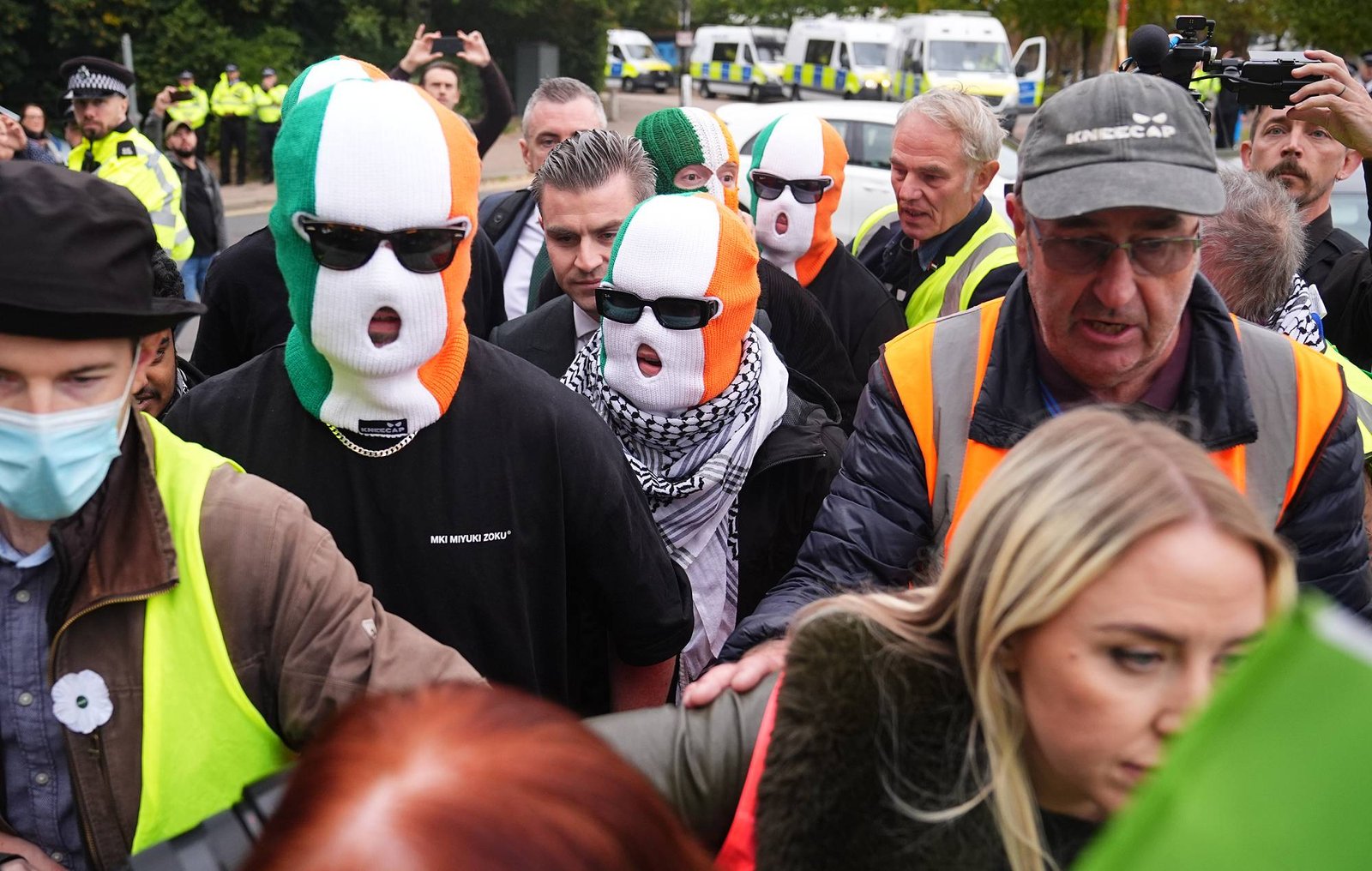
Watch our full interview with the band at the top of the page, or read on below as Kneecap open up about their battle with the government, the real issue of anti-Semitism, balancing their personal with the political on their best album yet, and who might play their pal Keir Starmer in the sequel to their movie.
NME: Hello Kneecap. The crosshairs really zoomed in on you after Coachella. How would you describe how things were going for you guys before and after that?
Mo Chara: “Things were obviously going very well. Things went well after Coachella as well. We never did anything different at Coachella – it’s the same gig we did all year. Obviously, we were in America, and there were thousands of young Americans shouting ‘Free Palestine’. The mainstream media in America have tried to hide away the Palestinian movement. There was no disguising the fact that there were young Americans in solidarity with Palestine, and that was something that the mainstream media could not handle.”
DJ Próvaí: “The people who were outside the court were the same people supporting Palestine Action. They saw censorship happening and abuses of power and went, ‘Right, if this is allowed to carry on, then who’s next?’ Not challenging those abuses of power would be a dereliction of their actions. As soon as you try to put a blockade on art and people expressing themselves, then it’s a slippery slope into fascism.”
Do you feel like the dialogue has moved on much? We just had The Strokes use their Coachella headline set to make a statement against the US government and the destruction of the last university in Gaza, and 1,000+ artists pushing to boycott Eurovision over Israel is no small thing…
Móglaí Bap: “The limitations of what bands think they can do has definitely shifted. Even at Coachella, there were other bands who spoke out for Palestine as well, but they weren’t in the news. There has been a shift because there’s more solidarity between the bands. It feels safer to put yourself out there. Before this, it was quite isolating if you spoke out for Palestine. That’s the whole reason for that: to make you feel more insecure in your job.”

As for the court case and the events that led to it: if there’s a potential would-be Kneecap fan out there who wants to be part of this but has a big question mark looming over what happened with the flag and the accusations, is there anything you’d like to say to put it in context?
Mo Chara: “We’ve spoken about this a million times and put out press statements. Let’s just say we don’t pick flags up anymore.”
And you said you don’t always know what’s going on when the lights are down?
Mo Chara: “Oh, Jesus, it’s impossible. It’s hard to even see what’s happening. A gig feels like it’s over before you know it; you fucking barely remember anything. I’m not going to get into it because we’ve talked about it already. Obviously, we won, and we expected to win. It just shows how ludicrous the whole case is. They threw millions of pounds at it, tried for an appeal and lost.
“When you take years and years of gigs and compact it into 20 seconds of a satirical band on stage… You can cut any comedian on Earth into a five-second clip, and they can look like the worst person in the world. You’ve got to put things in context. There’s never ever been an issue at a Kneecap gig, and a Kneecap member has never been convicted of any crime in any country ever, so we’ll start, surely but slowly, moving on.”
With the things you say at the gigs and the atmosphere there, combined with what’s really in the songs and the statements you put out, would you say you’re actually an anti-hate band?
Mo Chara: “Of course. We come from Belfast, we understand sectarian violence, we understand sectarianism, we understand that religious divide serves absolutely nobody. Anti-Semitism is a real issue, and it’s growing at the moment. It’s something that genuinely needs to be talked about and needs to be tackled, but what happens is when you have the Zionist lobby labelling bands and actors as anti-Semitic just because they speak out against Israel, you’re starting to water down that term. We need to be talking about that term a lot more because it’s on the rise all over the world.
“We are obviously not anti-Semitic. I think anyone with any right mind knows that. We don’t stand for any kind of hate at gigs or any kind of fascist ideologies. We’re from Belfast, we’re Irish, it’s not in our nature.”
Was it cool to be enemy of the state for a minute?
Mo Chara: “It’s [DJ Próvai’s] turn next.”
Móglaí Bap: “I think there’s a good tradition of English governments choosing Irish people as enemies, and there’s a good history there of Irish people being criminalised for crimes they never committed. So it’s pretty cool. We’re not the first Irish people to be called terrorists.”
Second albums are difficult enough as it is, but did the pressure enter your mind of all this going on and having to make a statement record that backed up your politics and the headlines?
Mo Chara: “I didn’t see it as pressure. Obviously, we do thrive in the chaos, and sometimes it’s easier to deal with things when it’s so chaotic, and you’re onto the next thing. We understood that there were a lot of eyes on this album. Second album syndrome is quite intense for a lot of bands.
“We knew if you were a Kneecap fan and had been watching what had been going on for the last year, you’d be very disappointed if there was no mention of it in the album. Of course there is, and we wouldn’t let you down.”
It’s an album that’s as political as it is personal. Let’s start with ‘An Ra’, where you thank the UK for their contributions to Irish life: “Jimmy Saville and HP Sauce, now that is a worthy cause”. That’s going to look good on a t-shirt…
Mo Chara: “We’re in enough trouble as it is.”
Móglaí Bap: “I love brown sauce, though, on sausages and stuff.”
Mo Chara: “Brown sauce and free healthcare. Other than that, that’s it. We’re keeping that.”
Mo Chara: “It was written as a piss-take about how much we’re going to miss the United Kingdom when we eventually get a United Ireland.”
Móglaí Bap: “The joke is that when colonising countries talk about ‘civilising’ other countries, like they did with Ireland or Kenya – so we’re playing with that idea that we were actually quite civilised before they got there.”
DJ Próvaí: “There’s nothing more civil than genocide.”
Mo Chara: “Jesus Christ, there’s our t-shirt. If you translate the UK into Irish, it’s ‘RA’, which looks like the ‘RA so it’s a play on words for The IRA. We’re expecting people who don’t speak Irish to become outraged, thinking it’s a song about the IRA, when we can actually explain to them that’s actually a love letter for the United Kingdom. We thought you’d like that!”
And with ‘Smugglers & Scholars’, what did you want to tell people about the real Ireland?
Mo Chara: “It’s this idea that Americans have of Ireland that it’s all poetry and clovers, and the line is that it’s actually raincoats and police Land Rovers. That’s the idea that we had of Ireland growing up in an urban setting.”
Móglaí Bap: “It’s a reply to those American movies and what their perception of Ireland is. Wild Mountain Thyme or something. The whole movie, she had dirt on her face.”
Mo Chara: “Christopher Walken is in that and doesn’t even try to do the accent. He knows how shit that film is. Irish Wish with Lindsay Lohan, did you watch that? It’s offensive.”
‘Carnival’ is banger, dealing with your trial and subsequent reaction from the government and media in a very head-on way…
Mo Chara: “The ‘carnival of distraction’ is the term that we ran with. It was unfortunate and against our will, but we became part of that. We became a cog in the wheel of that distraction. Talking about us in that court case did highlight Gaza slightly, but that time spent talking about us could have been spent doing actual journalism and talking about the actual genocide in Gaza.”
Why do you think politicians are so obsessed with artists saying things rather than the origins of what they’ve said?
Mo Chara: “It’s the same thing as why is it more controversial when a band goes on stage compared to a genocidal regime where the prime minister of that country has an arrest warrant against them? We’re not the only people calling it a genocide, the ICJ are. It’s always, ‘Do you condemn Hamas?’ They’re never asking politicians if they condemn the IDF.”
DJ Próvaí: “They’re always looking for their column inches as well and trying to latch on to anything in the news.”
Móglaí Bap: “It’s that need for sensationalism. Keir Starmer giving an interview about us playing Glastonbury to The Sun? Why would he do that? That’s weird. He gets to pretend to be outraged about something that doesn’t really have an impact or any repercussions for him, but it makes him look good. We have this dysfunctional symbiotic relationship with politicians.”
You went the mile on this album to write the song ‘Palestine’. How did you tackle the essence of capturing something so profound into a song?
Móglaí Bap: “Obviously, with everything going on, politics was going to be quite important for the album, and we thought it was quite important to have a representation from Palestine on there. We’d heard of Fawzi from Ramallah, and we connected with him. It was something we wanted to develop, to build on that connection between Belfast and Palestine.
“It’s been that way in Ireland for a long time: this international solidarity. Because we’re musicians and artists, this is a way for us to build that bridge. There’s no better people to speak about Palestine than Palestinians.”
One of the most personal songs on the album is ‘Irish Goodbye’, which is about Móglaí Bap’s mother’s depression, taking her own life, and the courage she gave you. What did it mean to you to put that into song, and what did you get out of it?
Móglaí Bap: “When someone passes away, someone close to you, it takes a long time to remember them with nice memories if they’re going through hard times. It’s been five or six years. I didn’t have a plan to make a tune about it, but somebody sent me a documentary with my ma’ in it and us as children. It was the first time I’d seen us happy in a video, and that had a profound effect on me. It helped me remember the happy times, so this song was reflecting on those. All the happy times are the boring, mundane stuff where you miss somebody, never the big moments. It’s always just walking around a park and the small things that become really big.
“It was really nice for me to go back in my memory and recreate that in my head with the song. It was a nice way to reinforce those memories.”
Your parents crop up a couple of times on the record for their activism with the language. There’s been a nearly 400 per cent rise in pupils in Irish-medium education over 25 years, and over 1million active learners on Duolingo learning the language. What does it mean to you when people talk about ‘the Kneecap effect’ with people picking up their native tongue?
Móglaí Bap: “On the opening track ‘Éire go Deo’, this is an ode to the people that gave Kneecap this opportunity, who set the framework, who started the schools and the cultural centres, the youth clubs. We just feel like Kneecap is part of the wider movement. We’re working with kids, sports teams and all this stuff. If I were 16 years old now and saw an Irish language film in the cinema, it’s very important that you feel that your culture is valued and seen in these mainstream areas.”
Before the band started, Móglaí Bap was active in promoting the Irish language through music, DJ Próvaí was a teacher, and Mo Chara was training to be a youth worker. What was it about the spirit of who you were before Kneecap, why you needed this outlet, and how much of that you still carry today?
DJ Próvaí: “Those three things you mentioned all kind of align in the language movement. When we all started out, we all loved the language. We were in our early twenties, and all found each other. Something happened in Belfast, and we were all drawn towards it. We became this big friendship group. Lots of people were leaving school and didn’t get the chance to speak the Irish language in a social setting. We found each other just at a time when we needed that in a social outlet.
“Music, partying and talking in Irish was what it all revolved around. All of those things lined up nicely.”
Mo Chara: “With the youth work and stuff, there was that need for a social space. Any kind of movement needs social spaces. People were going to school, a lot of people were leaving school with a basic grasp of Irish, and then weren’t really using it again. We were kind of creating that social setting. That’s when I started volunteering, and it was out of that ethos that Kneecap grew: that need to see the subculture represented. Once we all bumped heads, this was the natural progression to go.”
Móglaí Bap: “It was a grown collective self-esteem that Kneecap came out of – this idea that we do deserve the same rights as everyone else. Because we had these jobs as youth workers, teachers or working in events, we thought that we should have art and culture in the Irish language. That seed was planted.”

What do you want now? How do you imagine the future for Kneecap?
Móglaí Bap: “I’m happy to be making music and having the opportunity to go around the world and meet with people from different indigenous cultures. That’s such a cool thing. Not just in Ireland, but people all around the world are going towards their native, indigenous language. That’s something that we can hopefully connect more with.”
Mo Chara: “I’m just hoping that we can keep doing what we’re doing and not think too far ahead. We’ll keep reminding ourselves of how lucky we are and long may it last.”
Do you feel like the next to undermine you could be just around the corner?
Mo Chara: “I don’t know. I try not to think about these things. If it is, it’s going to be out of our hands anyway. We’ll just do what we can. As long as people listen to us and as long as long as there’s a demand there, then we’ll just continue to create.”
Móglaí Bap: “We started Kneecap with a lack of self esteem. We thought nobody would be interested in Kneecap outside of our 10 friends. Maybe something was changing and people were looking for something more authentic. Over the years our confidence grew and Kneecap is something that we’ll continue to work on and bring us to new places around the world.”
DJ Próvaí: “Hopefully new generations will take some more self esteem and take it to the next level as well.”
Móglaí Bap: “If we’re an inspiration for other bands to do a similar thing in Irish, then even better. That will be a great conclusion.”
In the very least, you’ve got some great material for Kneecap: The Movie 2.
Móglaí Bap: “And we’re going to franchise it like The Fast And The Furious, 1, 2, 3, 4, 5.”
Mo Chara: “If the money’s right.”
Who’s going to play Keir Starmer?
DJ Próvaí: “Quasimodo.”
Móglaí Bap: “Sharon Osbourne.”
‘Fenian’ by Kneecap is out now.
Source:
www.nme.com