



WASHINGTON — A new requirement for handheld counter-drone capabilities aimed at taking down small unmanned aerial systems is coming soon, a Marine official told Breaking Defense today.
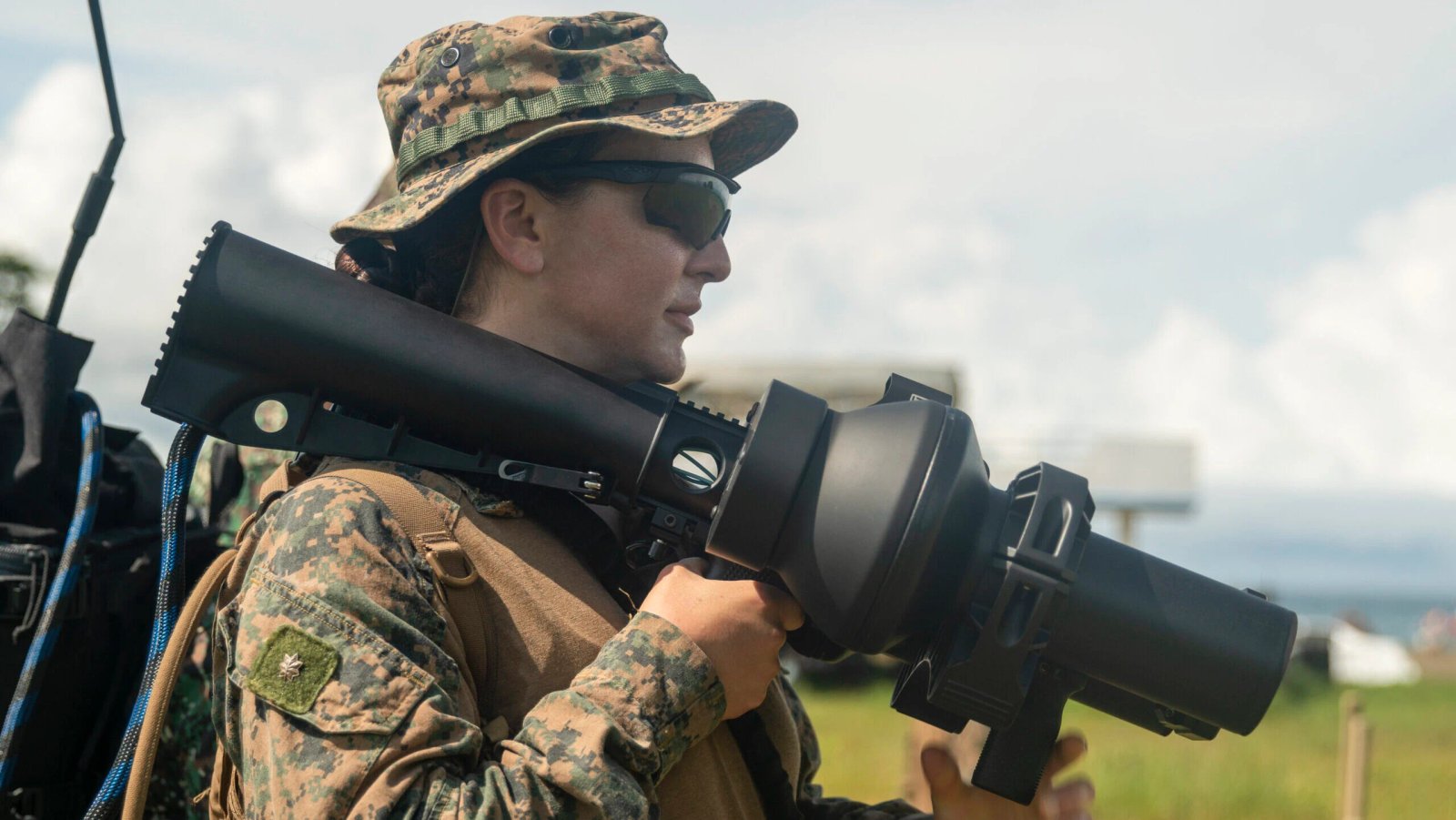
Such counter-unmanned aerial systems are lightweight tools that can be attached to a Marine’s person, Lt. Col R.M. Barclay, Marine Air Command and Control System branch head, said during a panel at the annual Modern Day Marine expo. He told an audience that these systems are currently being fielded to Marines due to an “urgent field need,” though there is not a current requirement or program of record for such systems.
However, a requirement will be coming within the “next couple of months,” he told Breaking Defense on the sidelines of the event. Currently, “the document is at the O6/O7 level,” meaning it’s being reviewed by a colonel or one-star general. (Typically such requirements have to be approved by generals with at least three stars before they’re official.)
The “wearable” cUAS tech deployed now is primarily being operated in non-kinetic ways via handheld passive sensors or jamming, Barclay said. The problem, he added, is that the systems being deployed now aren’t linked to one another, so the hope is the new requirement will mandate that such systems are all connected.
“These are disparate systems that are not integrated into each other. I think the end goal is to have all that integrated again. That connective tissue to IMD [integrated missile defense] really, really matters in the future. Our current systems that we’re buying don’t do that because we had an urgent need being filled immediately,” Barclay said.
Barclay’s comments come after Maj. Gen. Jason Morris, director of operations within the Marine’s headquarter division, said the Marines are experiencing a “shortfall” in protecting their ground fleet from drone threats. He further noted that complex systems like Lower Tier Air Missile Defense Sensors (LTAMDS) are not cutting it when protecting against small drone threats as they work best when used to shoot down larger drones like those in Groups 3-5.
“While the Force Design did field a number of systems, think [LTAMDS] into the formations, there is still a shortfall in maneuver coverage at the GCE [ground combat element] and the LCE [logistics combat element] level,” the two-star general said this morning.
He added that the service is “taking action” to field cUAS kits to the lower level formations to make sure they “tackle” the Group 1 and Group 2 threats.
“That is something that we are really doing in real time to the best of our ability,” Morris said. “We’re building the plane as we’re flying it, but we can’t wait on the standard acquisitions program timeline for things to be fielded in five to seven years, because things are changing on the battlefield so much and so quickly that we’ve got to be able to adapt, to adapt faster than that — in the weeks and months timeframe.”
Source:
breakingdefense.com