








Queen Elizabeth II, the longest serving British monarch, showed her nature as a sartorial strategist from the very beginning of her reign: At her coronation in 1953, she wore a gown featuring embroidered motifs that nodded to places throughout the British Commonwealth.
Elizabeth’s rule, which ended in 2022 when she died at 96, coincided with the ascendance of the British fashion industry. She was loyal to homegrown brands and, in 2018, her patronage was immortalized with the creation of the Queen Elizabeth II Award for British Design, a distinction since given annually to a rising British designer.
In her later decades on the throne, Elizabeth was known to favor bright, monochromatic ensembles that she accessorized with hats, brooches and a black handbag at the crook of her arm. Something of a uniform, the queen’s colorful attire seemingly reflected a philosophy that she once told a biographer: “I have to be seen to be believed.”
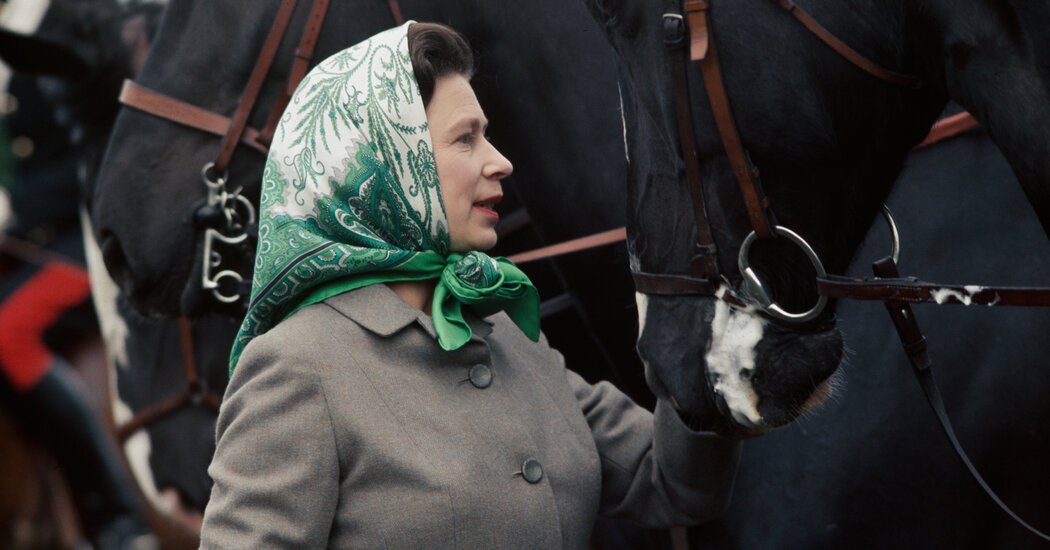
But just as indelible as Elizabeth’s rainbow attire was her selection of understated rubber boots, barn coats, head scarves and tartan skirts, items she often wore on trips to Balmoral Castle, her family’s private estate in the rural Scottish Highlands. Many of those pieces, along with others from her expansive wardrobe, are featured in a new exhibition, “Queen Elizabeth II: Her Life in Style,” that opened at Buckingham Palace in London this month, timed to coincide with what would have been Elizabeth’s 100th birthday on April 21.
Elizabeth’s casual wear typically featured neutral shades that blended in with the bucolic environments where she wore it, and it was more relaxed than the finery that she sported for public appearances. For many people, seeing how she dressed in laid-back settings held a unique allure, explained Elizabeth Holmes, the author of “HRH: So Many Thoughts on Royal Style.”
“Those choices feel less about how they play in public or for the photographers, and more representative of who that person is and what their style preferences are,” Ms. Holmes said.
The queen’s country attire also underscored her deep commitment to British fashion, said Caroline de Guitaut, the curator of the new exhibition. “It’s so British, and it’s so quintessentially the essence of some of the best clothing produced in this country,” Ms. de Guitaut said.
She added that the queen’s “off-duty” wardrobe was practical and inspired by her countryside pursuits — horseback riding, hunting and hiking. It included suede jackets from Simpson, Balmoral tartan skirts, Burberry capes, Barbour waxed jackets and Hermès handkerchief scarves (the rare item from a brand outside Britain).
The new exhibition showcases many of these garments, several of which Elizabeth routinely had repaired or altered because of frequent use, Ms. de Guitaut said. “That also goes back to the fact that she grew up during the Second World War,” she added, “where, of course, there was clothes rationing; there were shortages of things; and there was a lot of what we call the, kind of, ‘make do and mend’ philosophy.”
Elizabeth’s off-duty style has influenced designers in Britain and beyond. The English designer Richard Quinn — the first person to receive the queen’s namesake fashion award — said that her scarves were an inspiration for a coat in his spring 2018 collection. The Italian designers Miuccia Prada and Alessandro Michele have also nodded to the look: Mrs. Prada’s 2024 Balmoral collection for Miu Miu included tweed handbags and chore jackets, while a 2017 collection designed by Mr. Michele for Gucci featured tartan skirts and head scarves.
As part of the just-opened exhibition of Elizabeth’s fashion at Buckingham Palace, several British labels were tapped by its organizers to produce promotional merchandise.
It includes a Burberry trench coat with a dark green version of the brand’s signature check print, a homage to a style of tartan favored by the queen (2,190 pounds, or about $2,957); gloves made in collaboration with the leather-goods brand Dents (about $128); and tartan socks made in partnership with Corgi (about $24), a knitwear label that shares its name with Elizabeth’s preferred canine breed.
Though the queen’s casual wear incorporated luxury brands like Burberry, the fact that a person could walk into a store and buy the same boots or barn jacket owned by Elizabeth created a “personal connection to what she was wearing in a way that was accessible,” said Ms. Holmes, the author. “A lot of her other moments, especially the more glamorous ones, are not.”
Source:
www.nytimes.com