




“Today, Mary Oliver saved my life.”
This happens to be the opening line of a poem I wrote a few years back, but in Sasha Waters’ new documentary, “Mary Oliver: Saved by the Beauty of the World,” we see countless pieces of fan mail flood the screen to thank the poet for the same. Perhaps the film’s title has a double meaning: The beauty of the world saved Oliver, and Oliver’s reoffering of the world’s beauty through poetry has saved her readers, too.
Celebrities willing to gush about Oliver in Waters’ documentary include the musician Lucy Dacus, Stephen Colbert and Oprah Winfrey, who said this: “Mary Oliver’s poems are for me a balm in the storm. They speak the language of my soul.” Would anyone disagree?
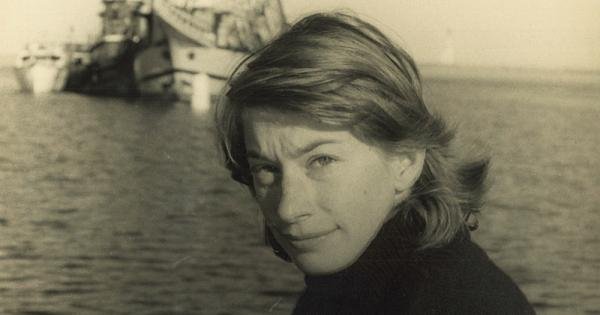
And yet the woman behind the Pulitzer Prize is something of a public mystery. Who was the poet, really? The filmmaker and actor John Waters, a close friend of Oliver’s who offers funny interludes about her throughout the film (“She was in the woods like a crazy person talking to animals!” and “She joined the church because she was after the woman preacher!”), and emphatically states that Oliver was not a healthy “earth mother.” She chain-smoked. She drank. She was a beatnik. What else?
Throughout the film, we hear marvelous readings of Oliver’s poems set over images and videos of her at various stages of life. We watch as contemporary poets offer poignant accounts of how her words affected them. We follow her from childhood in Ohio, to young adulthood in Greenwich Village, to years at the artist haven of Provincetown, Massachusetts, and all the way to balmy Florida, where she died at age 83 in 2019.
The documentary is being advertised, in part, as unearthing the enigma — a boast emboldened by never-before-seen photographs, excerpts from notebooks and personal correspondences. But while “Saved by the Beauty of the World” captivates the senses and moves the heart, it fails to meaningfully mine the deeper layers of the poet’s elusive life.
Commentators brood about Oliver’s “dark and broken” childhood; friends speak in ominous but vague tones about her second partner; in an archival interview with journalist Maria Shriver, Oliver speaks of being a victim of childhood sexual assault. This is about the extent of what we learn of her upbringing, which Oliver wanted desperately to leave behind. All the blank spaces suggest that perhaps she succeeded.
As the poet Nick Flynn put it, “I know there’s a lot more to her life than just waking up in the morning and going up for a walk. What is the storm?” This is a common critique of Oliver’s poems, but could also apply to this film as well.
The most intimate access made available to the audience is Oliver’s 40-year-long romantic partnership with the photographer Molly Malone Cook, affectionately called “M,” whom she met while living at Edna St. Vincent Millay’s home, Steepletop, in New York. The couple later moved to Provincetown, Massachusetts, the chilly, oceanside landscape that inspired so much of the poet’s work.
Oliver’s lesbian identity has mostly been left out of her public persona, so much so that many of her readers might be surprised. Oliver, the commentators tell us, was proudly out of the closet but not a gay activist. She was private about her love life not because she felt ashamed, but because she considered romance akin to a religious experience.
Oliver’s private approach to homosexuality, even during the AIDS epidemic when so many in the gay community died, led to a question probed by the film: What is the civic duty of a writer? Should Oliver have written explicitly about marginalized people? Was she “antique” in her attention to the natural world? Was her work unjust because it didn’t include overt advocacy? It’s a question writers and other public figures far less famous than Oliver face with increasing pressure today.
“I really believe in the resistance of the artist to be fully an artist,” said U.S. poet laureate Ada Limón in defense of Oliver. Later in the film, in a clip from a speech, Oliver declares, “Our enjoyment of the natural world is, in the long run, political.”
In one of her most famous poems, “The Summer Day,” which we hear read at times throughout the documentary, Oliver writes of a day spent kneeling in the grass and strolling idly through the fields. She posits: “Tell me, what else should I have done?” There’s a pluck to that question, as if she’s urging us to see attending to our surroundings as a kind of rebellion against the pressures of modernity.
“What is the meaning of life? Where can I go for solace? How do I find happiness?” asks Dacus. These are the kinds of questions readers bring to Oliver’s poems, which usually contain, if not the answers, at least a way through whatever hardship has descended. Waters’ documentary is a 90-minute visual “thank you” to Oliver, to which so many of us wholeheartedly say: “Amen.”
Source:
www.ncronline.org