









China senses opportunity when Donald Trump visits later this month. A nakedly transactional US president in need of a trade deal, and hoping that Beijing could lean on Iran, might shift on Taiwan in return. China’s foreign minister, Wang Yi, linked the issue explicitly to broader bilateral cooperation in his call with Marco Rubio, the US secretary of state, on Thursday. Beijing would be delighted to see Mr Trump soften the US position, and perhaps pull back on arms sales after a mammoth $11bn package was announced late last year.
Taiwan has been self-governed since the end of China’s civil war in 1949, so never ruled by China’s Communist party. Xi Jinping has made unification central to his legacy. Three years ago, US intelligence assessed that he had told the People’s Liberation Army to be ready for an invasion by 2027. But Beijing would surely prefer to achieve its goal without force.
Even a blockade – simulated in intensive military drills in December – would come at a hefty economic price, and could quickly escalate. China could instead seek to keep building military and economic might, and upping intimidation, until it was clear the US would not risk intervention or Taiwan felt it had no choice. Beijing hopes even a small shift in US rhetoric this month might help to make unification seem “inevitable” – in Mr Xi’s words – to Taiwan.
Analysts believe that China is highly unlikely to take a military path in the next couple of years. Some think it may see a relatively short window: another US president might be stauncher on Taiwan; the administration has pivoted away from Asia, is tied up in the Middle East and is burning through munitions; Taiwan’s surge in defence spending has yet to kick in. But Mr Trump is utterly unpredictable. Iran may show that great powers can do as they will – but also that they can regret it. And Beijing appears convinced that the US is in decline, while its own power grows. Its armed forces are currently roiled by purges at the top.
With a 2028 presidential election due in Taiwan, and the two main opposition parties joining forces for local polls this year, China also sees an improving political outlook. Any lingering belief that Taiwan’s people might actively embrace a “one country, two systems” formula was killed off by Beijing’s evisceration of Hong Kong’s freedoms. Its intimidation tactics towards Taiwan have increased suspicion; around two-thirds of the population see China as a major threat. The proportion identifying as “Taiwanese-only” has more than tripled, to 63%, since 1992. There is a generational shift. But many still see improving relations with China as the pragmatic choice.
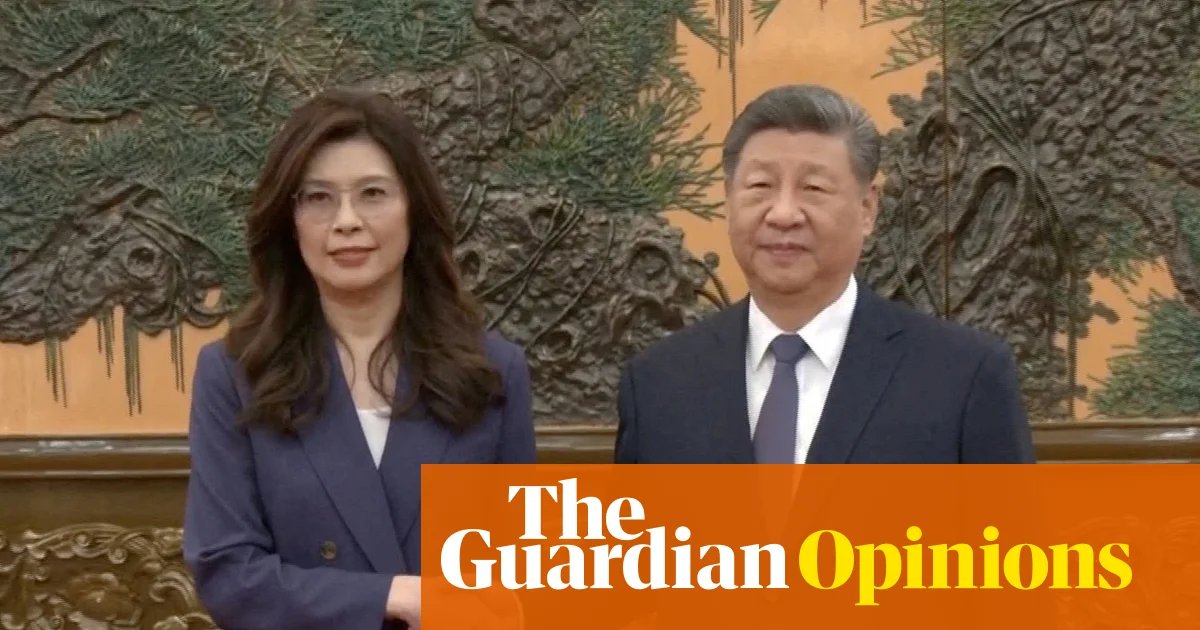
Last month, Mr Xi hosted Cheng Li-wun, leader of Taiwan’s Kuomintang opposition party, at the first such meeting in a decade. Ms Cheng’s party advocates closer ties to Beijing and has blocked a $40bn special defence budget put forward by the ruling Democratic Progressive party. Beijing proffered economic carrots – yet increasingly uses the stick. Taiwan’s president, Lai Ching-te, visited Eswatini, one of its few remaining diplomatic allies, this weekend. But the trip was previously aborted after other states revoked overflight permits.
A vibrant democracy deserves continued support. Mr Trump’s mixed messages might encourage China to believe it can unify Taiwan without military force – but could also lead to further escalatory steps by Beijing. That raises the risks of missteps or accidents, which are not in anyone’s interests. The US too would benefit from shoring up the status quo.
Source:
www.theguardian.com