




The soldiers heaved the 300-pound plastic sleds down the hallway of their headquarters building. Packed inside were the things they would need to survive when the temperature at their Alaska training area plunged to 40 below or colder.
Each sled carried a tent with enough room for 10 troops if they curled their legs. There were gasoline containers to fuel a small metal stove that would keep them warm. There were shovels to clear the snow and hammers, stakes and rope to keep their tents standing when the winds howled.
There were fire extinguishers in case the whole thing caught ablaze.
“Make room!” the soldiers screamed.
The white sleds screeched across the linoleum floor.
In Washington and other world capitals, the Arctic is cast as a new frontier for military competition, a region where rising temperatures are opening new sea lanes and creating new access to valuable rare earth minerals. Pentagon strategy papers have repeatedly called for closer cooperation with Arctic allies and the construction of new bases to ward off rivals like Russia and China. President Trump has expressed his interest in more atavistic terms, vowing to buy or, if necessary, conquer Greenland by force.
“I would like to make a deal the easy way,” Mr. Trump said earlier this year of his ambitions for the semiautonomous Danish territory. “But if we don’t do it the easy way, we’re going to do it the hard way.”
Absent from all of the strategy documents and Oval Office threats is any sense of how U.S. troops might fight in the brutal conditions.
In February, the Iran war was looming and tens of thousands of U.S. troops were gathering in the Middle East, the region that has been the Pentagon’s focus for the last 25 years. But in Alaska, the Army was preparing for a new kind of war.
The setting was the Yukon Training Center, a 400-mile expanse of snow and ice near Fairbanks and the Arctic Circle.
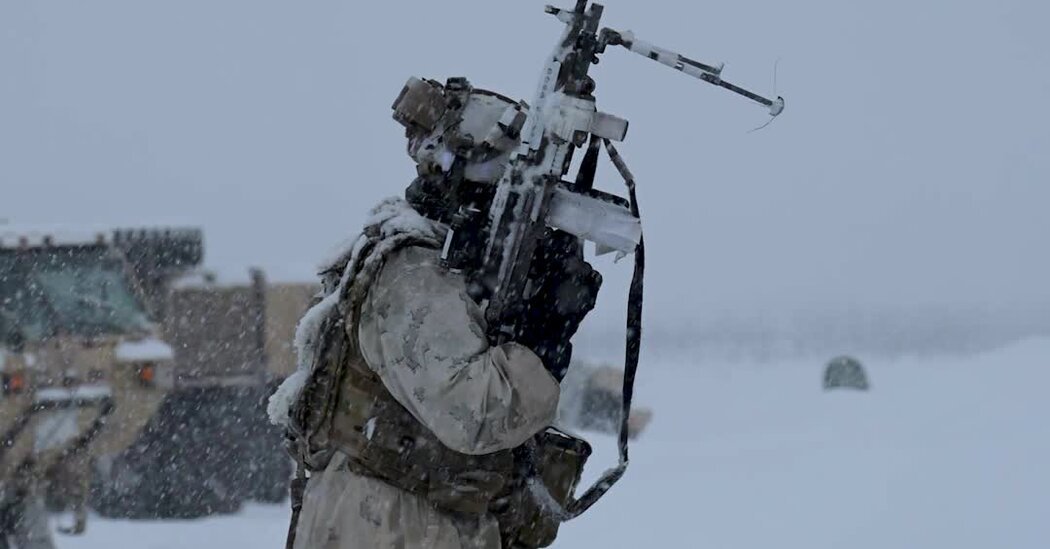
At minus 40 degrees and below, weapons fail, batteries quickly lose their charge, and fuel turns into a viscous jelly. Army officials wanted to learn how their equipment would perform in the extreme cold.
But their biggest questions were about the soldiers who came from places like Alabama, Texas, Florida and California. How far could these troops go before exhaustion set in and they started to lose focus, make mistakes or simply quit?
About 4,000 soldiers from the Army’s 11th Airborne Division, including 107 from the division’s Able Company, were taking part in the training battle, which pitted two similarly sized forces against each other.
In this fight, the ammunition was fake; blanks and lasers replaced bullets and artillery shells. But the cold was unsparingly real.
Capt. Trung Duon Vo had been in command of Able Company for almost a year, enough time to understand the dangers his soldiers faced from frostbite. The coldest nights, he knew, could take fingers and toes. If soldiers got sloppy, it could cost them their lives.
Captain Vo called the company’s leaders together inside their small headquarters building to update them on the latest intelligence on the enemy, which consisted of about 1,000 paratroopers positioned along two ridgelines.
Outside, it was a relatively balmy minus 3 degrees. A light snow was falling.
Captain Vo’s most immediate worry was the company’s movement across a frozen river into the training area and the possibility that someone might break through the ice. He stressed the importance of quickly alerting him and other leaders to “real world issues” like frostbite or hypothermia.
Heads nodded.
“The Arctic always puts a little fear into me as a leader,” Captain Vo confessed. “If you don’t do the right things, you will die.”
The troops’ eagerness to get moving mixed with dread at the prospect of 10 days in the bitter cold. A few minutes later they were streaming onto buses that would drop them off in the icy, dark wilderness.
Into the Fight
The Able Company soldiers said they often felt as if they were participants in a “big experiment.”
Some of the soldiers had volunteered to serve in Alaska, in search of adventure or because the Army had offered them a cash bonus. Others were there purely by chance; someone in the Pentagon’s vast bureaucracy needed to fill an open spot in an infantry platoon.
The troops climbed off the buses and spent the next several hours searching for their rucksacks and other equipment in the dark. The soldiers knew they were at higher risk for frostbite and other weather-related injuries when they were not moving. So, they flapped their arms and stomped their feet to keep their blood flowing.
“If you’re cold, put on your Level 7s,” a sergeant screamed, referring to their heaviest jackets.
Captain Vo expected that his company’s lead element — about two dozen troops from its first platoon — would push across the frozen river and march about three miles through knee-deep snow with their tents and equipment.
Around 2 a.m. Captain Vo’s lieutenant and first sergeant quietly approached. The 10-day exercise had barely begun and some of the troops already looked miserable. The snowfall was growing heavier.
The lieutenant and first sergeant suggested that they modify the plan and cut the first platoon’s movement that night down to one mile.
Captain Vo’s normally upbeat demeanor shifted quickly to disgust. “I’m so sick of whiny infantrymen!” he yelled.
He was a relative newcomer to Alaska and still learning how to fight and survive in the extreme cold. His uncertainty about his new environment, though, was balanced against a powerful belief in “the human capacity to endure difficult things,” he said.
As a child, he had endured six years in a Malaysian refugee camp. Hundreds of displaced Vietnamese families, including his own, were packed into a space not much larger than a football field.
A chain-link fence surrounded the facility, with armed men at every gate.
Eventually, his family was granted political asylum and a new chance at life in the Atlanta suburbs, where they opened a nail salon.
Now, he was a 35-year-old Army officer who needed to get his infantry company motivated and moving.
“It’s Day 1 and you already sound like you’re tired,” he shouted. A string of profanities followed, along with a shared understanding that the first platoon soldiers were going to march the full three miles as planned through the snow before they broke for the night and set up their tents.
By 2:24 a.m. the soldiers had strapped their snowshoes to their boots. Bent under the weight of their 60-pound rucksacks, they made their way across the frozen river and disappeared into the darkness.
They arrived at their objective as the sun was rising and started digging out a clearing in the snow to put up their tents. After about 30 minutes of shoveling in search of solid permafrost, they realized that they were digging in frozen muskeg, a deep bog common in the Alaska wilderness.
Instead of looking for a better spot, they decided to temporarily lay out their sleeping bags in the open snow. They squeezed each other’s fingertips and earlobes, a regular check to ensure that blood was still flowing through their capillaries and they were not at risk for frostbite.
They boiled water, using portable gas heaters, and poured it into plastic bottles that they stuffed into their sleeping bags for extra warmth.
After a couple of hours in their cold bags, they resumed their search for solid ground. Captain Vo arrived just as they were scraping the permafrost and staking their tents.
“You look demoralized,” he told First Lt. Jordan Lofgren, the platoon leader.
“That was an ass kick,” replied Lieutenant Lofgren, 26. “Without some rest we can’t move the way we just did.”
The platoon had about six hours before they would have to head out again.
They climbed inside their dark, cramped tents. As the heat from small metal stoves spread, the soldiers sprang back to life. They talked about the parties they were going to throw when they got back to the base and the high cost of plane tickets home. They showed affection in the macabre ways of the infantry. Specialist Zooey Adams, a 20-year-old from Texas, told Lieutenant Lofgren that she had seen him running on post and debated hitting him with her car.
“Like a light nudge or a real hit?” he asked.
“In my mind, I’m taking you out, sir,” she replied.
Soon the only sounds in the tent were snoring and the occasional rustle of a soldier rising to do a shift as fireguard.
The Endless March
Senior leaders knew that their frontline troops cared about two things more than anything else. “They want to know when they are going to get warm, and they want to know when they are going to eat their next hot meal,” said Col. Christopher Brawley, who oversaw about 2,700 troops, including Captain Vo’s Able Company.
Colonel Brawley built his strategy around this harsh reality. If he could cut off the enemy’s access to food and fuel, Colonel Brawley believed that he could rapidly break their will to fight.
The Able Company troops were part of a big force moving to cut off the enemy’s northern supply routes. A smaller force, made up of several hundred Canadian soldiers, was pushing across more than 10 miles of heavy snow and muskeg — a multiday slog — to close off the harder-to-reach southern routes.
“The Canadians have a horrifying task,” Colonel Brawley said.
But they also had some advantages. They had three times as many snowmobiles as the U.S. battalions in the Arctic. Their soldiers were accustomed to operating in the extreme cold.
As the Canadians drove south, Captain Vo and his troops trudged toward their objectives in the north.
The days blurred together. The troops longed for the moment when they would sneak up on the enemy and test their soldier skills in a simulated firefight with lasers, smoke and the loud pop of blank rounds. But the actual gun battles were few and far between.
Most days they simply marched.
The lower the temperatures fell, the louder the snow crunched under their boots. “The worst sound you can hear,” Sgt. First Class Stephen Bowers said.
When the temperature plunged below minus 30, the soldiers said they could feel a cold ache in their lungs. Exposed skin prickled and turned red in a matter of seconds. At minus 40 and below, the soldiers retreated to their tents and shifted into survival mode. Sergeants had to force their reluctant troops to keep drinking water. No one wanted to leave their tent to pee.
On Day 5, heavy snows forced a six-hour pause so that the Army could plow the roads leading into and out of the training area. It was a relatively warm morning, with temperatures hovering around 10 degrees.
A dozen of the Able Company soldiers grabbed their weapons and strapped on their skis so they could practice being pulled by a snowmobile. The tactic, known as skijoring, was supposed to help them move faster while carrying a heavy load. But many of the troops were still wobbly on the snow.
The snowmobile made a big circle, pulling five soldiers who clung to a rope. On one of the passes, Specialist Zaurion Caldwell’s M240 machine-gun barrel caught in the snow, sending him flying and taking out several soldiers behind him. Everyone was laughing and smiling.
“Anyone wanna do it one more time?” the platoon sergeant asked.
“Yeah, me!” someone yelled.
The skijoring soldiers did another loop, hitting 22 miles per hour before letting go and gliding to a gentle stop.
“The Arctic is a hell of a place,” said Sgt. John Wolf, 26, of Selma, Ala.
An hour later, the pause was lifted. And with that, Able Company returned to the endless march.
A big question that hung over the entire Arctic training exercise, now in its fifth year, was whether the U.S. Army could really fight a war this way.
One problem was the warm tents, which stood out in the extreme cold and could be easily spotted by drones carrying thermal sensors. “They glow like Christmas trees,” said Sgt. Marcus Soto-Simmons, one of the Able Company drone operators.
A few days into the training center battle, Captain Vo launched a surveillance drone and, using its thermal sensor, quickly found an enemy platoon in its tents.
He then sent out a second killer drone carrying a mock explosive. The opposition soldiers heard its whirring engine as it sped toward them at 80 miles per hour and tried to scramble out of their tents to safety. But it was too late.
The judges overseeing the exercise concluded that Captain Vo had killed most of the enemy platoon. “What would happen if drones took out a string of American tents?” Captain Vo wondered. How would the American people react? How would he?
The Army had been using the same heavy canvas tents for decades. Senior Army leaders were looking for tent fabrics that radiated less heat.
The Army was realizing it needed more Arctic vehicles, like snowmobiles or big, tracked troop carriers. The Swedish-made machines cost $1 million each, carry a dozen soldiers and can move swiftly through deep snow.
The exercise also showed the value of Arctic expertise. The Canadians had weighed every piece of equipment that they brought to Alaska and meticulously planned how far their troops would be able to move each day. “The American technique is go, go, go until you can’t anymore,” Colonel Brawley said. The Canadian approach, he concluded, was more effective.
By the ninth day of the exercise, the American and Canadian troops under Colonel Brawley’s command had cut the opposition’s supply lines. They were running low on fuel. “You have the enemy in checkmate,” one of the Army officers overseeing the exercise texted him.
For the Able Company soldiers, though, the combat never felt as real as the cold.
A handful of soldiers were forced out of the exercise by cold weather injuries, twisted knees, broken ribs or wrenched backs. But the vast majority endured and were now taking turns digging out spots for their tents. Most preferred shoveling, which got their blood pumping and warmed their bodies, to standing around.
They struggled to hammer tent stakes into the permafrost. The smell of smoke, from metal pounding metal, hung in the air.
Two hours passed before they had raised the tent.
Specialist Abdul Mare, 25, who emigrated from the Ivory Coast, threaded the Yukon stove’s metal chimney through a hole in the canvas.
“I don’t like the cold,” he said. “But, here I am.”
Everyone was moving slower than normal. Everyone’s muscles ached. In the morning, they would head home and finally escape the cold.
Source:
www.nytimes.com