






The Venice Biennale, once said it wouldn’t welcome any artists with ties to Russia’s government as long as the country waged its “grievous” war in Ukraine. But on Tuesday, Russia was back in Venice at the art world’s most important event — the country’s latest attempt to normalize its standing on the world stage.
It didn’t stick to the usual Biennale formula, though.
Typically, nations host exhibitions in their pavilions that show off works by their most exciting living artists. Yet when the doors opened on Tuesday, there weren’t any paintings or sculptures in Russia’s grand pale green building, which dates to before the Revolution.
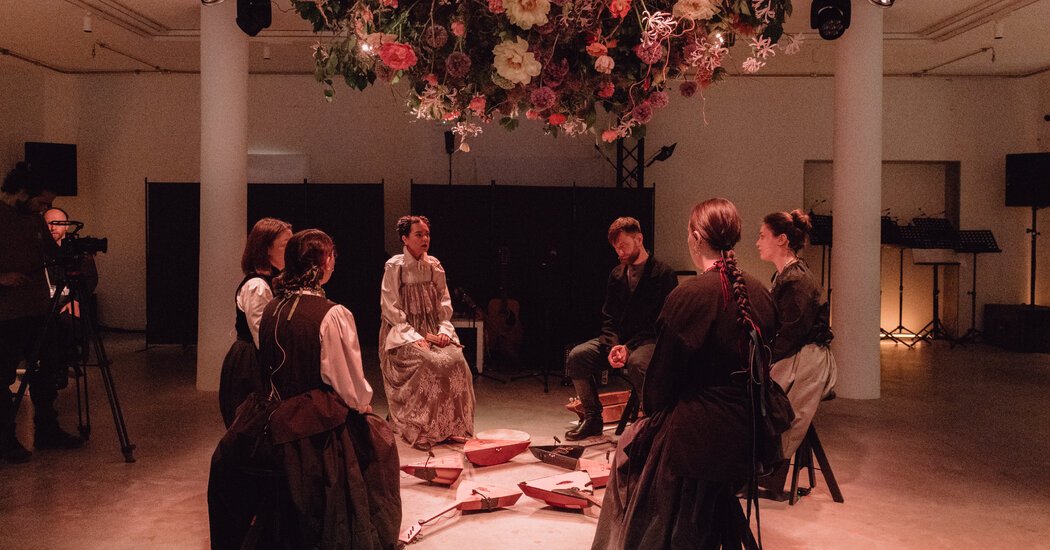
Instead, six members of the Toloka Ensemble, a folk group, sat below a bulbous flower arrangement and sang traditional songs to a cluster of reporters eager to witness the country’s controversial comeback at the Biennale, which is sometimes described as art’s version of the Olympics.
Later, D.J.s played super-fast electronic music to a handful of dancers while upstairs, white-shirted bartenders were waiting to serve free double vodka tonics to visitors who sat listening to a crackling sound installation. More audio performances are scheduled over the next few days.
There were few visitors compared with the Biennale’s more popular pavilions. And one other expected element was missing: protesters. Although activists had put up anti-Russian posters around Venice, there were no attempts to disrupt the pavilion during the first day of the press preview on Tuesday.
It may not have fit the usual Biennale script. But it was still a soft-power opportunity for Russia.
International sporting bodies have helped clear the way for the country’s return to the cultural spotlight: At this year’s Winter Paralympics in Italy, Russian athletes competed under their nation’s flag; and FIFA, global soccer’s governing body, is considering allowing Russia to compete again in events like the World Cup.
But Russia’s return to Venice has caused outrage in Italy and across Europe since it appeared unexpectedly on the list of participating nations in March. The European authorities threatened to withhold funding of 2 million euros, or $2.3 million, if the Biennale did not cancel Russia’s participation, and Italy’s culture ministry sent inspectors to the Biennale’s offices to assess whether the organization had violated European sanctions by allowing Russia’s participation.
The Biennale’s prize jury also said last month that it would not consider giving awards to artists from countries whose leaders were being investigated by the International Criminal Court, including Russia. The jury then resigned last week amid blowback over that decision, although the furor focused more on the fact that the jury was excluding Israeli artists.
A Biennale spokeswoman, who declined an interview request for this article, said in a statement that the event had followed all necessary laws, and Pietrangelo Buttafuoco, the president of the organization that runs the Biennale, told the Italian newspaper La Repubblica that he was happy with Russia’s involvement. “You must bring together peoples who are at war with each other,” he said.
Many Ukrainians and Russian dissidents staunchly disagree. Zhanna Kadyrova, Ukraine’s representative at this year’s event, said it was easy for Biennale officials to say that Russia deserved a comeback when Italians did not face daily threats of drone strikes as she did in Kyiv.
In Venice on Tuesday, Kadyrova opened her own show, “Security Guarantees,” a title that she said referred to international promises made 30 years ago to protect Ukraine in exchange for it giving up its nuclear weapons.
The show includes an 8-foot-tall statue of an origami deer that Kadyrova originally made in 2019 for a public park in eastern Ukraine, but which was removed after Russia invaded the region. In Venice, the statue is hanging from a crane near the Biennale’s entrance, about 50 yards from Russia’s pavilion.
Given the pushback, the Russian pavilion’s exhibition is open to visitors only during the preview days, from Tuesday through Friday of this week. When the public arrives from Saturday, the pavilion will be closed, but visitors can watch videos of the musicians’ performances on screens outside.
Anastasia Karneeva, the pavilion’s commissioner, published a video on Instagram on Monday saying that she would “very much like art to be the only voice” in Venice. Closing pavilions shuts off dialogue and means “nothing can grow,” added Karneeva, who runs the exhibitions company Smart Art, which she founded with Ekaterina Vinokurova, a daughter of Russia’s foreign minister, Sergey V. Lavrov.
Russia’s exhibition is titled “The Tree Is Rooted in the Sky,” and the official list of 38 participants includes Phurpa, a Russian group that specializes in Tibetan throat singing; members of an electronic music collective called the Moscow Noise Factory; and as the Toloka Ensemble, the folk group, whose recent YouTube videos include a farewell ceremony for one of its members who was conscripted into the Russian Army.
It is also scheduled to feature performances from musicians from outside Russia, all of whom make pounding club music. They include D.J. Diaki from Mali, and Jaijiu, an Argentine artist whose real name is Elias Musiak.
Musiak, 33, said in an Instagram message that the Russian team had invited him to perform a set mixing experimental electronics with traditional Argentine music. He said it was “important to keep the focus on the role of art and dialogue, even (and especially) in difficult times.”
He added that the international art circuit was engaging in a “selective moral outrage” by calling for boycotts on Russian artists but not on those from “Western nations involved in devastating conflicts.”
Some of the musicians in Russia’s pavilion on Tuesday said they were there for the performance opportunities rather than political reasons. Tatiana Khalbaeva, a sound artist who has an installation in the pavilion’s top floor, said she was just “glad to be a part of such an amazing project.”
Her installation included sound and video recordings made during a visit to her parents’ home region, Buryatia, in eastern Russia, including the sound of a man ice fishing. Khalbaeva, who declined to answer any questions that weren’t about her music, said she was “trying to connect” with her ancestral homeland.
The peaceful scene at the pavilion may not last. This week, protests are planned over Russia’s participation, including by Pussy Riot, the dissident Russian punk band and performance art group.
Katia Margolis, a dissident Russian artist who lives in Venice and has helped organize the protests, said that she found Russia’s pavilion “offensive to art and artists.” She said that the Biennale, by allowing Russia’s presence, was trying to act like the United Nations — and sacrificing its ethics in the process.
Kadyrova, the Ukrainian artist, said she wouldn’t be taking part in the protests. She didn’t want to give Russia any more attention, she said. Instead, she added, she wanted the focus to be on her own project and, more important, on what is happening in Ukraine.
Source:
www.nytimes.com