








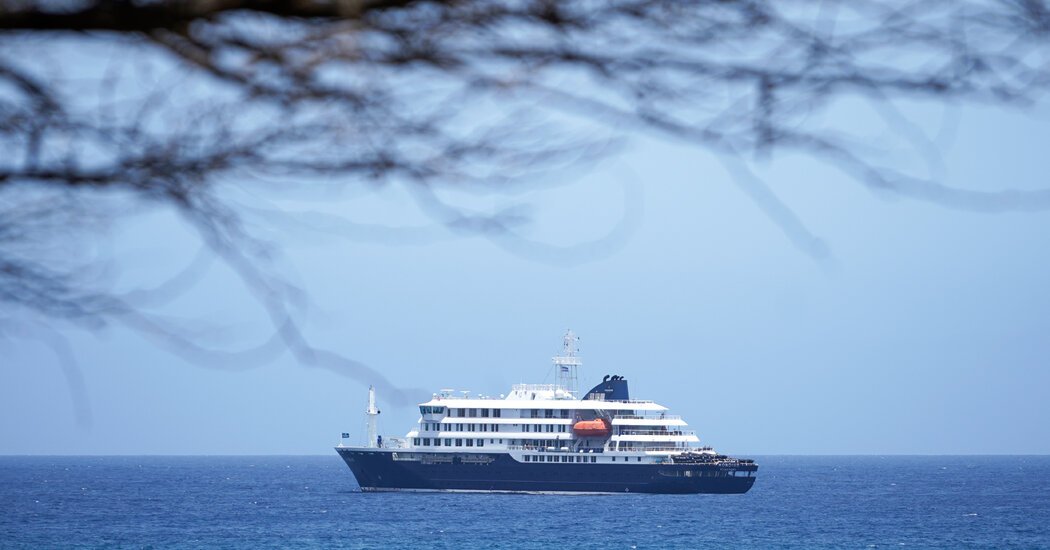
A cruise ship struck by a deadly outbreak of hantavirus is expected to sail to the Canary Islands, the World Health Organization said on Tuesday, though the Spanish authorities noted that a team of disease experts would investigate the vessel before any decision on the ship’s destination was made.
The W.H.O. also said on Tuesday that some of those who had fallen ill may have been infected through human-to-human transmission, cautioning nonetheless that the vessel still needed to undergo a full investigation and that human-to-human transmission remained rare.
“The risk to the general public is low,” Dr. Maria Van Kerkhove, the W.H.O.’s head of epidemic and pandemic preparedness and prevention, said at a news conference in Geneva.
“This is not a virus that spreads like flu or like Covid,” she added. “It’s quite different.”
The ship, the Dutch-flagged MV Hondius, has been moored off the coast of Cape Verde, an archipelago in the Atlantic Ocean off West Africa, in recent days as government and health authorities scramble to find a way to evacuate sick people onboard. The outbreak of hantavirus, a rare pathogen, has been tied to seven people on the ship so far, according to the W.H.O., with two confirmed cases and five suspected ones. Three people have died.
“We do know that some of the cases had very close contact with each other and certainly human-to-human transmission can’t be ruled out,” Dr. Van Kerkhove told reporters. Two of the victims, a Dutch couple, had been traveling in South America before boarding the ship and were sharing a cabin, she noted.
Hantavirus is primarily transmitted to humans by inhaling particles of mouse feces or urine, according to the Centers for Disease Control and Prevention.
Dr. Van Kerkhove said at the news conference that the ship would head to the Canary Islands, a Spanish territory that is about 1,000 miles northeast of Cape Verde. But the Spanish Health Ministry said on Tuesday that it had not yet decided “which port of call is most appropriate.” The ministry said on social media that the decision would be based on “the epidemiological data collected from the ship during its stop in Cape Verde.”
The MV Hondius departed from Argentina in early April with about 150 passengers and crew members. Officials from Cape Verde did not allow passengers to disembark, Oceanwide Expeditions, the vessel’s operator, said in a statement on Monday.
“The atmosphere on board MV Hondius remains calm, with passengers generally composed,” Oceanwide said in its statement.
The W.H.O. said that medical teams from Cape Verde had boarded the ship and recommended that all passengers remain in their cabins.
The first fatality was a 70-year-old Dutch man who died onboard the ship on April 11. The man’s 69-year-old wife became ill and died on April 26 in Johannesburg, South Africa, while attempting to fly home to the Netherlands. The W.H.O. said that it was working to trace other passengers on a flight the woman took from St. Helena, an island in the Atlantic Ocean, to Johannesburg.
A third person, a German national, died on the ship on Saturday, and the ship’s operators said that they were working to evacuate an individual “associated with” that victim.
For now, investigators are assuming that the cases involve the so-called Andes species of the virus, which has been known to cause some human-to-human transmission in close contact, Dr. Van Kerkhove said. Epidemiologists in South Africa and Senegal were working to identify the remaining cases, she said.
Two patients still onboard the ship were being prepared for evacuation, Dr. Van Kerkhove added. A third person onboard who was suspected of having contracted the infection, she said, was “doing well and is asymptomatic.” A British citizen fell ill during the voyage between St. Helena and Ascension Island and is in intensive care in Johannesburg, though Dr. Van Kerkhove said on Tuesday that he was improving.
Hantavirus refers to a family of viruses that are carried by rodents. Hantavirus pulmonary syndrome, the illness caused by the virus, can cause flulike symptoms and is fatal in nearly four in 10 people.
With symptoms appearing up to eight weeks after initial exposure, health officials are still trying to identify the initial source of the cruise ship infection.
The MV Hondius departed from Ushuaia, Argentina, on April 1, making stops in “remote and ecologically diverse” regions such as mainland Antarctica, South Georgia, Nightingale Island, Tristan da Cunha, St. Helena and Ascension Island, according to the W.H.O.
“The extent of passenger contact with local wildlife during the voyage or prior to boarding in Ushuaia remains undetermined,” the W.H.O. said.
Jake Rosmarin, a travel influencer who is onboard the MV Hondius, said in a social media post on Monday that the uncertainty on the ship was weighing heavily on him.
“What’s happening right now is very real for all of us here,” he said in a tearful video. “All we want right now is to feel safe, to have clarity and to get home.”
Carlos Barragán contributed reporting from Madrid.
Source:
www.nytimes.com