






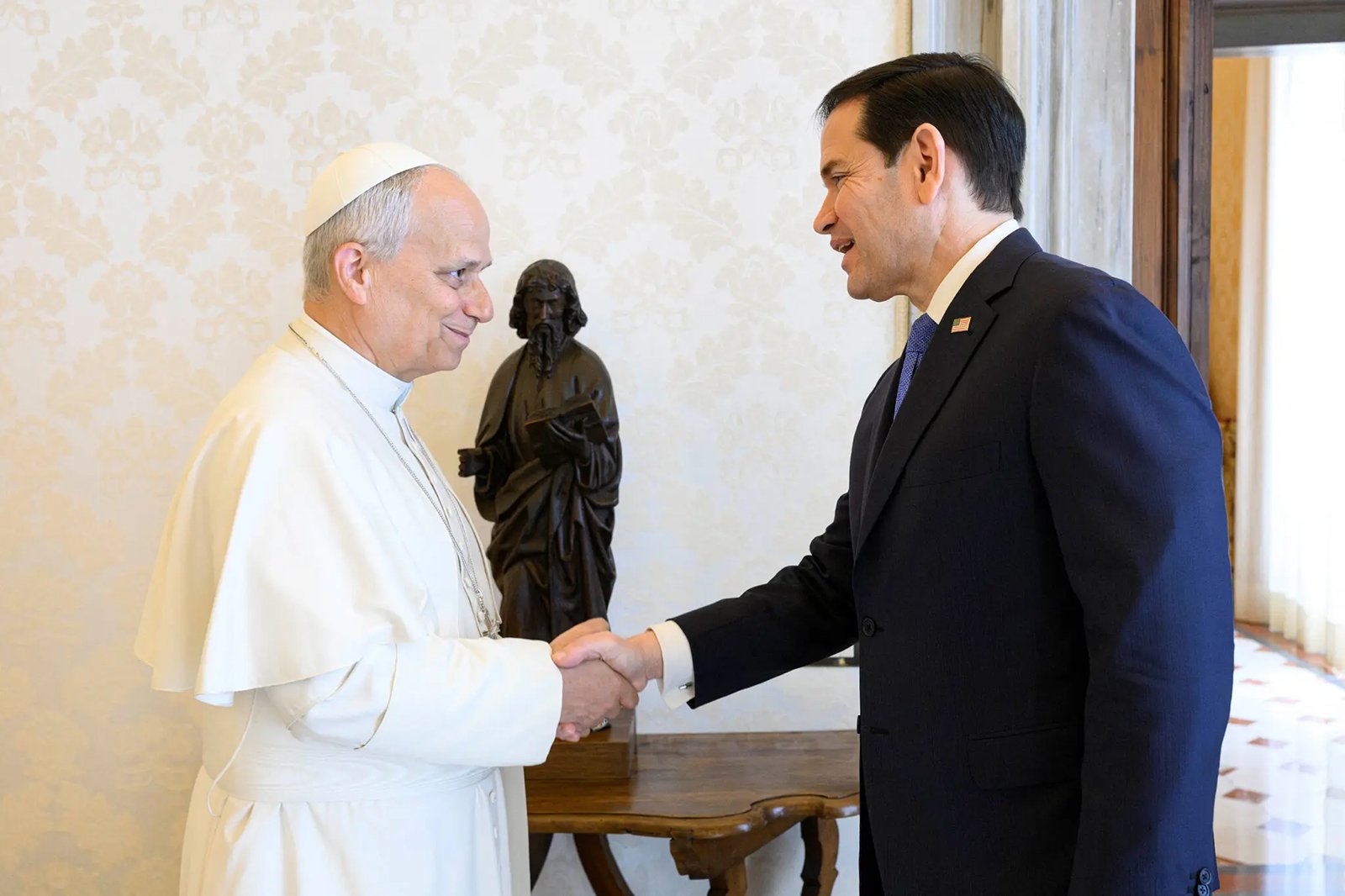
MILAN, Italy (RNS) – Amid a growing public rift between Pope Leo XIV and President Donald Trump — arguably the two most influential American-born figures in the world — Secretary of State Marco Rubio visited the Vatican on Thursday seeking to highlight common ground between the Holy See and the Trump administration.
Rubio’s meeting with Vatican officials lasted roughly two and a half hours and focused on “the strong relationship between the United States and the Holy See and their shared commitment to promoting peace and human dignity,” read a statement by the U.S. embassy to the Holy See on X.
Met with @Pontifex to underscore our shared commitment to promoting peace and human dignity. pic.twitter.com/BIZ9SfW5nY
— Secretary Marco Rubio (@SecRubio) May 7, 2026
Rubio also met with his Vatican counterpart, Cardinal Pietro Parolin, and “reviewed ongoing humanitarian efforts in the Western Hemisphere and efforts to achieve a durable peace in the Middle East,” as well as the U.S. and Holy See partnership in “advancing religious freedom,” according to the spokesperson for the U.S. Department of State, Tommy Pigott.
But the timing of the visit led some Vatican observers to interpret it as an effort to cool tensions after weeks of increasingly sharp exchanges between Leo and Trump.
In April, Trump accused Leo in a lengthy social media post of being “weak on crime” following the pope’s continued appeals for peace and nuclear disarmament. Speaking on “The Hugh Hewitt Show” on May 4, the president accused Leo of being sympathetic to Iran obtaining nuclear weapons.
“I think he’s endangering a lot of Catholics and a lot of people,” he said.
The first major rift between Leo and the Trump administration came in October of last year, when the pope criticized “inhumane” treatment of migrants. During the Easter season this year, the pope underlined the importance of peace as the U.S.-Israeli conflict escalated with Iran and he decried Trump’s threat to eradicate Iranian civilization as “truly unacceptable.”
In response to Trump’s April social media post, Leo replied that “the mission of the church is to proclaim the gospel, to preach peace.”
“If someone wants to criticize me for proclaiming the gospel, let them do so truthfully. For years, the church has spoken out against all nuclear weapons, so there is no doubt on that point,” he added.
The visit by Rubio, a son of immigrants and the most prominent Catholic in the Trump cabinet after Vice President JD Vance, could be seen as an effort to “reverse” the negative trajectory, according to an analysis by Jesuit Rev. Antonio Spadaro, undersecretary at the Vatican Dicastery for Culture and Education and a keen observer of U.S.-Vatican affairs.
The meeting is an attempt “to return the confrontation to a quieter, more institutional register,” Spadaro wrote in an anlysis on May 5. “Diplomats have a term for this kind of work: cooling the rhetoric. It is the necessary precondition for any substantive realignment, whenever that might come,” he added.
Rubio denied the meeting was meant to smooth over relations in a press conference on May 5 at the White House. “It’s a trip we had planned from before,” he said, while aknowledging that “obviously, we had some stuff that happened.”
The U.S. secretary of state also defended Trump’s criticism of the pontiff, stating that “Iran can’t have a nuclear weapon because they would use it against places that have a lot of Catholics, including Christians and others for that matter.”
While in the past, Rubio seemed to downplay the political significance of the pope, his remarks at Tuesday’s press conference recognized Leo as “also the head of a nation-state.”
There is “a lot to talk about with the Vatican,” he said, underlining their shared concerns about religious freedom. “It’s an organization that has a presence in over 100-something countries around the world, and we engage with the Vatican quite a bit because they’re present in many different places.”
In Cuba, where his parents were born, Rubio noted the church’s role is essential to deliver humanitarian aid.
But it’s not only abroad that the Catholic Church has strategic relevance for the Trump administration, according to Spadaro.
“American Catholicism is politically significant,” he wrote.
While a majority of Catholic voters supported Trump in the 2024 elections, a recent poll shows a dip in support amid the U.S. war with Iran. A Washington Post-ABC News-Ipsos poll published May 6, found that 61% of American Catholics had a negative reaction to Trump’s criticism of the pontiff.
“The United States cannot afford to be against the pope and the Vatican — a compromise is necessary,” said Cardinal Gerhard Ludwig Muller, former head of the Vatican’s doctrinal department, in an interview with the Italian daily “Il Corriere della Sera.”
“It’s also a matter of prudence,” he added. “There are over 50 million Catholics in the USA who surely did not like the attacks against the pope. Politicians must be more diplomatic, more reasonable.”
The U.S. bishops have also criticized the Trump administration’s policies on Iran and migration. Many religious charitable organizations in the U.S. have seen their federal funding cut as the Trump administration rolled back support for organizations aiding and allocating migrants last year.
Leo met with Catholic Charities USA, a network of 169 charitable organizations serving more than 16 million people in the U.S. each year, on May 4 at the Vatican. On that occasion he thanked them for their work, but also recognized the hardships they face on “both the personal and the institutional levels.”
“These include finding sufficient resources, demonstrating to others that this type of service is an integral part of authentic Christian living, and not giving way to discouragement, particularly when we meet those whom we cannot help in the way that we would like,” he said.
Rubio’s outreach comes as major American Catholic institutions appear eager to align themselves with the new pontiff despite tensions with the White House.
On May 2, Leo met with a delegation of the Papal Foundation, a U.S. based charitable organization founded by Pope John Paul II. The organization, which had clashed with Pope Francis over funding for a scandal-ridden Catholic hospital, displayed significant support for the newly elected pontiff.
The foundation announced a $15 million grant for a record-breaking 144 projects in 75 countries. It also saw the addition of 25 new families to the foundation, who have promised to donate $1 million to the pope’s charitable works since Leo’s election.
“The bottom line is this: Washington has not come to Rome to convert the pope. It has come to acknowledge — implicitly but legibly — that his voice carries weight in the world that cannot simply be dismissed,” Spadaro wrote.
Source:
religionnews.com