




After days of discussions, info sharing and strategizing among nearly 60 nations on ways to wean the world from fossil fuels, Catholics who attended the first-of-its-kind summit in Colombia left encouraged by the promise the conversations represented.
Even if they were, as advertised, a first step.
“Church advocacy does not end here: it begins here,” Panamanian Archbishop José Domingo Ulloa Mendieta, a top official with the Latin American and Caribbean Episcopal Council (CELAM), said at a press briefing at the midway point of the first Conference on Transitioning Away from Fossil Fuels, held in Santa Marta, Colombia, from April 24-29.
More than 40 Catholics and two-dozen church organizations, alongside other religious and multifaith groups, lent their voices and support for the conversation in Santa Marta — shifting from coal, oil and gas to clean energy sources — that has proved elusive within the United Nations climate change conferences for three decades. While countries have committed to deep reductions in greenhouse gas emissions to limit the impacts of climate change, they have largely resisted setting requirements to stop emissions from the primary source driving global warming: burning the fossil fuels that power economies and development worldwide.
“The sheer fact of the meeting felt like a long-overdue exhalation,” said Yeb Saño, board director for the Laudato Si’ Movement and the former chief climate negotiator for the Philippines at the U.N. climate conferences.
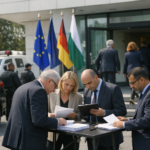
Convened by Colombia and the Netherlands, 57 countries including the Holy See met in Santa Marta, a historical coal port on the Caribbean Sea. Dubbed a “coalition of the willing” and representing one-third of global GDP, delegates from oil-producing and consuming countries, as well as those on the front line of climate impacts, met for two days of high-level talks on how to realistically, responsibly yet rapidly implement such a massive, global shift in energy sources.
The cohost countries said in a concluding statement the aim of the conference was not to develop new targets but to strategize how to move on plans already in place under climate pacts like the Paris Agreement. They focused on reducing economic dependence on fossil fuels, transforming energy supply and demand and advancing international cooperation.
“Transitioning away from fossil fuels is more than replacing one energy source with another,” Colombian and Dutch officials wrote in the statement. “It requires broad economic transformation to overcome structural dependencies, overcome debt constraints, expand reliable energy access, and support diversified, resilient economies,” all with coordination with workers and other affected communities.
“Above all, however, it is clear that decarbonizing our economic, trade and energy systems is the best path towards equitable, stable and resilient societies,” the host countries wrote.
Countries in Santa Marta launched a scientific advisory panel to support the development of national roadmaps to phase out fossil fuels in line with the Paris accord’s goal to limit global warming to 1.5 degrees Celsius (2.7 degrees Fahrenheit). They also created working groups to assist with the roadmaps and to address the financial and socioeconomic constraints holding back the energy transition.
The conference’s final statement noted the transition is partly under way, as renewables, whose costs continue to fall and are increasingly cheaper than fossil fuels, power nearly all new energy demand, according to the International Energy Agency. Additionally, global investments in the energy transition reached a record $2.4 trillion in 2024, more than double financing in 2019.
Still, fossil fuels account for more than 75% of global greenhouse gas emissions, and production by 2030 is set to more than double levels aligned with the 1.5 C goal, despite scientific studies repeatedly concluding rapid and substantial reductions in the use of coal, oil and gas are necessary to avert the worst impacts of climate change, such as more extreme storms, droughts, heatwaves and flooding that threaten life for humans and other species. Under current trends, average global temperatures are set to eclipse 1.5 C within the next decade.
Countries that gathered in Santa Marta plan to assess progress next year at a second conference on the Pacific island-nation of Tuvalu, with pre-meetings held in Ireland. They will also share their report with U.N. officials and work with ongoing efforts there on a global roadmap toward a fossil fuel phaseout.
The high-level meetings were complemented in the preceding days by meetings of civil society groups, Indigenous peoples, workers, scientists, academics and the faith community. Catholic officials took part in dialogues with other faiths and the broader civil society. They also celebrated Mass at the Cathedral Basilica of Santa Marta.
A global challenge like phasing out fossil fuels can only be solved through global solutions, Ulloa said.
“We are aware that a just transition cannot be built based on the logic of each nation and church acting on its own,” the archbishop of Panama City said in Spanish at the April 27 press conference. “We need genuine multilateralism, cooperation and collaboration among countries willing to jointly undertake the transformations that this historic moment demands.”
Ahead of the Santa Marta conference, the three continental bishops’ conferences representing more than 820 million Catholics across the Global South issued a joint manifesto in which they repeated past support for a full phaseout of fossil fuels, and explicitly endorsed a potential treaty as “a moral and political imperative.”
The proposed treaty, modeled after past accords on landmines and nuclear arms, was not the main focus of the Santa Marta conference. The 18 countries, including Colombia, which so far have endorsed the treaty effort called for the gathering to formally recognize the need for a new international instrument on fossil fuels.
Saño said that while the diplomatic dialogue in Colombia was positive, ultimately voluntary roadmaps on phasing out fossil fuels must lead to a treaty.
“The global community needs a legally binding mechanism that immediately ceases new exploration and enforces an equitable decline, rather than relying solely on the ad hoc goodwill of ‘front-runner’ nations,” he told EarthBeat.
In the Global South bishops’ manifesto — just the second-ever joint document the three continental conferences have issued, both on the topic of climate change — they put forward technical proposals informed by Catholic teachings for a just energy transition. Among them, swapping developing countries’ debt for financing for climate projects (an approach endorsed by the Vatican). The conferences have previously pledged to create a moral watchdog body to assure marginalized voices in decision-making and commit their churches to advocacy and education during an ecumenical decade of action for climate justice.
Catholics present in Santa Marta noted how the clarity and vocabulary countries conveyed in their talks reflected Pope Francis’ words in his 2015 encyclical “Laudato Si’, on Care for Our Common Home” and 2023 apostolic exhortation Laudate Deum on the climate crisis. In Laudate Deum, Francis observed the shift from fossil fuels to clean energy “is not progressing at the necessary speed.”
“Working toward a transition beyond fossil fuels is not, therefore, an ideological choice, but a demand of our faith,” Ulloa said in his homily at the April 26 Mass.
Gina Castillo, an official with Catholic Relief Services who represented Caritas Internationalis at the conference, said it’s essential for this new coalition of “front-runner” countries in the next year to move forward with national energy transition plans and in proposing actions to overcome financial and legal barriers impeding a swifter shift.
“Many Global South countries don’t have the fiscal space to invest in the transition. So debt cancellation, debt relief are important and the costs of borrowing all have to be considered,” she said.
That nations openly discussed these and other aspects of a fossil fuel transition was a welcome, hopeful change of course, said Catholics in Santa Marta.
Madeleine Alisa Wörner, an adviser on international climate and energy policy for Misereor, the German bishops’ development organization, was one of four church officials in the room as the final plenary drew to a close.
“We were crying when we heard the result, because this is such a dilemma that at the [U.N. climate conferences], despite 30 years of work, it was not possible to advance on the fossil fuel phaseout although fossil fuels are the main reason why we are in the climate crisis at the moment.
“So a really big moment, historic moment, and I am so glad that I could be part of it.”
Source:
www.ncronline.org