
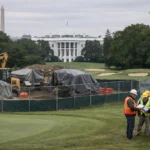







A federal judge has ordered a two-week delay on work connected to Donald Trump’s planned redevelopment of a historic public golf course in Washington, putting the project on hold while the court reviews the matter. The order, issued Saturday, applies to any work at the course, which sits not far from the White House. The decision is temporary, but it immediately freezes activity at a visible public site where fencing had already appeared.
The course is part of East Potomac Park, a well-known recreational area in the capital with long-standing public use. The park is overseen by the National Park Service, which manages major parkland and monuments across the city. Its location gives the dispute significance beyond golf: redevelopment in this area touches on public access, historic urban space and the management of federal land in the heart of Washington.
The two-week pause does not resolve the future of the redevelopment. It preserves the current situation while legal issues connected to the project continue to be considered. For residents and visitors, the immediate effect is straightforward: no work may move forward during the period set by the judge. For the project’s backers, the order creates a short but meaningful interruption at an early stage, when physical preparations can shape the direction and pace of a redevelopment.
Public golf courses in major cities often carry a dual role, serving both as sports facilities and as open recreational landscapes. That role is especially sensitive in Washington, where parkland is frequently tied to questions of preservation, access and federal oversight. Any proposed change to such a site can draw close scrutiny because the land is not merely a private venue; it forms part of the capital’s civic environment.
The court’s order now sets a limited timetable. Once the two-week delay expires or is revisited, the next steps will depend on further judicial action and the handling of the redevelopment process. Until then, the historic course remains in a holding pattern, with the dispute highlighting the tension between redevelopment plans and the stewardship of public spaces in one of the country’s most closely watched urban landscapes.