





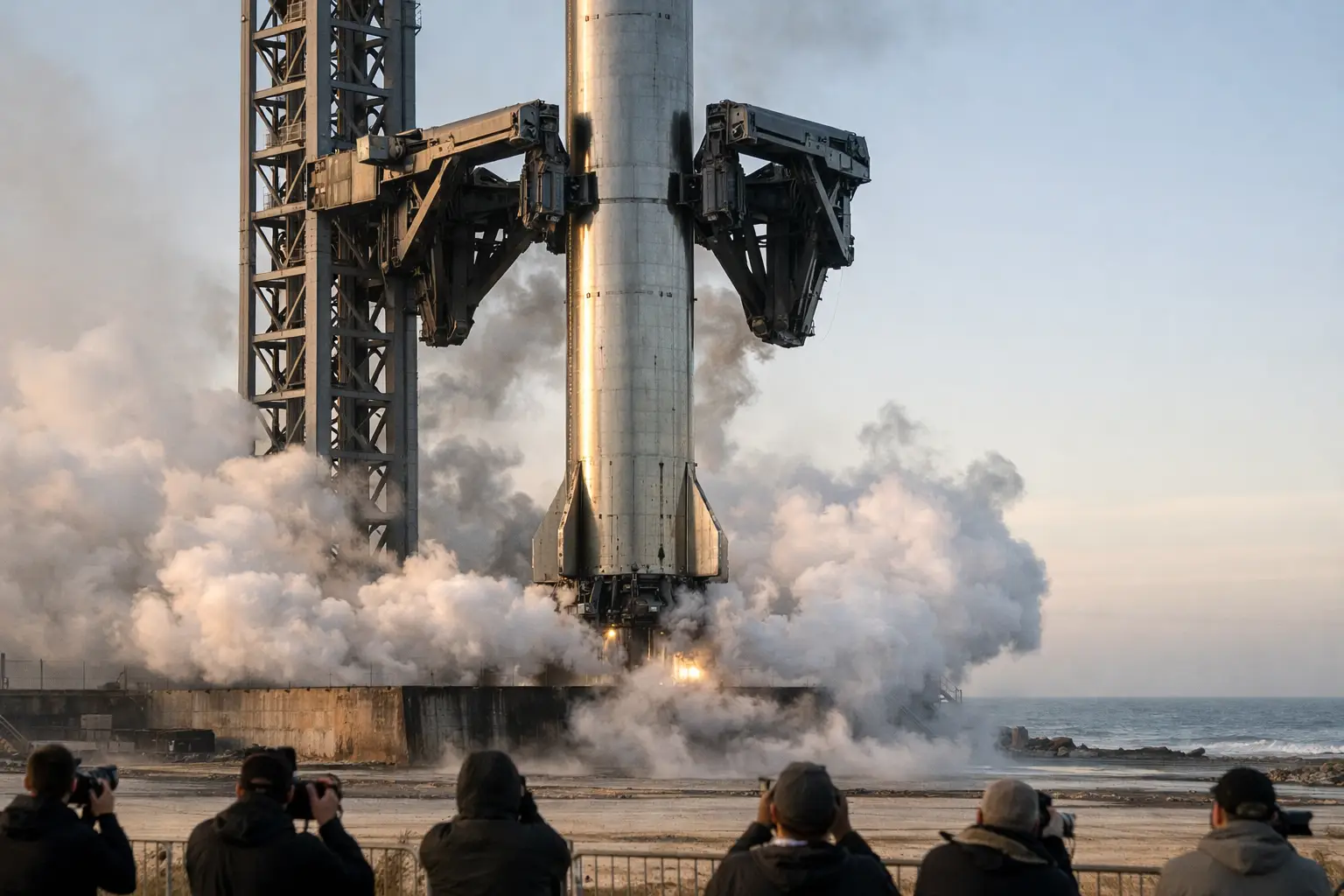
SpaceX has reached a major milestone in the development of fully reusable launch systems after successfully catching the Super Heavy booster from its Starship rocket system. The test, carried out as part of the company’s continuing Starship flight campaign, demonstrated a maneuver long seen as central to the goal of turning large orbital-class rockets around quickly after launch.
The achievement involved the booster returning to the launch site and being secured by the tower’s mechanical arms rather than landing on legs or splashing down at sea. For SpaceX, the operation is designed to reduce recovery time, limit hardware refurbishment and move closer to what the company calls rapid reusability. That concept is critical to the economics of space transport, where lower launch costs depend heavily on flying the same vehicle repeatedly.
The Starship system consists of the Super Heavy booster and the Starship upper stage, making it the largest and most powerful rocket architecture under development for future missions. Its intended uses range from deploying large payloads to supporting crewed exploration plans. NASA has selected Starship as part of its Artemis lunar program, giving the vehicle strategic importance beyond commercial launch markets. Each test flight therefore carries implications not only for SpaceX, but also for the wider timetable of deep-space exploration.
The successful catch does not by itself complete the path to routine reuse. Starship must still demonstrate consistent performance across launch, stage separation, re-entry, landing and refurbishment cycles before it can operate at the cadence envisioned by the company. Regulatory approval also remains a key part of the process, with the Federal Aviation Administration overseeing launch licensing and safety requirements in the United States.
Even with those challenges ahead, the catch represents a visible shift in rocket recovery technology. Previous reusable systems have relied on powered landings on pads or drone ships; capturing a booster directly at the launch tower is a different approach aimed at shortening the interval between flights. If SpaceX can repeat the maneuver reliably, it could reshape expectations for heavy-lift launch operations and intensify competition across the global rockets industry.