
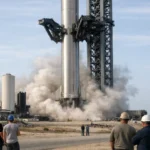









SpaceX has taken a notable step in its long-running effort to make the largest rockets reusable, bringing its Starship spacecraft back to a South Texas launch site on Saturday afternoon. The company described the operation as the first successful catch of Starship, turning a test flight into a milestone for a system designed around repeated use rather than single missions.
The 170-foot-long spacecraft had lifted off from Starbase, Texas, on Friday for its 15th flight, the SpaceX team said in a Saturday release. After reaching orbit, the vehicle returned to the same coastal launch complex, where the controlled recovery demonstrated a capability central to the program’s ambitions. The company led by Elon Musk has made reusability a defining feature of its launch strategy, and Starship is its most visible test of that approach at larger scale.
The successful return carries significance beyond a single test. Recovering flight hardware is intended to reduce turnaround times, preserve expensive components and support more frequent launches. Those goals remain technically demanding, especially for a vehicle of Starship’s size, but each controlled recovery gives engineers data on guidance, heat management, structural performance and landing operations. In a development program built around iterative testing, a completed catch provides evidence that the recovery architecture can move from concept to execution.
The flight also drew praise in Washington, where progress in private launch systems is watched for its implications for American space capability. Starship’s development has become part of a wider conversation about launch access, industrial capacity and the future of crew and cargo transport beyond low-Earth orbit. While Saturday’s result does not by itself complete the system’s development, it strengthens SpaceX’s case that fully reusable heavy-lift vehicles can become operational through repeated flight testing.
Starship remains in a test campaign, and the company’s next steps will depend on the performance data gathered from this flight. The achievement, however, adds a concrete benchmark to a program that has advanced through rapid launches, hardware changes and increasingly complex recovery attempts. For SpaceX, the first catch is not only a technical success at Starbase; it is also a demonstration of the operating model it wants to bring to the next generation of reusable rockets.