








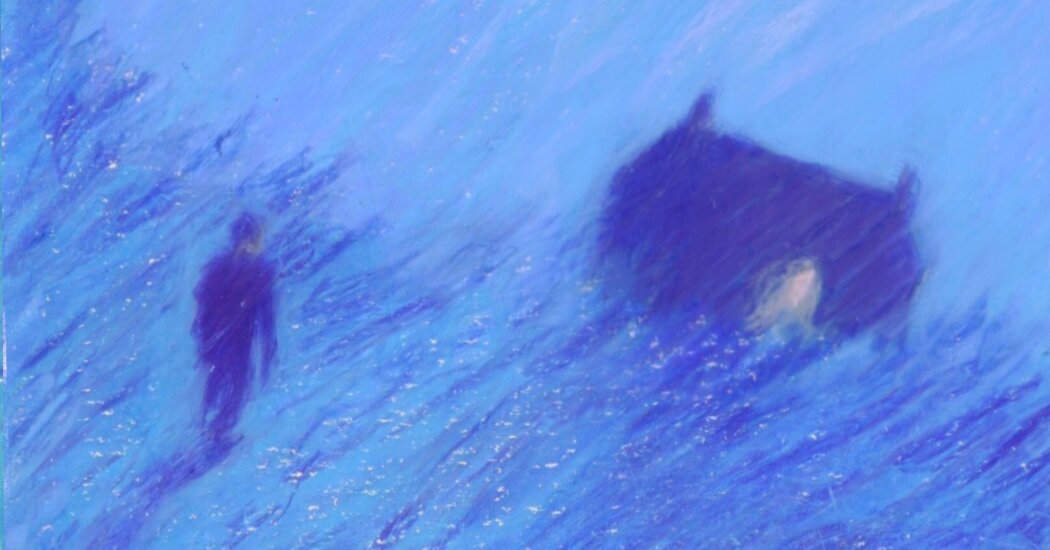
When we meet 22-year-old Cal (short for John-Calum), he’s on the verge of giving up. Just months out of art school in Edinburgh, he has failed to thrive and has been summoned home by his ruggedly handsome, permanently angry father, John, a weaver, farmer and thunderingly severe Calvinist deacon who tends a flock of 26 faithful humans and probably about as many sheep. Cal is gay, and the time is the late 1990s, which means that he grew up “nourished by the horrors he saw on the evening news, all those biblical images of gaunt, sunken-eyed men, covered in sores and dying alone.” His father, who is worldly enough to read “Swann’s Way” and “To the Lighthouse” in a book group, doesn’t know. And the home they share, though it barely merits the label, is a small house on a croft (a rented farm — I learned some good words from this novel and hope one day to deploy “fank” and “chuntering”) on the rocky, jagged Isle of Harris, the sparsely populated northernmost island of the Hebrides. Rendered by Stuart in precise brushstrokes, it sounds like a rough equivalent of rural Maine if someone sawed off a small chunk and shoved it several dozen miles into the North Atlantic.
A few chapters in, you will want to wire Cal whatever money he needs to ditch his family and get on the first ferry back to the mainland, although a poignant, mortifying account of his attempt to find a hookup via newspaper personal ads (again, the late ’90s) doesn’t suggest that a utopia awaits him there. Still, at least Edinburgh has gay men; in Cal’s hometown, there is nothing for him but a father who is both emotionally and physically abusive, a grandmother who has her own issues, a catalog of old relationships in such disrepair that there’s no mending them, and a dead-end life he doesn’t deserve.
One of the biggest surprises in a novel full of them is that Stuart is not particularly interested in telling either a coming-home or a coming-of-age story, at least not the one you think you’re going to hear. Though he starts by hitting some familiar beats — “Thought you were too good for us,” one old friend snipes at the prodigal Cal — he uses that architecture to build something different, stranger and far more original. What Cal’s father doesn’t know about him is, it turns out, nothing compared to what Cal doesn’t know about his father. Without giving too much away, they have more in common than either suspects, including the deep affection of a third man, and their respective identities come to a head in an encounter that may make you shout “No! Don’t!” even as you race on.
Stuart is not just a very good writer but an immensely skilled storyteller who is more than up to the extraordinarily challenging task he sets himself — to build bridges between characters who are so cut off from one another and from themselves that they are, as Cal’s grandmother puts it, “islands within islands.” Notwithstanding the novel’s striking setting, he’s not given to rhapsodic fugues about the sky and the sea and the crags; he’s more interested in the seams and faults and chasms within people who have come to believe that they’re living past any expectations of pleasure. When John summons Cal home, it’s with the words, “You’ve had your fun.” Not a syllable is wasted. He doesn’t have to add “forever”; you know he means it.
Source:
www.nytimes.com