

When Money Enters the Polling Booth, Voting Freedom Recedes
Every representative democracy relies on an elementary principle: citizens must be able to freely choose the individual to whom they entrust a portion of their political sovereignty. However, as soon as a financial counterpart enters into this choice, the nature of the democratic relationship changes. The voter is no longer merely solicited for a conviction, a platform, a track record, or a vision for the future; they become the target of a transaction. An election can then retain all its institutional appearances—candidates, campaigns, ballot boxes, ballots, and vote counting—while seeing its sincerity locally impaired if a sufficiently large number of votes was obtained through money. This is precisely why answering that vote-buying is “not widespread” is insufficient. It is by no means necessary to buy an entire country to alter an election. In a constituency contested by a few hundred or a few thousand votes, a minority practice can have a majority impact on the outcome. The issue is therefore measured not only by the absolute number of citizens involved, but by the capacity of these practices to alter the will expressed by the electorate as a whole.
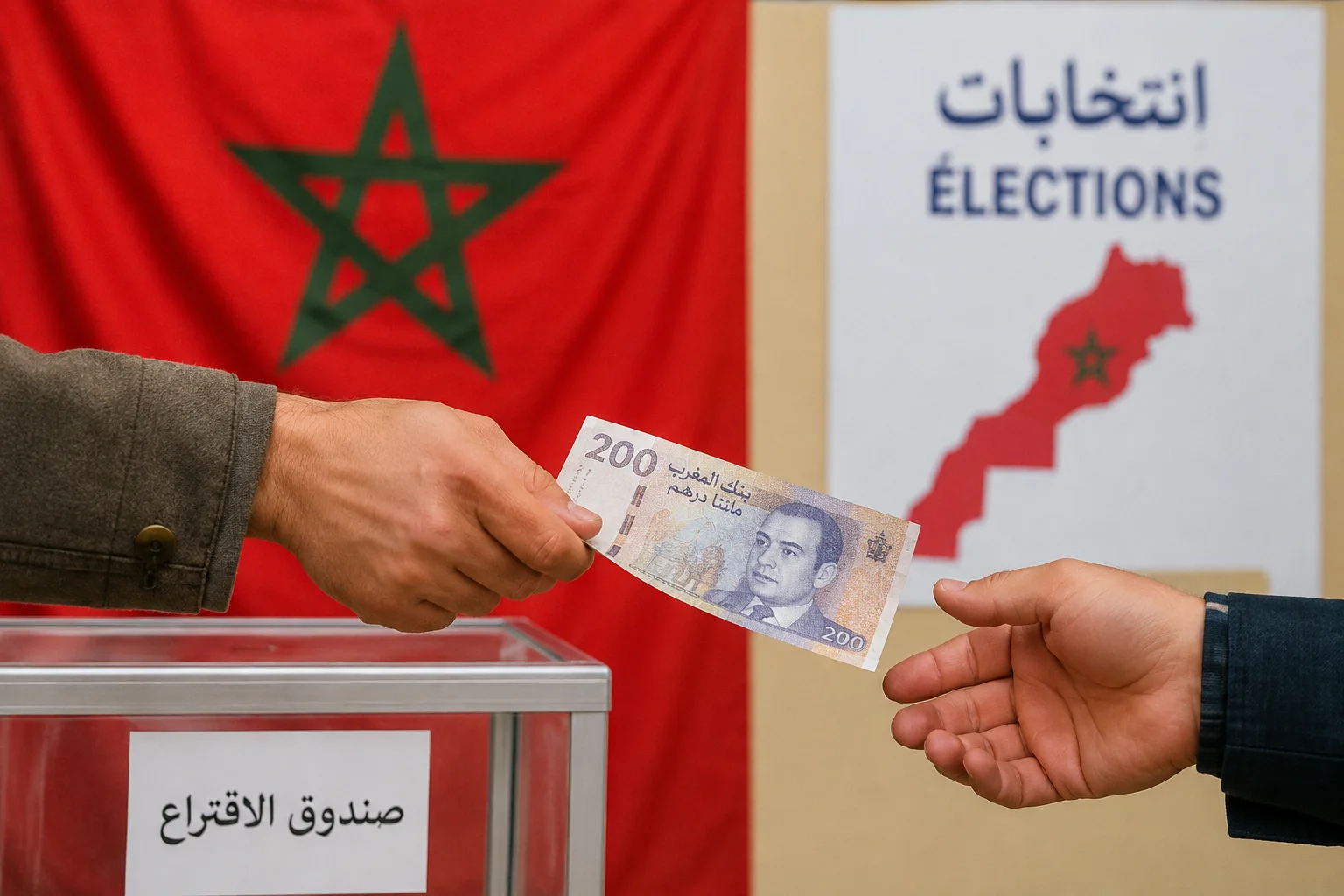
The famous “200-dirham note” belongs more to popular Moroccan vocabulary than to electoral statistics. It would be unwise to turn it into a sort of national rate for corruption: no serious study allows for the assertion that a Moroccan voter’s vote has a uniform price. But if this phrase has become so familiar, it is because it reflects something deeper. It symbolizes the possibility of a transactional relationship between certain candidates and certain voters, either directly or through local intermediaries. At that moment, the candidate is no longer seeking merely to convince; they are seeking to acquire support. And the difference is immense. Democracy relies on the confrontation of competing projects; clientelism relies on the exchange of immediate interests. When the latter begins to replace the former, it is not just an electoral offense that emerges: the very meaning of the representative mandate degrades.
What Observers Have Actually Noted: Neither Exaggerating Nor Concealing Anything
The gravity of the subject demands precisely that one does not fall into exaggeration. A distinction must be drawn between allegations and judicially established facts, testimonies and statistics, individual irregularities and a judgment passed on an entire election. Claiming that all Moroccan elections are bought would be as unserious as asserting that money plays no role in them whatsoever. Available documents allow for a far more nuanced analysis. Following the legislative elections of September 8, 2021, the Parliamentary Assembly of the Council of Europe Notably reported allegations concerning vote-buying and a lack of transparency in certain aspects of campaign financing. Observers also reported allegations regarding material benefits offered to voters. These findings by no means imply that the Council of Europe declared the Moroccan election “bought”; that would distort the report. However, they establish one essential point: the question of the influence of money in Moroccan electoral competition is not merely a matter of popular conversation or accusations between political opponents. It was serious enough to be noted by international observers.
Moreover, the phenomenon did not appear in 2021. Ten years earlier, during the 2011 legislative elections, a delegation from the Parliamentary Assembly of the Council of Europe indicated that it had already been informed of allegations concerning vote-buying, the undue use of certain administrative resources, and pressures or intimidation. Here again, the proper terms must be used: these were allegations, not proof that the entire electoral process was corrupted. But when the same concern persists across multiple electoral cycles separated by a decade, it can no longer be brushed aside as a passing anomaly. It invites reflection on the existence of deeper mechanisms: local networks of influence, social dependencies, electoral intermediaries, clientelism, and the financial power of certain candidates. The law can be amended in a few months; an electoral culture, however, may require a generation to change.
A Prohibition That No Longer Inspires Sufficient Fear Risks Losing Its Power
An illegal practice truly recedes when its probable cost becomes higher than the potential benefit it yields. Yet in electoral matters, the potential benefit is considerable: a parliamentary seat, a municipal presidency, access to a local majority, several years in office, and the capacity to influence public decisions. If the likelihood of being identified remains low, if intermediaries can hardly be linked to the decision-makers, or if sanctions occur long after the election, the legal prohibition loses part of its deterrent function. The key question is therefore not only whether Moroccan law prohibits vote-buying, but whether someone considering practicing it truly believes they risk being caught and paying the price.
This is likely where one of the major stakes of the upcoming elections lies. Morocco does not need another solemn declaration stating that electoral corruption is unacceptable: this principle is already known. Change will occur when a candidate with substantial financial means asks themselves—even before mobilizing an intermediary or pulling out cash—whether a few tens of thousands of dirhams distributed clandestinely could cost them their mandate, their eligibility, their reputation, and, when legal conditions are met, entail criminal consequences. Democracy does not ask political actors to suddenly become virtuous; it builds a system in which fraud becomes a bad calculation.
The Court of Auditors Can Track a Declared Dirham; The Real Challenge Is Finding the One That Never Is
Yet Morocco possesses oversight institutions that are neither theoretical nor negligible. The Constitution notably entrusts the Court of Auditors with auditing political party accounts and verifying the regularity of election-related expenditures. The Court examines public funding, submitted receipts, declared expenses, and the accounts of political organizations and candidates. It has published works relating to various elections, notably the 2016 legislative elections and the votes held in 2021. There is indeed an institutional architecture capable of monitoring a portion of political money.
However, it is precisely here that the most difficult limit to overcome appears: accounting audits what enters into accounting. Money intended to clandestinely buy a vote is, by definition, designed never to appear in an electoral account. A poster has an invoice. A hall rental can be documented. A communication service leaves a trail. A sum handed in cash to an intermediary tasked with convincing several families will obviously never be registered under the heading “purchase of votes.” The official dirham can be audited; the clientelist dirham seeks precisely to become invisible. Two fights must therefore be distinguished—fights that complement each other but are not identical: controlling campaign finance and combating electoral corruption. The former primarily requires transparency, proof, and audits; the latter demands credible reporting, investigations, tracking financial circuits, identifying intermediaries, and, above all, the ability to trace back to the actual order-givers.
When Money Selects Candidates Even Before Voters Cast Their Ballots
Furthermore, the influence of money does not necessarily begin on the day someone offers a sum to a voter. It can intervene much earlier, at the very moment political parties select their candidates. Imagine a constituency where a party must choose among several hopefuls: an experienced activist, a recognized academic, a young community leader, and a wealthy entrepreneur with a vast local network. If the electoral competition is perceived as extremely costly, the personal capacity to fund a campaign can gradually become a criterion as important as competence, platform, or grassroots engagement. Money then no longer merely influences the vote: it begins selecting those who will have the political right to be seriously competitive even before the voter enters the booth.
This mechanism produces a particularly dangerous cycle. The more a campaign depends on financial resources, the more parties are tempted to seek candidates with access to those resources; the more they favor these profiles, the more citizens associate politics with money; and the more normal this association becomes, the more financially modest candidates refrain from entering the race. A young Moroccan may perfectly understand the issues facing their region, have worked ten years in community organizations, mastered policy areas regarding schools, employment, water, or healthcare, and possess a true political vision. But if they become convinced that across from them stands an opponent whose financial power can neutralize years of grassroots work in a few weeks, why would they dedicate their life to politics? Electoral corruption does not only steal votes; it can deprive the country of candidates who will never run in the first place.
The Real Price of 200 Dirhams Is Not 200 Dirhams
Consider now what that famous note represents symbolically. For a citizen living in extreme precariousness, 200 dirhams is not necessarily a trivial sum. It would be easy—and indeed unfair—to judge with condescension a family struggling to meet daily expenses. It is precisely because poverty creates vulnerability that electoral clientelism can function. The economic weakness of certain citizens then becomes a political resource for those with money. The problem is therefore not solely moral; it is also social. The more economically vulnerable a population is, the more tempted someone with resources may be to convert that vulnerability into electoral influence.
Yet the calculation changes radically when observing the transaction over the entire length of a mandate. The voter receives, at most, 200 dirhams once. The elected official obtains several years of power. During those years, budgets, investments, facilities, municipal policies, development plans, infrastructure, public services, and sometimes contracts representing millions of dirhams will be debated or decided. The real transaction is therefore never “one vote for 200 dirhams.” It looks much more like this: an immediately consumed sum exchanged for several years of political power. Viewed from this angle, the deal becomes extraordinarily unbalanced. The person selling their vote is not relinquishing a piece of paper; they are surrendering, at a very low price, a fraction of their right to decide who will manage public funds.
Citizens Bear Responsibility, But It Cannot Become a Political Alibi
One regularly hears this argument: if candidates exist who buy votes, it is because citizens exist who are willing to sell them. The statement contains a element of truth, but it does not tell the whole truth. A transaction indeed requires two parties. Anyone who consciously agrees to sell their electoral choice carries civic responsibility. But the two actors are not necessarily in an equal position. On one side stands a candidate possessing money, organization, intermediaries, and the goal of winning power; on the other, a citizen whose economic precariousness can be exploited. Pointing out voter responsibility is legitimate; using it to diminish the responsibility of the candidate who organizes the system would be far more questionable.
Above all, there is a rarely discussed political consequence. When a candidate obtains a vote in exchange for a material benefit, the relationship between the elected official and the voter is corrupted before the mandate even begins. In a normal democracy, the official remains accountable to the citizen because they promised a platform. In a clientelist relationship, the official may be tempted to view the transaction as settled: “I gave, they voted; we are even.” This is perhaps one of the most destructive consequences of vote-buying. It does not merely corrupt election day; it progressively destroys the notion of accountability during the years that follow. Why demand that an elected official honor a political promise if the initial contract was never political to begin with?
When Institutions Exist, the Question Becomes Their Effectiveness
It would be excessive to conclude that Morocco is simply incapable of organizing democratic elections. The Kingdom experiences genuine multi-party competition, organizes complex elections, possesses an electoral administration, courts, campaign finance rules, and oversight institutions. But this reality must not serve to close the debate; on the contrary, it should make the standard higher. When a country lacks institutions entirely, the primary goal is to create them. When it already possesses them, the question becomes far more specific: do they function effectively enough to alter behavior?
The reasoning is difficult to bypass. A democratic election requires free suffrage. Buying votes destroys that freedom when it dictates the voter’s choice. Moroccan law combats these practices, and institutions exist to protect the integrity of the process. If, despite this, illicit money continues to influence certain contests, one must necessarily examine either the capacity for detection, the speed and effectiveness of sanctions, or both. The solution does not necessarily lie in constantly adopting new legislation. A democracy does not grow stronger by accumulating laws; it grows stronger when citizens and candidates see that existing laws carry real consequences.
International Rankings Provide Context, Not a Verdict on Elections
International indicators dedicated to corruption must also be used with precision. Transparency International’s Corruption Perceptions Index does not measure the number of bought votes in Morocco, nor does it allow for the calculation of an electoral fraud rate. It evaluates the perception of public sector corruption through a specific methodology. Thus, it can illuminate the general institutional environment, but it would be intellectually incorrect to turn an international corruption ranking into a statistic on vote-buying. This distinction is vital in a debate where numbers can easily become political weapons rather than analytical tools.
Furthermore, one must accept a frustrating reality: no one today can seriously state how many votes are bought in Morocco. How many voters actually accept money? What amount truly circulates? How many constituencies had their results altered by these practices? No national figure robust enough exists to answer with certainty. And this is hardly surprising. A clandestine transaction that both buyer and beneficiary have an interest in concealing is, by nature, difficult to measure. The absence of a reliable figure does not mean the phenomenon does not exist; it simply requires that one does not invent a statistical precision that available data does not support.
2026 Should Not Be the Year of Speeches Against Corruption, But the Year Corrupting Becomes a Risk
This is perhaps where the true expected change lies. Speeches on ethical political life are useful, but they eventually lose their force when unbacked by visible effects. An awareness campaign might convince a citizen; a credible sanction can deter hundreds of candidates and intermediaries. The fight against electoral money must begin before the official campaign, continue through the vote, and persist after the announcement of results. Clientelist networks are not necessarily born forty-eight hours before polling stations open. They can build over months through economic, familial, organizational, or local ties—among which legitimate community activity must obviously be distinguished from mechanisms designed to purchase electoral loyalty.
True progress will be achieved when the risk of corruption is factored into the candidate’s calculations. As long as a candidate thinks: “If I spend this sum, how many votes can I gain?”, money remains an electoral tool. When they begin thinking: “If I spend this sum clandestinely, could I lose my election and my political career?”, the balance of power will have shifted. It is this inversion that a truly deterrent system must produce. Success will not be measured solely by the number of convictions handed down after elections, but by the number of practices that never take place because those contemplating them deemed the risk too high.
What If the 200-Dirham Note Revealed a Deeper Crisis?
Yet there remains a question that deterrence alone can never resolve. Why does a citizen agree to sell their vote? Poverty provides part of the answer, but not all of it. There is also political disillusionment. When a voter no longer believes in platforms, considers that campaign promises will be forgotten the day after the election, or no longer clearly distinguishes between the proposals of different candidates, an immediate benefit can seem far more concrete than the promise of a better future. The logic becomes terribly pragmatic: since the candidate may disappear after their election, one might as well get something out of them while they still need me.
This rationale demonstrates that combating vote-buying also requires restoring political value to campaign platforms. Parties must regain the ability to produce distinct proposals, train their members, select candidates based on competence as much as electoral viability, publish track records, and, above all, accept being evaluated on their commitments. When platforms become interchangeable, personalities weak, and promises repetitive, money finds fertile ground. The best response to the 200-dirham note is not merely the police officer, judge, or auditor. It is also a candidate credible enough for a citizen to believe that their vision is worth far more than the money being offered.
Morocco Knows the Problem: It Remains to Prove It Can Overcome It
Morocco is no longer at the stage of needing to discover the existence of electoral clientelism. The debate has existed for a long time, parties are aware of it, citizens talk about it, observers have noted it, and institutions now possess greater oversight tools than in the past. This is precisely what makes upcoming milestones noteworthy. The question is no longer simply: “Is there money in elections?” The real question becomes: how far is the State prepared to go to prevent that money from buying power?
It would be unrealistic to promise the total disappearance, in a single election, of practices built over decades. No serious democratic system can guarantee that no infractions will be committed. But there is a fundamental difference between marginal fraud prosecuted by the State and a practice sufficiently tolerated to become an almost routine component of certain campaigns. This is the boundary Morocco must shift.
The Kingdom no longer has to demonstrate merely its logistical capacity to organize elections. The challenge is now more demanding: enabling a citizen without wealth to run against a rich candidate with the reasonable conviction that the depth of their pockets will not be the deciding factor; enabling an economically vulnerable voter to know that their ballot is worth infinitely more than a few banknotes; and finally, enabling parties to understand that a constituency must be won through trust, not financial power.
For the ultimate issue is not whether 200 dirhams can buy a vote.
It is knowing how much it costs a democracy when its citizens come to believe that their vote has a price.
And if upcoming elections manage to break with that conviction, victory will belong neither to the majority nor to the opposition.
It will belong to the Moroccan voter.