





As public health officials declared the end of a sewage contamination emergency in the Potomac River last month, scientists feared the waterway was still in distress.
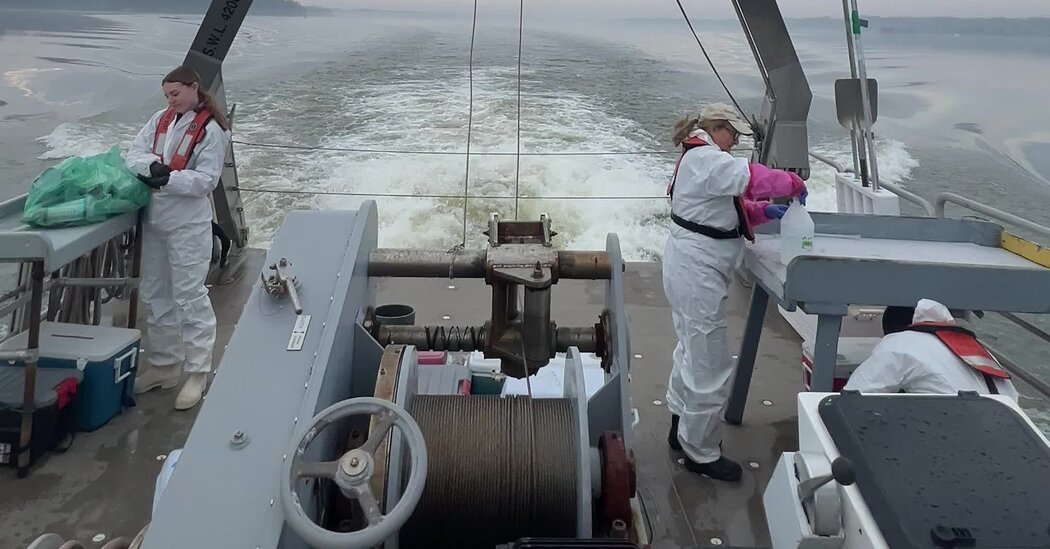
More than 240 million gallons of human waste had poured into the river from a broken sewer main. Researchers went out in early March to sample the water, trying to see what damage had been done.
“The color is not good,” said Judy O’Neil, an associate research professor at the University of Maryland Center for Environmental Science, as she looked into churning brown water from the deck of the research vessel Rachel Carson.
Weeks later, the lab results confirmed Dr. O’Neil’s unease: Telltale signs of raw human waste lingered near the site of the January sewer collapse along the riverbank in Montgomery County, Md., some 10 miles upstream of that initial collection site. Dilution made downstream waters relatively safer, allowing for health advisories to be lifted, but the data showed plenty of hazards for the river and the plants, animals and people exposed to it.
And as temperatures warm, the largest release of human waste into the river since wastewater treatment began nearly a century ago threatens to throw the ecosystem severely off balance, experts said. Sewage may be lurking in river-bottom trenches and muddy banks around popular recreation spots that will soon draw people, said Dean Naujoks, the Potomac Riverkeeper.
“Everybody’s ready to declare victory,” Mr. Naujoks said.
Efforts to determine the extent of possible contamination in soils and sediment are ongoing. Toxic algae blooms, fish kills and “dead zones” devoid of dissolved oxygen are unlikely to arrive until the heat of summer sets in, he said.
Officials from both the Environmental Protection Agency and Maryland Department of the Environment this week sued over the contamination, filing separate actions seeking to hold D.C. Water, the utility that owns and operates the sewer line known as the Potomac Interceptor, responsible for its impacts and cleanup.
The environmental group American Rivers also declared the Potomac the country’s most endangered waterway this month.
Ongoing monitoring of water quality data shows “strong evidence that the river has now returned to typical conditions,” Sherri Lewis, a D.C. Water spokeswoman, said in an email.
The utility acknowledged that rainfall and other environmental factors could cause residual contamination to spike, though. In response to the lawsuits, D.C. Water defended its actions to contain most of the sewage overflow within five days, and all of it within three weeks.
Some of the alarming results the scientists found in early March may have been linked to rain that fell a day earlier, or to a related leak that the Potomac Riverkeeper group uncovered a few days later. When D.C. Water used a bypass system to carry waste around the broken sewer, contaminated water seeped into the Potomac through cracks in an old culvert, the group found.
It takes weeks or months for the river to flush most of the contamination, experts said. The Potomac is tidal downstream of a rocky area called Little Falls, near the land border between Washington and Maryland, which means much of the sewage sloshed slowly down the river from late winter into spring.
All along, the nitrogen and phosphorus contained in sewage — which feed bacteria and fuel algae blooms that disrupt aquatic ecology — were being drawn into the food web of phytoplankton, zooplankton, fish, crabs and oysters. Had the sewer collapse occurred during warmer months, impacts on those creatures likely would have been more immediate, scientists said.
But because aquatic life was still largely dormant in winter when the sewage pollution was most concentrated, it will take longer to learn the full toll of the contamination.
There are some ominous signs. The researchers found that levels of nitrogen, phosphorus and carbon are far above average for this time of year, said Lora Harris, a professor at the Maryland environmental science center. And farther downriver near Indian Head, Md., Dr. Harris said they found a large bloom of phytoplankton, organisms at the bottom of the food web that can help fuel dead zones.
Adam Ortiz, a deputy secretary at the Maryland environmental agency, said he isn’t “overly celebrating” data that show bacterial conditions improving. The state’s lawsuit said contamination could still be seen on the Potomac’s riverbanks this month.
“We’re encouraged, but we’re still concerned,” Mr. Ortiz said.
E.P.A. officials declined to be interviewed but said they are committed to continuing water quality monitoring through May 1. The agency has been coordinating some data collection and cleanup since President Trump issued a federal emergency declaration for the Potomac in February.
The University of Maryland environmental scientists said they plan to continue tracking river conditions far beyond that. Their first data collection relied on federal funding that they quickly cobbled together. They are working to secure more money for further testing but were struggling to line it up, said Ryan Woodland, an associate professor at the environmental science center helping to lead the Potomac research.
The Potomac empties into the Chesapeake Bay, the country’s largest estuary, which has undergone a slow ecological recovery over the past few decades. Both the river and the bay have suffered from persistent pollution from sewage, farm fertilizers and urban runoff. In the environmental science center’s latest Chesapeake report card last year, the Potomac earned a D-plus.
The researchers hope to better understand how the surge of sewage affects the Potomac’s health and how it may bounce back.
“We get these setbacks, but the trajectory is in the right direction.” Dr. O’Neil said. “We want to maintain that.”
The repaired Potomac Interceptor is once again carrying sewage from Virginia and Maryland to be treated at the Blue Plains Advanced Wastewater Treatment Plant in Southeast Washington, D.C.
As aging water and sewer infrastructure takes on more wear and tear, Dr. Woodland of the research center is certain they’ll need any information that scientists can gather: “More of these spills are coming.”
Source:
www.nytimes.com