






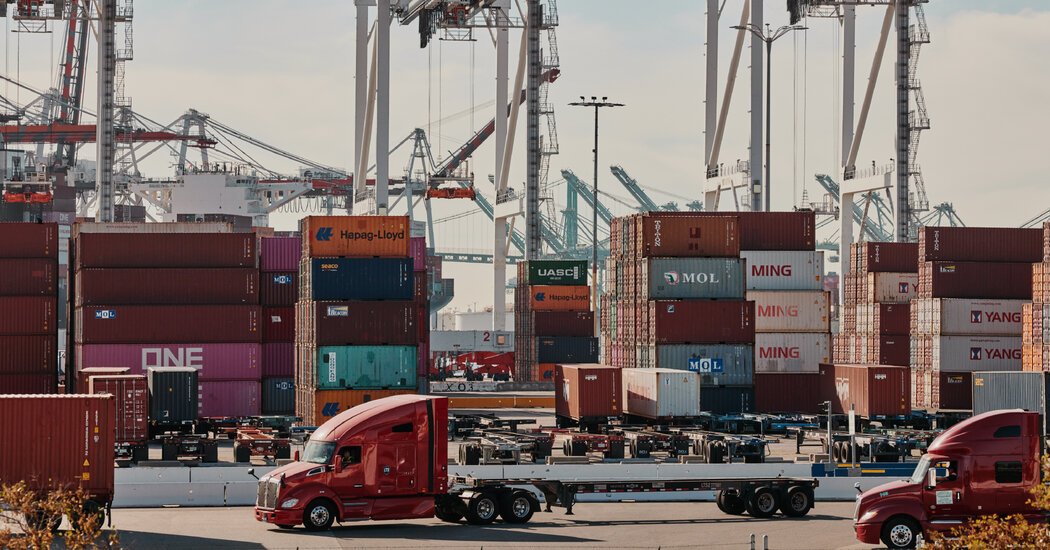
The price of diesel has risen much more quickly than gasoline as the U.S.-Israeli war with Iran has choked global oil supplies. That could have severe consequences for the diesel-dependent transportation industry.
Since the war began on Feb. 28, the average price of a gallon of diesel has gone up about 45 percent, while a gallon of regular gasoline has risen about 35 percent. The Energy Information Administration, a federal research agency, expects average diesel prices to peak at more than $5.80 a gallon this month. Gasoline, the agency said, would average $4.30 a gallon.
Prices have gone down modestly in the past week on hopes for a peace deal, but the gap between diesel and gasoline remains yawning.
Why did diesel prices rise so quickly?
Even before the war, supplies of diesel were tight. That meant the world had little buffer when Persian Gulf countries — which produce a fair amount of diesel — were forced to slash exports. Adding to the challenge is that a lot of the oil produced in the region is especially suited for making diesel and the fuel that jets use.
“This is why diesel more than doubles, while gasoline basically moves up in tandem with crude,” said Joe DeLaura, a global energy strategist at Rabobank. “You have a shortage of diesel, you have a shortage of jet fuel, you have a shortage of fuel oil. Gasoline is relatively well supplied.”
Before the war, refineries in the Persian Gulf exported much more diesel and jet fuel than gasoline — and no other countries have the capacity to make up for that loss.
“You’ve lost that supply in a market that was already tight, and there’s no way to replace that,” said Jason Gabelman, an energy analyst at the investment bank TD Cowen.
China, which has refineries that could have picked up some of the slack, decided to restrict fuel exports when the war started to make sure it did not experience shortages, Mr. Gabelman said.
The United States is a net exporter of petroleum products, including diesel. And countries like Australia, which used to import diesel from Asia or Europe, have ramped up imports of the fuel from the United States.
But with a fifth of the world’s oil supply cut off, even the United States could not make up for the missing Persian Gulf diesel.
“The U.S. can produce quite a bit, but we can’t fuel the world,” Mr. DeLaura said.
In addition, much of the oil produced in Gulf countries is especially suited for making diesel. The oil produced in Texas and New Mexico, by comparison, is better suited for making gasoline.
There is another problem: Truckers, farmers and other users of diesel may not be able to cut back easily, whereas individuals buying gasoline can, for example, car-pool or forgo some trips.
How are diesel and gasoline different?
Both fuels are made from crude oil at giant industrial plants known as refineries. But they have different qualities that make them suited for specific uses.
Gasoline, referred to as petrol in much of the world, is mainly used in passenger cars. It has less energy per gallon or liter than diesel, which typically powers trucks, tractors and other heavy equipment.
Refineries are only so flexible and cannot make much more diesel even if they wanted to.
Refiners are able to use heat and chemical processes to “crack” molecules and turn them into gasoline, diesel or other fuels. But once they have decided how much of each fuel they intend to make, they are stuck with those choices unless they spend a lot of money to rejigger their equipment and processes.
“Generally, the refinery has chosen investments over time to allow it to produce more or less of certain products, within reason,” said Patrick De Haan, an analyst at GasBuddy. “You can’t bend science enough to just get all diesel out of a refinery.”
Does diesel normally cost more?
In the United States, diesel generally costs more than gasoline.
Before stricter environmental regulations, diesel had a high sulfur content, which caused more air pollution. Now, diesel used in the United States and many other countries must be stripped of much of its sulfur. That process is intensive and expensive.
When the low-sulfur fuel was introduced in 2006 during the George W. Bush administration, the price was expected to go up 3 to 5 cents per gallon. The fuel is also taxed more; the federal tax on diesel is 24.4 cents a gallon, or 6 cents more than gasoline.
Many U.S. refineries were set up to produce certain amounts of diesel, much of which is exported. As a result, U.S. diesel prices tend to more closely reflect the global supply and demand for the fuel than the price of gasoline.
“The more that leaves this country, the more that diesel prices are impacted,” Mr. De Haan said.
Kenneth Gillingham, a professor of energy economics at Yale, said it was also harder to transport diesel because of a lack of pipeline capacity. As a result, prices for the fuel can vary a lot from place to place.
“The difference between gasoline and diesel comes about due to the more regional supply constraints,” Professor Gillingham said.
When will prices go down?
If the Strait of Hormuz reopens to ships, energy prices will fall and shortages will be resolved over time.
But diesel prices may not quickly return to prewar levels because the supply has been disrupted so much. Getting enough of the fuel to every place that needs it could take months.
“It’s diesel that really runs the economy,” Mr. DeLaura said, “and kind of runs the world.”
Rebecca F. Elliott contributed reporting.
Source:
www.nytimes.com