







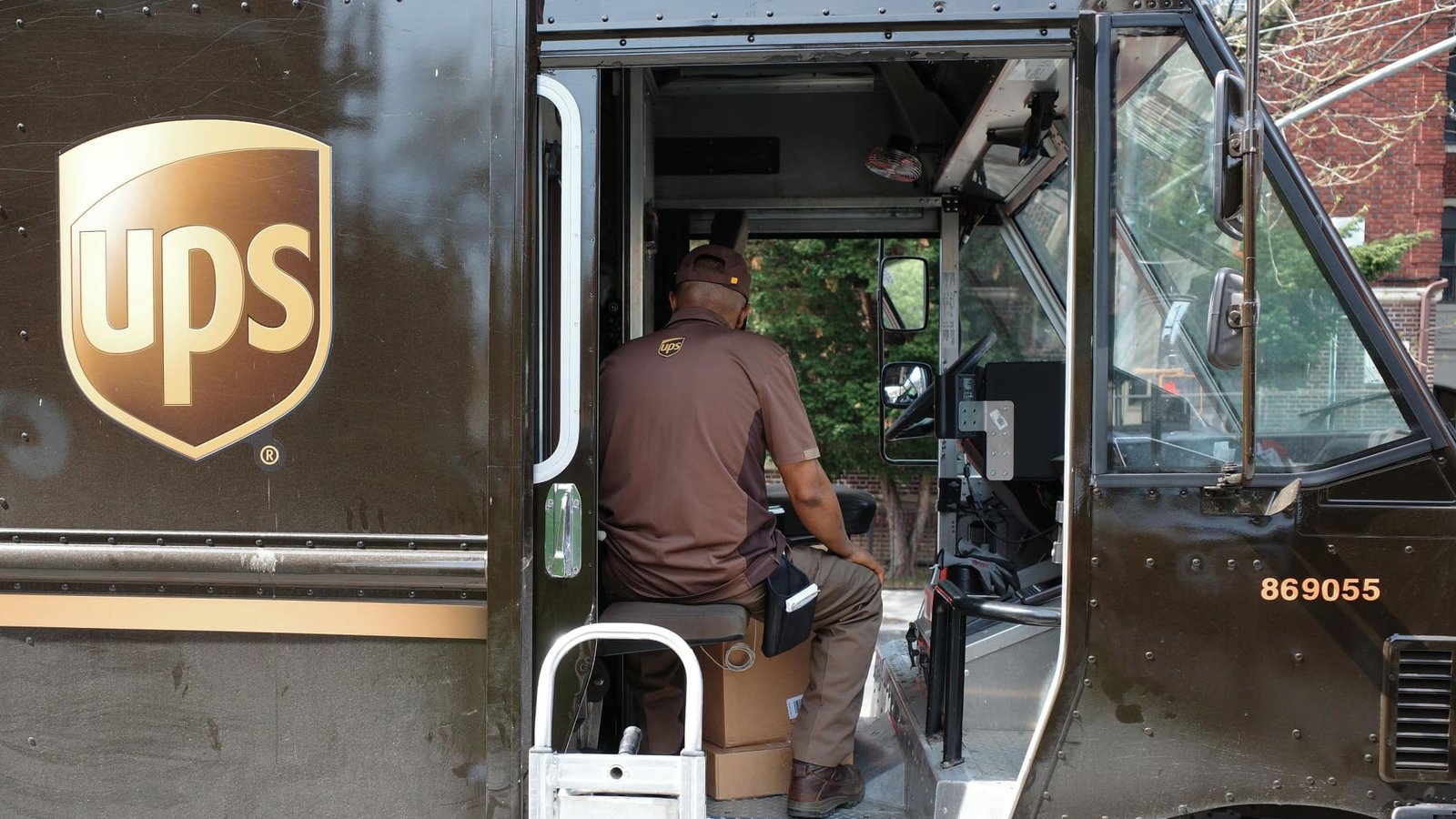
A UPS driver sits in his truck on April 15, 2026 in the Flatbush neighborhood of the Brooklyn borough in New York City.
Michael M. Santiago | Getty Images
United Parcel Service on Tuesday posted first-quarter earnings results that beat on the top and bottom lines.
Shares of the delivery giant sank roughly 5% in premarket trading.
Here’s how the company performed in its first quarter, compared with what Wall Street was expecting, based on a survey of analysts by LSEG:
Earnings per share: $1.07 adjusted vs. $1.02 expectedRevenue: $21.2 billion vs. $20.99 billion expected
For the quarter ended March 31, UPS reported net income of $864 million, or $1.02 per share, compared with $1.19 billion, or $1.40 per share, a year prior. Adjusting for one-time items, the company reported a profit of $906 million, or $1.07 per share. Revenue fell to $21.2 billion from $21.5 billion a year ago.
“The first quarter of 2026 marked a critical transition period for UPS in which we needed to flawlessly execute several major strategic actions and we delivered,” CEO Carol Tomé said in a statement. “With that behind us, we expect to return to consolidated revenue and operating profit growth, and adjusted operating margin expansion in the second quarter of this year.”
For its full-year 2026 outlook, the company reaffirmed its consolidated financial estimate of $89.7 billion in revenue and non-GAAP adjusted operating margin of 9.6%.
“It is early in the year to raise [guidance],” Tomé said on a call with analysts on Tuesday, adding that there are no indications to be concerned about the health of the business.
In its domestic segment, UPS said revenue dropped 2.3%, primarily due to an expected decline in volume.
UPS is also in the midst of a turnaround plan and enhancing the automation in its network. In the first three months of the year, UPS said it achieved $600 million in cost savings from its network efficiency program, with expectations to reach $3 billion in year-over-year savings in 2026.
Company executives added on the call with analysts that fuel surcharges have not had a material impact on UPS’ business and that it remains too early to determine exact impacts from the war in the Middle East.
Source:
www.cnbc.com