







Stay informed with free updates
Simply sign up to the Artificial intelligence myFT Digest — delivered directly to your inbox.
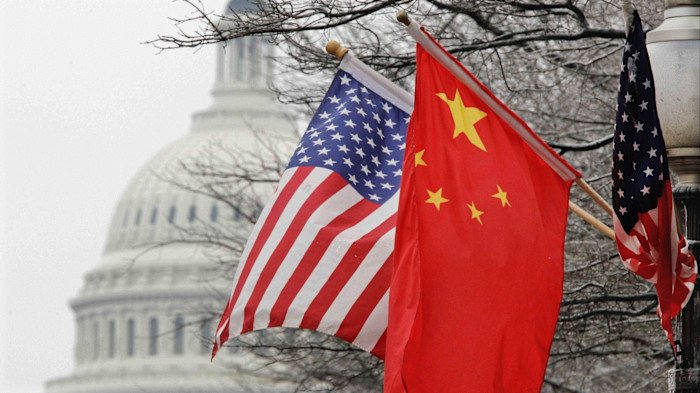
The White House has accused China of undertaking industrial-scale theft of American artificial intelligence labs’ intellectual property and warned that it would crack down on a practice that exploits US innovation.
“The US government has information indicating that foreign entities, principally based in China, are engaged in deliberate, industrial-scale campaigns to distil US frontier AI systems,” Michael Kratsios, director of the White House Office of Science and Technology Policy, wrote in a memo seen by the FT.
The accusation marks the latest escalation in tensions around Chinese groups allegedly raiding advanced American AI research amid an arms race to lead in the technology. It comes just weeks before President Donald Trump will meet President Xi Jinping in Beijing.
The issue gained attention after China’s DeepSeek was accused of using distillation — the process of training smaller AI models based on the output of larger ones — to build a powerful product at a lower cost.
Kratsios’ memo to government departments said the administration would share information with American AI companies about “attempts by foreign actors to conduct unauthorised, industrial-scale distillation” and help them co-ordinate against attacks.
He said Chinese campaigns were “leveraging tens of thousands of proxy accounts to evade detection and using jailbreaking techniques to expose proprietary information”.
The US would explore measures “to hold foreign actors accountable for industrial-scale distillation campaigns”, Kratsios added.
The Chinese embassy in Washington said the White House accusations were “pure slander”.
“China has always been committed to promoting scientific and technological progress through co-operation and healthy competition,” said Liu Pengyu, the embassy spokesperson. “China attaches great importance to the protection of intellectual property rights.”
Chris McGuire, a technology security expert at the Council on Foreign Relations said: “Chinese AI firms are relying on distillation attacks to offset deficits in AI computing power and illicitly reproduce the core capabilities of US models.”
McGuire said the US should ban Chinese groups from accessing US models and sanction entities that conduct or enable distillation, as well as tighten export controls to prevent China from smuggling or remotely accessing US AI chips.
US AI firms, including Anthropic and OpenAI, have increasingly voiced concern about distillation by Chinese groups, which they argue enables foreign labs to close the competitive advantage that the US enjoys because of export controls on advanced American chips.
Kratsios said distillation was a vital part of the AI ecosystem when used legitimately to make lighter-weight models but “industrial distillation” used to undermine American research and development was “unacceptable”.
He added that while models created by “surreptitious, unauthorised distillation campaigns” did not match the performance of the original models, they can benefit foreign groups because of the significantly lower cost.
In February, Anthropic accused three leading Chinese AI companies — DeepSeek, Moonshot and MiniMax — of distillation attacks on its models.
That came after OpenAI said in early 2025 that it had evidence that DeepSeek had used outputs from its GPT models to train its model in violation of its terms of service.
American AI companies are concerned that distilled models pose national security risks because they lack the safeguards that, for example, prevent the development of bioweapons or malicious cyber attacks.
The House Foreign Affairs Committee on Wednesday passed a slew of bills designed to make it harder for China to catch up with the US in the AI race.
One bill tackles distillation by requiring the administration to consider adding groups that employ it to the “entity list” — an export blacklist that would make it very hard for US companies to sell technology to the groups.
Source:
www.ft.com