








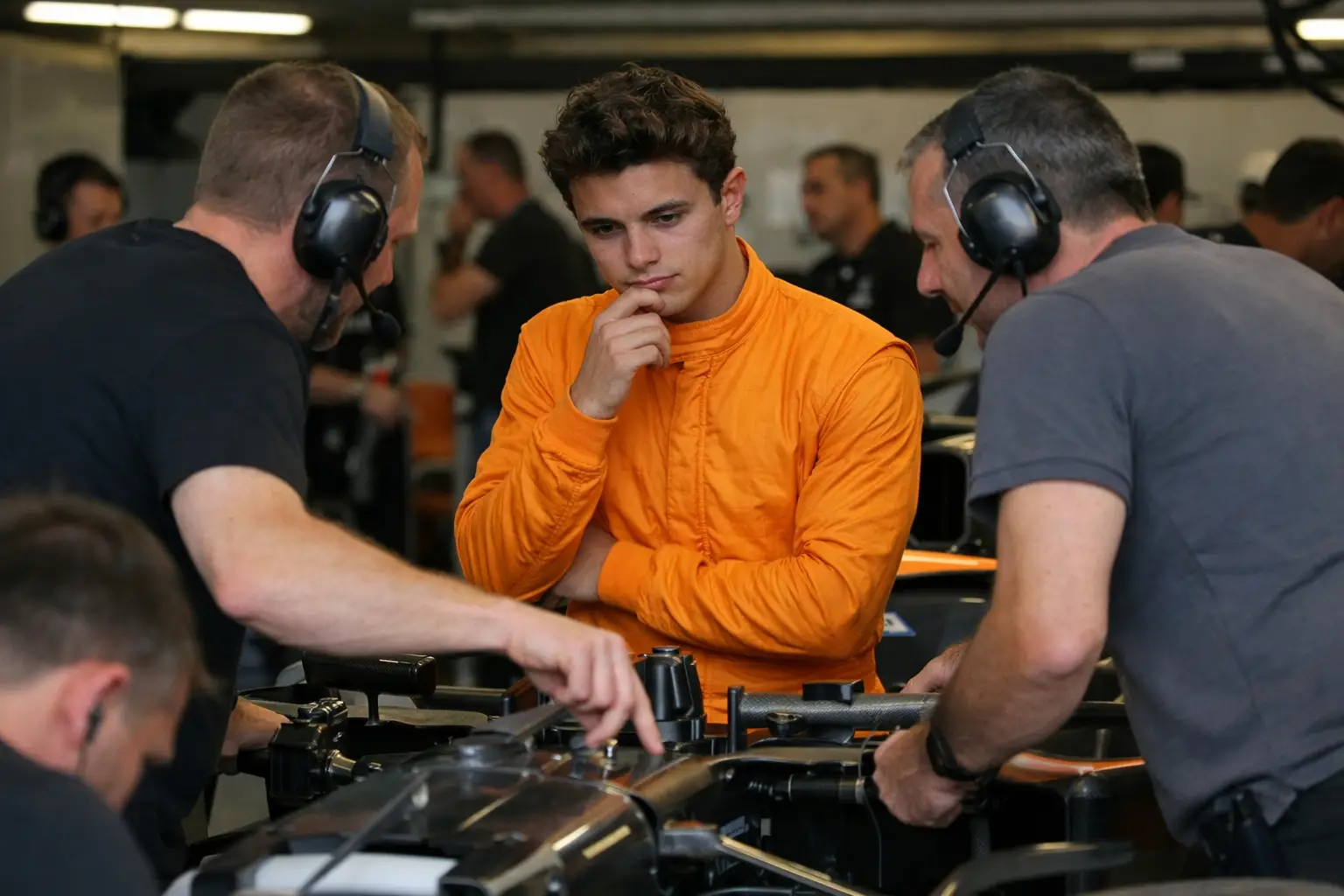
Lando Norris arrives at the São Paulo Grand Prix with limited confidence that McLaren’s latest upgrades will immediately resolve the handling problems he has described as “horrible”. The British driver’s caution underlines the uncertainty that can accompany mid-season development in Formula 1, where new components do not always translate into a clearer balance or greater driver confidence from the first session.
The team is introducing changes for this weekend’s race in Brazil, but Norris has made clear that he does not yet know whether they will improve the car’s behaviour. His concern centres on handling, a broad but decisive area that affects how predictable a car feels under braking, through corners and when power is applied. For a driver, that confidence is often as important as raw aerodynamic performance, particularly on a circuit that combines rhythm, elevation change and heavy braking zones.
The São Paulo Grand Prix at Interlagos, officially the Autódromo José Carlos Pace, is a demanding venue for evaluating upgrades because it exposes several aspects of a car’s performance over a short lap. Teams must balance stability, traction and aerodynamic efficiency, while drivers need a responsive car to attack the circuit’s flowing middle sector and manage the slower corners cleanly. In that context, McLaren’s practice running will be central to understanding whether the new package offers a genuine step forward or simply changes the nature of the existing problem.
For Norris, the issue is not only whether the car is faster on paper, but whether it becomes easier to place consistently on track. A difficult balance can limit a driver’s ability to extract lap time, complicate tyre management and make qualifying execution more fragile. Modern Formula 1 upgrades are measured through data as well as driver feedback, and any mismatch between simulation expectations and track behaviour can force teams to adjust set-up direction across the weekend.
Formula 1 development remains a continuous process, and McLaren’s work in Brazil will be assessed session by session rather than judged on introduction alone. Norris’s uncertainty reflects a practical reality of the sport: new parts can provide solutions, but only track running can confirm whether they address the limitations that matter most to the driver behind the wheel.