

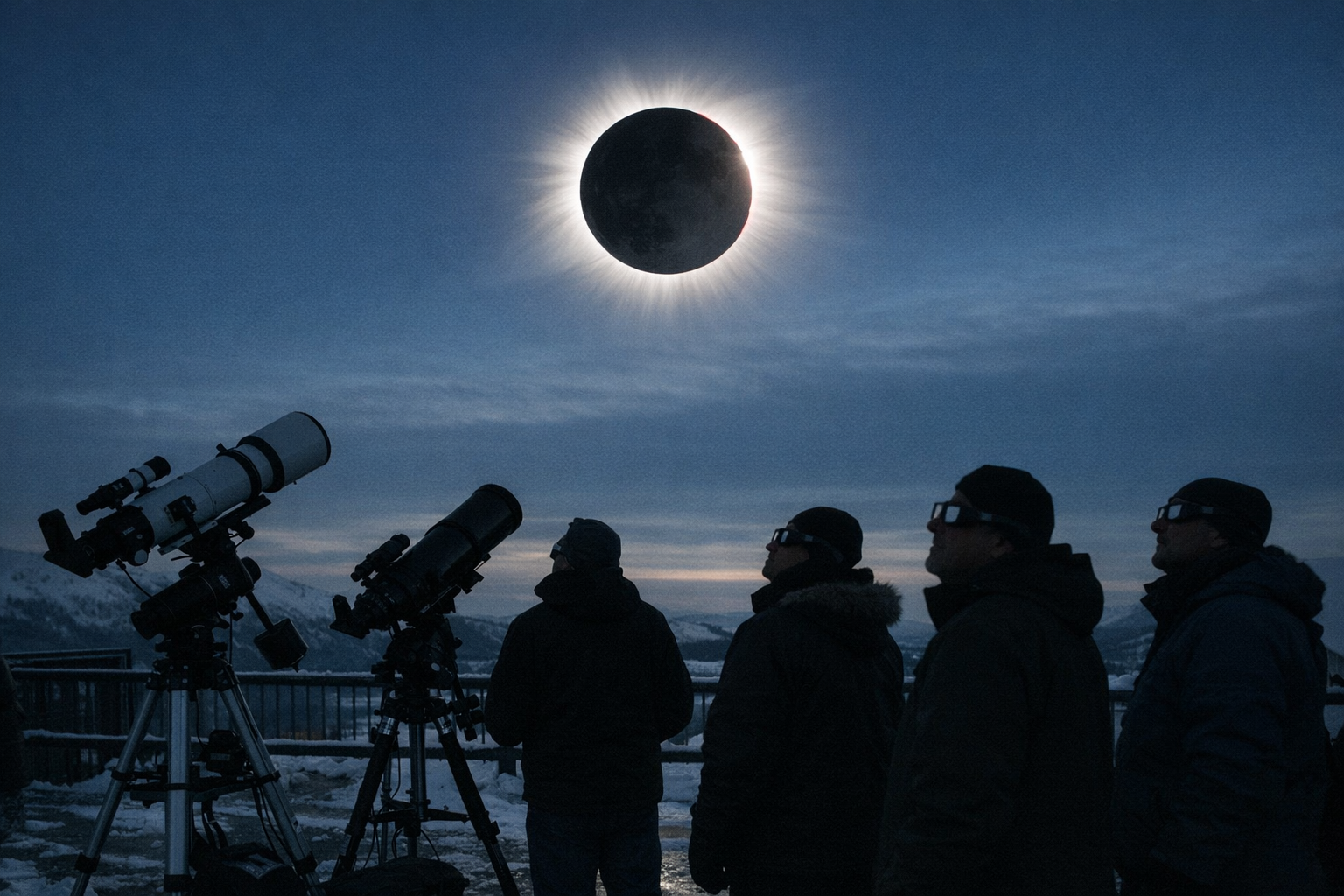
Millions in Europe stepped outside Monday evening to observe a total solar eclipse whose path of totality traversed portions of Greenland, Iceland and Spain. The Moon moved directly between Earth and the Sun along a narrow corridor, producing complete obscuration of the solar disk for observers located within that path and partial effects across a broader region of the continent.
Photographers and observatories recorded striking views as the eclipse coincided with late-day light in many locations. A widely shared image from the Javalambre Astrophysical Observatory in Arcos de las Salinas, near Teruel, shows the Moon fully covering the Sun with the faint solar corona visible around the darkened disc; the photograph is credited to Christian Hartmann. Local astronomy clubs and public institutions organized viewing events, and officials and scientific groups reiterated guidance on the use of certified eclipse glasses to protect eyesight.
Solar eclipses provide scientists with opportunities to study the Sun’s tenuous outer atmosphere, the corona, under conditions that are otherwise difficult to reproduce from the ground. Research teams frequently deploy portable instruments and coordinate observations from multiple sites along the path of totality to gather data on coronal structure and solar-terrestrial interactions; data collected during this event will be examined by researchers in the coming weeks.
Weather conditions varied along the eclipse corridor, producing clear, high-contrast views for some observers and cloud-obscured glimpses for others. Public interest remained high across affected countries, with civic authorities and cultural organizations reporting substantial turnout at designated viewing locations and observatory open days where available.
Images and data from the eclipse were distributed by news organizations, observatories and social media accounts, with image credits attributed to professional photographers and institute teams. Scientists and amateur observers alike will continue to analyze the visual and instrumental records gathered during the event to refine understanding of coronal dynamics and to support future observing campaigns.