








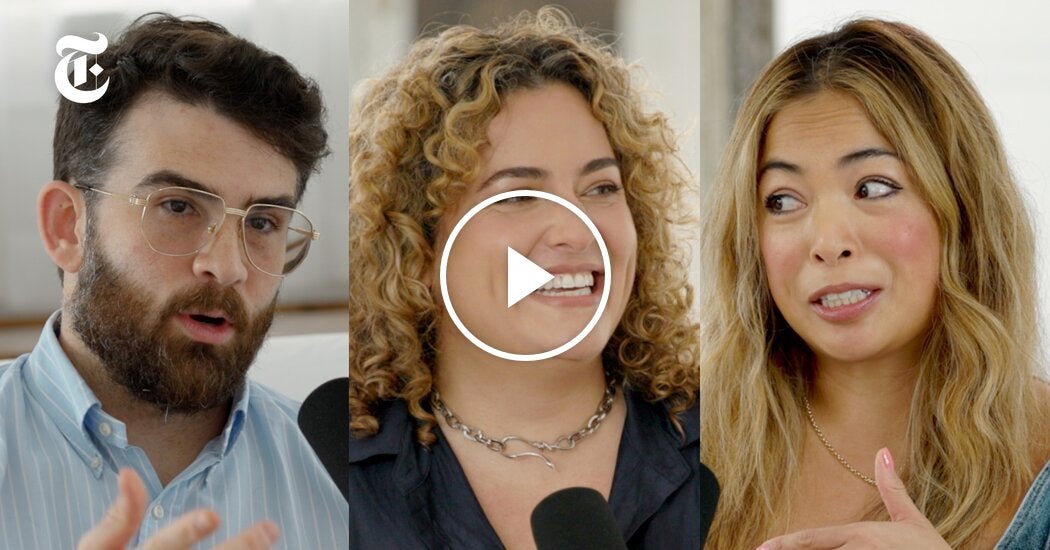
I forgot four lemons and on several occasions I was like, I’m just going to go back, grab those four lemons and get the hell out. You should go to prison. I know you think they’re going to ban me. They should. They should throw you in jail. But I didn’t feel. I didn’t feel bad about it at all. I’m proposing a new term: Microlooting. I started going into the grocery store. I would pick up the thing that I wanted, and then I would go. It’s a survival technique. Gotta eat to live, gotta steal to eat. You’re paying for that. No, babe. Food is a human right. People are taking small things from big corporations, and they’re feeling justified. Like, look, everyone’s shoplifting from Whole Foods when you’re shopping there. You’re not going to steal from a deli like that. But Whole Foods, Whole Foods. [expletive] Bezos, [expletive] Amazon, all that. We should be rioting, but we’re tired. So I’m going to take these bagels. But is it a slippery slope. What’s going on with our moral code. To find out, I’m talking to political commentator Hasan Piker, a New Yorker and writer Jia Tolentino. Thank you both so much for being here with me today to talk about this. Hi, Jia. Hi, Hassan. Hi. I want to start with a little exercise. Just about our own morals. Would you share your Netflix password. I do. I also do. Well, with anyone. For the longest time, I actually had someone else’s Netflix password. That was my primary access to Netflix. And now you share your own Yeah would you get around a paywall on an article you’re trying to read. Do it every day on my stream. Every day. I support it when people do it for my own work. I say go off. Use the Wayback Machine. Would you pirate music from an indie band. Is it 2005? And I’m using LimeWire because yes, I feel like every millennial has at some point. I mean, I feel fundamentally Spotify is kind of like deleterious to the musician livelihood, and I use that. But then I go to the shows. Oh, yeah. No, I’m pro piracy all the way across the board. Would you pirate a car. Yes, if one could pirate a car, if it was just a classic thing back in the day the government funded anti-piracy initiatives would be like, would you steal a car. Oh, yeah. Sure if I get away with it, if it was as easy as pirating IP, I would do it? Yeah. Would you dine and dash from your local diner? Never never. Tip 35 percent Mike’s come on. No, I wouldn’t do that. And if I saw somebody doing that, I’d probably pay for their meal. Would you steal a book from the library. Never no. Would you steal from the Louvre. Yes. I would not be logistically capable of executing such a fact. But would I cheer on every news story of people that I see doing it. Absolutely, absolutely Yeah, I think it’s cool. We gotta get back to cool crimes like that. Bank robberies. Stealing, stealing priceless artifacts, things of that nature. I feel like that’s way cooler than the 7,000th new cryptocurrency scheme that people are engaging in. Would you steal from Whole Foods. You want to go first. And I have under very specific circumstances, I think that stealing from a big box store, I’ll just state my platform. It’s neither very significant as a moral wrong, nor is it significant in any way as protest or direct action. But I did steal from Whole Foods on several occasions I’ve been involved in a neighborhood mutual aid group since 2021. And so every week, I would go get groceries for Miss. Nancy. My now family friend who lived nearby, and she wanted to go to Whole Foods. She wanted food from Whole Foods. And I was like, O.K, great. And so I’d be getting Miss. Nancy all her groceries, and then I would finish and I’d be like, oh my God, four lemons, I forgot for lemons. And on several occasions I was like, I’m just going to go back, grab those four lemons and get the hell out and go to prison. I know you think they’re going to ban me. They should. They should throw you in jail. But I didn’t feel bad about it at all. And was part of it because of how you feel about Whole Foods as a corporation, it already felt like a bit of a compromise. Like at the time, I was like, I had not been to Whole Foods. I had a bit more consumer discipline about where I was spending my money then and I already felt like I was in the hole even by shopping there. And it certainly felt in a utilitarian sense, I was like, this is not a big deal. Well, right, guys, I’m pro stealing from big corporations because they steal quite a bit more from their own workers. However, one thing that might even help your ethical dilemma is the fact that the automated process that they designed, these companies know will increase shrink. So it’s actually factored in the lemons that you stole are factored into the bottom line of these mega corporations regardless. And they still end up having increased profit margins because they no longer have to pay the cashiers that they used to hire, as opposed to this automated system, knowing full well that people are still going to be able to steal, steal, steal a lot more efficiently, as a matter of fact, through the automated process. Well, I also I was looking things up and shrinkage is a roughly equal internally as externally like they expect it from their employees that they are disenfranchising constantly but what about the argument that if everyone just starts stealing wantonly from these self-checkout machines. Whole Foods will eventually raise the prices Yeah, chaos. Full chaos. Let’s go. I mean, look, I’m in favor. I’m in favor of fast and free buses and also government owned storefronts. And two of those policies the mayor of this beautiful city is currently working on. Would you encourage stealing in the same way from a Mamdani run, city owned grocery store with lower prices. And why. I would not, because I feel like that’s taxpayer funded. And the prices are this union labor and the prices are also adjusted regardless. I think that hypothetical is interesting. Because if you look at it from a categorical imperative type thing, what if everybody did this. The converse is like, oh, what if every major grocery chain stole from workers and consumers. And that is basically true. It’s interesting like, I think it speaks to the thing where a kind of harm committed by the individual strangely, continually draws more ire than the same harm being committed by a structure. And so, I mean, and so I kind of am inclined towards this. It’s like. Everyone try it, see what happens. Well, by the way, ironically enough, I don’t personally do it. I never do it. When I was younger, I stole some Pokemon cards from a friend and my father punished me. And it was such a harrowing experience that I have. Like, I literally can’t even steal like a candy bar. When we were in college, a lot of my friends used to love doing that. Getting drunk, going to the gas station, five-finger discount. I would never participate in it and I still can’t to this day participate in it. I’m just saying that I personally don’t really care if someone needs the food. They should absolutely steal it. There’s one thing that’s like stealing when you’re a teenager and you want the adrenaline rush. And part of it is about testing the rules and getting away with something. But I feel like what I’m seeing on TikTok and social media is people saying that they’re stealing from Whole Foods, not just for the thrill of it, but out of a feeling of anger and moral justification, because the rich don’t play by the rules. So why should I. And Jeff Bezos has too much money. He’s a billionaire. So why should I have to pay for organic avocados. My friends and I have started calling this microlooting because it has slight political valence to the theft, as opposed to just the thrill of getting away with something. Have you noticed this around you online. Have you noticed more people talking about stealing in this way. I mean, I have not seen people talking about microlooting or such whatever action that this is online. But I think I mean, it kind of speaks to an attenuation of the tactical language of direct action what I mean. It’s like it doesn’t work for me as a form of direct action because it’s concealed. Like any successful direct action in history has to be ostentatious, has to make itself known, is ideally collective. And this is necessarily individual and hidden. But I’m like, oh, great, let’s think of ways to let’s take this energy and let’s move it into some other thing. I think it’s great that the valence of property is kind of on the table as something to be toyed with in terms of direct action. I feel like we’ve forgotten there’s a long and storied history of sabotage and engagement with property destruction, even, which is abhorrent to people. I mean, you remember in 2020 Gucci, Chanel stuff in Soho when that was looted? Well, NYPD is investigating a robbery pattern targeting high end clothing boutiques in Soho. Latest happening Tuesday at the Chanel on Spring Street that looms so much larger in many Bloomberg liberals imaginations as a profoundly more violent in some ways than the original action being protested. And I find that really interesting. Yeah I mean, I was thinking about the Boston Tea Party as part of that’s a political destruction of property. And yet right now it feels like I agree with you. The looting around the 2020 protests was such a huge talking point. It made people so uncomfortable. And I’m curious why. Like, what do you think the root of that is. I was thinking, that thieves are actually quite highly valorized in narrative. I mean, Aladdin famously stop thief, Robin Hood, Jean Valjean. Jean Valjean. We understand it’s well within the collective consciousness that stealing for need or purpose. It’s something that we understand and feel quite friendly towards. And I think if someone were, let’s say, walking out of Whole Foods with an IKEA bag of whatever and giving it to the people, sheltering underneath the scaffolding at the jail, going up in Brooklyn next door, I think most people would agree that if someone were to be stealing with a purpose. We love that in America. We do. We can love it again. We just have to do it with a purpose. I was reading a Pew Research poll about Americans morality, and it basically was just like, well, we didn’t even ask about the obviously immoral things like theft. We only asked about having an affair. And, and I was like, but I feel like part of what I’m seeing around me is that people feel like the laws are immoral. The rich don’t play by the rules. It is. We live in a society where there are billionaires, where the top 1 percent holds 32 percent of the net worth and the bottom percent holds 2.5 percent So at some point, if the laws don’t feel moral, do you start to question your own sense of having to abide by them. Of course. Yeah I wanted to work off of a point that you were making. This was also something that was addressed in a previous New York Times’ podcast that I did with Ross Douthat, where I brought up the concept of adventurism in the Marxist tradition. Adventurism is the action that is oftentimes decentralized. Oftentimes anarchists will say, this is the propaganda of the deed. The action itself, no matter how violent or how disruptive it is justifiable because the disruption is the point. I believe in the power of organized labor and labor militancy and building these structures of power so that we can actually make more effective change, more long standing change. So concepts such as microlooting indicate that there is an energy there, just like you said. And yet many Americans, I think are totally oblivious to this political language. They lack the political education. They lack the class consciousness to recognize their position in society and lack the capacity, unfortunately, to engage in some kind of organized disruption that would be infinitely more effective. I think what you were saying about people lack the language and the organizing structure to engage in the obvious thing to do if you want to chip into the Whole Foods Amazon mega structure of exploitation is to unionize to work at a Whole Foods and form a union. And I think the first one was formed recently in Philly, I think. But I mean, this is it’s like microlooting. It feels akin to a posting about something. It’s a kind of as an and as an atomized individual action, it’s useless. It’s much harder to get a job and accept $17.50 an hour, and then to organize your colleagues, a process that takes years and is often unsuccessful. I mean, that’s really the thing about actual collective direct action, it’s so much harder. And it often doesn’t profit you whatsoever. Such as me getting an extra $10 by grabbing my extra loaf of bread for Miss. Nancy. Like, it’s like I do think there’s. We are also lazy as humans. We’re also selfish. We also like, we’ve lost not we’ve lost not only the language and the union density and the structure to engage in things like this. But we have also lost the muscle that is built up to be able to engage in these things. We’ve lost the rooms in which these things are planned and the confidence, I think we’ve lost the confidence within ourselves because there is not a lot of action like this. And in the absence of that, we lack the willpower because we don’t even know what that would look like. And actually, I mean, there are the climate protests in Europe tend to be more militant than the ones that are here. And they are blocking roadways. These things that are even objectively, completely nonviolent forms of obstruction and interference that don’t even involve property destruction, but merely the interruption of the capital flow of the workday are criminalized to shocking degrees. To me, even in Europe, and I guess I’m saying maybe we’re getting the lack of courage is maybe a rational response to the way these actions are treated in the popular consciousness as well as by the criminal justice system. But they shouldn’t be. I want to get back a little bit to the anger underneath this. Like in 1965, C.E.O.s were paid 21 times. The average worker in 2024, C.E.O.s are paid 281 times the average worker. I feel some of this is coming from a feeling of like the rules are the social contract is broken. And then there’s also the slippery slope of what happens if we completely break the social contract and no one plays by the rules anymore. And I wonder where you two see the interplay of those two ideas. Well, the rules are already designed in a way where if you steal from the poor, you become rich. If you steal from the wealthy, you go to prison. So there’s only one direction where you can do unlimited theft and erode the social contract for the 99 percent There’s an invisibility baked into the system that allows the wealthy to engage in this behavior, because I mean, it’s a cliche at this point, but wage theft is the most consequential amount of theft that takes place in the United States of America. A similar invisibility exists in structural violence as opposed to individual acts of violence as well. If it’s a police officer engaging someone violently, the automatic assumption from the average person is, oh, that’s probably a criminal. They probably deserved it. But if there’s any circumstance where someone else is fighting back against police, in a normal protest environment. For example, ultimately most people assume that is chaotic. That’s a chaotic situation, and that it is borne out of the escalations from the protesters themselves, even if as regular citizens, we’re infinitely closer to those exercising their First Amendment rights than those with the power stamping out people exercising their free speech rights. We never look at systemic forms of violence, and we don’t look at systemic forms of theft in the same way that we do as individuals, breaking that social contract. I think there is in my ideal world, what we are talking about, the one kind of theft being inescapable and hegemonic and completely oppressive. And then people trying to get a little bit of it back through stealing from Whole Foods or whatever. It’s the ideal world. It is not one in which this continues, and this and this increases to somehow even it out. The ideal world is when is one in which the theft from above is broken by regulatory means, and/or bottom up means unionization, right. You were just talking about wanting, not being like we should encourage wanton theft across the board. But we should try and fight against the theft that comes from the top. It feels difficult right now, in a moment when to hope for regulatory change. What does would come from the government, let’s say. And a lot of the billionaires like Bezos and cook and Elon Musk are given a seat at the table in terms of the government itself, when billionaires themselves pay much lower tax rates than most Americans. My producer was just giving me this fact that she saw today, 88 corporations that made $105 billion in profits in 2025, including Tesla, Southwest, United, Live Nation, Disney. They made $105 billion in profits, and they collectively paid income taxes of $0. I mean, it’s a far more consequential withdrawal of resources and trust from the public sphere to do that, to talk about any individual thing that any person has ever done. It’s like and I think I mean, the top 1 percent of Americans, percent of their income is withheld from reporting every year as just a standing statistic. And that’s not even a corporate structure. That’s not even I mean, that’s just ordinary rich people. O.K to go back, you were talking about of what you do see as effective political protest. And recently, a employee set fired Kimberly-Clark warehouse as a protest. Yeah is that an effective form of political protest or is that purely violent. No, I found it. No, that you got to be tactical. I mean, I feel like Mike Davis wrote about this. It’s like it’s not the action, it’s the context in which it exists. And do I think that some fire could hypothetically be framed within a collective action that is tactically useful. Yes. Does a disgruntled guy burning down the warehouse do it for me in terms of effective political action Not at all. But I do. But sabotage has played a formative role in labor union. Everything yeah. Labor unions as well. But if it’s conducted unilaterally, then it’s entirely different. And that’s an individual action. And if he could have gotten away with it without being caught, I bet he I mean, I didn’t follow this case very closely, but it seemed like yeah anything done by an individual on an emotional on a primarily emotional whim. That’s not the point. That’s not the point. But then when you feel this much anger and it doesn’t feel like there’s hope for it to be changed in a regulatory way, I think that’s when you get to things like killing the C.E.O. of UnitedHealthcare and there being an outpouring of glee for murder online because it feels like finally, someone can actually do something about health. I think 40 of Gen Zers felt that murder was morally justified. But it’s scary to be in a society where people feel that murder is morally justified. And I’m curious how we thread that line. Yeah, Friedrich Engels wrote about the concept of social murder, and Brian Thompson, as the UnitedHealthcare C.E.O., was engaging in a tremendous amount of social murder. The systematized forms of violence. The structural violence of poverty, for profit paywalled system of health care in this country. And the consequences of that are tremendous amounts of pain, tremendous amounts of violence, tremendous amounts of deaths. And that was a fascinating story from for me, because Americans are very draconian about crime and punishment. They’re very black and white on this issue. And yet, because of the pervasive pain that the private health system had created for the average American, I saw so many people immediately understand why this death had taken place. Even before they knew who the shooter was or what the motive was. We had universalized this pain, so much so that virtually every American has a similar experience, a shared experience where they have a loved one that spent their last days instead of spending them with their family, spending it on the phone and talking to their health provider to maybe get a little bit of economic respite so they don’t carry on medical debt for their next generation, for their next of kin. That’s a harrowing process for a lot of people. And for them, that is murder. For them, that is torture. And that is the reason why I think the reaction to Luigi Mangione, especially by younger generations, was not so negative. I think also it’s worth saying, it’s not so much there are not that many health care C.E.O.s. There are not that many industries that are as universally understood as merchants of social murder, as of structural violence upon people. And it was as if the language appeared lit up within people that had never articulated it out loud, there are so few industries. Maybe that is singularly the one that touches everyone, that harms nearly everyone. Look, even when Charlie Kirk was murdered like that, I kept seeing reactions online leftists are celebrating. And I was like, none of all my friends were just like, yikes, this is going to get so bad. And I don’t think we’ve turned into a culture where murder is sanctioned. I think that we have turned into a culture where private health is so profoundly immoral that people had a very particular reaction to Brian Thompson’s murder. I don’t actually think necessarily that we have come to a place where targeted assassination is seen I wonder with something like, murder the murder of a UnitedHealthcare C.E.O., is it just a release valve for anger, or is it actually effective political action has anything shifted in terms of Health care in this country because of that. I felt enormously frustrated in the weeks following that every single I assumed I don’t know why I thought that Democrats would immediately take this up as pushing of unified message towards universal health care. I don’t know why I expected that. I don’t know why I was disappointed that it didn’t happen. Elizabeth Warren did it, to her credit. Sure but what I mean — I thought it would be I don’t and I don’t know why I expected that, but I. I do not think that it was effective political action. I do think it was an effective act of political consciousness raising, but I don’t think that’s action at all. I do think it was served up for someone to just spike that ball over the other side. And I was and that did not happen at all. But I think and I find that kind of one of the most egregious missed opportunities that we have seen in recent political history. I go back and forth on this. I do, I think that Democrats are failing. Are they feckless because they’re just bad at politics, or is it something more indecent and that their fecklessness is simply cover for their ulterior motives, which is participating in this grand design. They’re funded by the same corporate lobbyists that Republicans are funded by, especially when it comes to private health providers, and they have a vested interest in the continuation of private health care. There is consensus in American politics when it comes to the continuation of the private health care system, that the system must be private. This also touches on something that I wanted to address that you said you were saying that Americans are not used to murder, right. Like Americans are not on board with murder. I kind of wanted to push back on that at the moment, because I do think we are a profoundly violent culture in some ways. Charlie Kirk’s assassination was not unique. School shootings are happening all the time. And we have actually decided, almost collectively, that it’s just another byproduct of American existence. I mean, I know part of the issue is that Americans have lost a lot of trust in their government. I have this other statistic here that in 1964, 77 percent of Americans trusted the government. In 2025, 17 percent of Americans trust the government. And yet it feels like there is some political action that feels hopeful. Like Mamdani’s politics policies for New York, is this kind of change achievable through the mechanism of politics. Does it line up with Mamdani’s politics. Oh, absolutely. I think that this global design of capital that we have seems like a behemoth that is impossible to defeat, and that obviously discourages a lot of people from taking action. One of the immediate reflections is the fact that we don’t really have a Democratic process any longer, and people don’t even have that confidence in the Democratic process. Because the wishes of the masses are rarely ever represented by our elected representatives. There are many different instances where this has become reality. There was an election cycle that just took place only two years ago, where there was a genocide that was happening alongside that, and that was the perfect opportunity to show Americans that your voices do matter. And yet, the Democratic Party chose not to lean into that real mobilization. 3,500 college campus protesters were arrested in the process. And now we write think pieces about why there aren’t any college campus protesters. Where are the anti protesters. Over and over again. Well, it’s like we did it. The government succeeded in undermining the people’s right to protest and the confidence that they have by refusing to listen to their demands. So they succeeded in that regard. However, while this system of global capital seems like a giant that is impossible to tackle, it’s also very fragile. Part of this, too, is part of the way that this feels weighted on both sides to me, is that if the material conditions of an average person’s life are ameliorated by a redistribution of wealth, then the conditions become more possible to take time and take risks and organize. I think one of the reasons, obviously, that these things that people don’t have time to attend multiple weekday meetings, weeknight meetings, organizing something in their community is because they have to work too long. They have to pick up their kids. They pay so much for childcare. There’s no margin for anything. And I think when talking about Mamdani, when there’s a political program that is about improving, about giving people margin for individual pro-social civic action, then, a whole realm of possibilities and energy and ability and interest will begin to regrow that won’t be redirected into, O.K, here’s my seven minutes of downtime. I’m going to use it scrolling or whatever. Not that I would know anything about that myself. Not that any of us have used our seven minutes of downtime to scroll. And the thing with Zohran is that he does instill confidence in governance all of a sudden because people for the first time ever see someone actually making that positive change. And it brings more confidence and it creates an environment where people can demand more. Zohran that’s why I always say, I want to let 1,000 Zohrans bloom all around the country. Because there are people like Zohran out there, there, and they’re just waiting to be elected and waiting to come into a position of power and show the rest of the country that no, you can actually do things. You can do good governance Yeah, I love that. So a lot of what we’ve been talking about is taking what little power we have and trying to make it bigger, trying to take back some of the power for ourselves. And so I just wanted to end by asking you, what’s one thing that you think should be O.K but currently isn’t O.K. I mean, IP theft, stealing movies, things like that. One thing that should be legal that isn’t. It’s interesting because I have to regularly explain this stuff to a small child, which is and have so thoroughly explained to her that some things are against the rules, but they’re O.K. And depending on who you are and some things are not against the rules, but they’re not O.K. There are so many perfectly legal things I do regularly that I find mildly immoral. Getting iced coffee in a plastic cup. I find that to be a profoundly selfish, immoral, collectively destructive action. I think a lot of the I have taken so many planes for so many pleasure reasons for I have acted in so many selfish ways that are not only that are not only legal, but they’re sanctioned and they’re unbelievably valorized culturally. And I think yeah, I guess I don’t really think of any laws Yeah maybe things like blowing up a pipeline. Let’s say that I really relate to what you were saying Yeah of like, it is so hard to live ethically in an unethical society. And also there are so many moral compromises I make every day. I do so many immoral things. I’m constantly acting in ways that don’t align with my belief system, and constantly having to justify that from ordering in food when it’s raining out, they’re just like so many moments when I’m like, my comfort is more important than someone bringing me food through the rain. And it doesn’t feel good, but it is part of living. I mean, I don’t no one’s making me do that, but it is part of the way in which we live in our society. And it’s so incentivized. I mean, it’s like splashed all over the subway ads. It’s just like, ladies be selfish tonight, it’s wild Yeah what is one thing that shouldn’t be O.K. But currently is so many things. Extraction of surplus labor value. Great you went really silly with it. I appreciate exploitation, yeah. Anything above Mao. I think New York should charge people to park on the street, which, I mean, I park on the street, but I think that’s an access to a large amount of public money that we should be taking, everyone who does street parking assassinated. But I think it’s someone’s going to fight you. I think it’s true. I also think private schools should be mostly illegal. Oh, I agree with that. That’s a good one. Yes you are going to piss off all the drivers of New York City driving their kids to private school Yeah, it’s a huge problem Yeah O.K, so because we have talked about so many different things, let’s give a smash or pass yes or no style. Summary steal from Whole Foods. Sure, sure. Burn down your employer’s warehouse. Oh, no. No my lawyers are telling me to answer. Negative murder. The C.E.O. of a health care company. Also no, no. So we have a yes on steel from Whole Foods. Microlooting. But the real yes is get a job there, spend three years being assault and organize the union, which I think is a true better answer than justify your wheel of Brie for yourself. But that’s fine too. Jia, Hassan, thank you so much for being here. This has been such an interesting conversation. It’s been a real pleasure to talk with you both. Thank you. Thank you for having me.
Source:
www.nytimes.com