




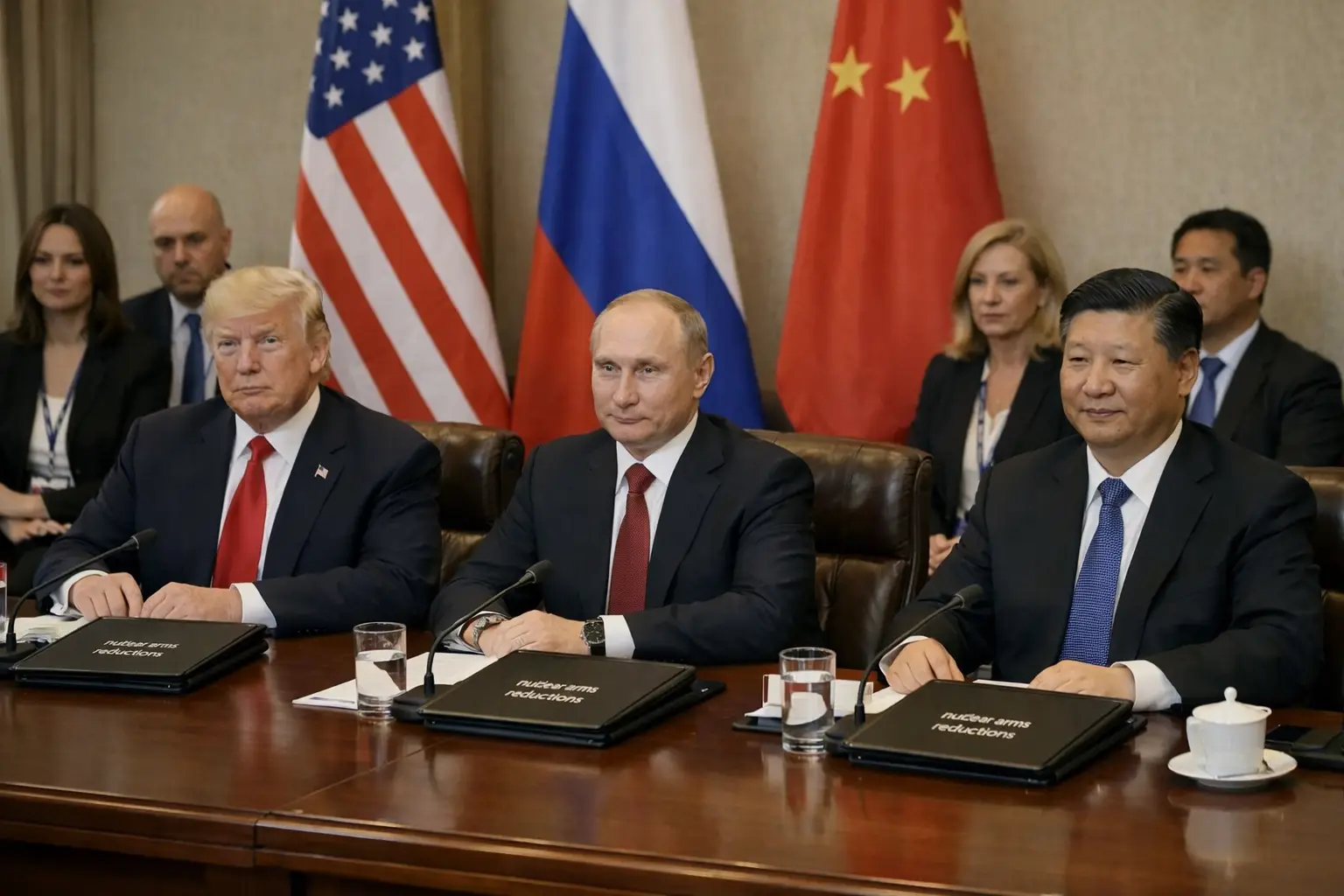
President Donald Trump will raise the issue of reducing the world’s nuclear arsenals when he meets Russian President Vladimir Putin and Chinese President Xi Jinping in China next week, the White House said Friday. The meeting is scheduled for Thursday and is expected to bring together the leaders of three countries central to global nuclear security.
White House spokeswoman Olivia Wales told reporters that Trump intends to discuss the reduction of nuclear weapons worldwide, describing proliferation as an issue the president views as highly dangerous. The statement places arms control on the agenda of a meeting already significant for its geopolitical weight, given the deep tensions that continue to shape relations among the United States, Russia and China.
The discussion would come at a sensitive moment for international arms control. Washington and Moscow have historically held the largest nuclear stockpiles and have been the main parties to major bilateral limits on strategic weapons. Beijing, while possessing a smaller arsenal than the two Cold War-era powers, has become an increasingly important actor in any debate over future nuclear restraint. A direct conversation among the three leaders would therefore carry diplomatic significance even without an announced negotiating framework.
The White House did not provide further detail on possible proposals, timelines or whether the meeting could lead to a formal process. The planned exchange nevertheless underscores the continued importance of nuclear risk reduction as a subject of high-level diplomacy. Arms-control talks often require sustained technical negotiations, verification mechanisms and political commitment, making any leader-level discussion an initial step rather than a substitute for detailed agreements.
For Trump, putting the issue before Putin and Xi allows the administration to frame nuclear proliferation as a shared global concern rather than a matter confined to bilateral rivalry. For Russia and China, the meeting offers an opportunity to hear Washington’s position directly in a setting where strategic stability, security competition and diplomatic leverage are closely intertwined. The outcome will depend on whether the leaders move beyond general concern and toward a concrete path for future talks.