







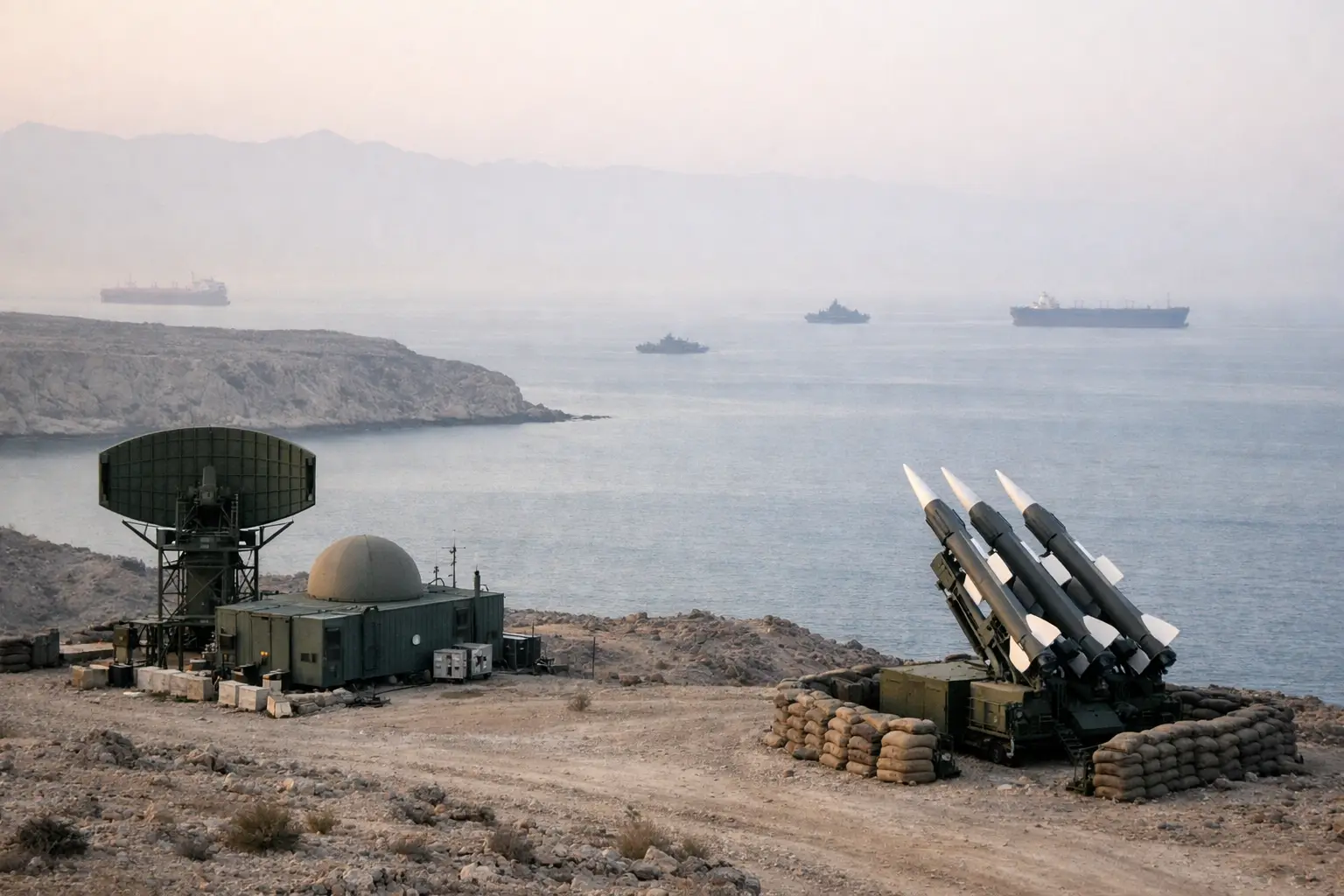
The United States carried out strikes on Iran’s Qeshm Island on Monday, a move described by U.S. officials as limited and defensive. The island sits in the Strait of Hormuz, one of the world’s most closely watched maritime passages, where military movements can carry immediate regional significance. The action was linked by officials to threats involving surface-to-air missiles directed against U.S. assets.
The operation was not characterized as a return to large-scale combat, and officials presented it as a narrow response rather than a broader escalation. One U.S. official said the strikes were confined in scope, while another described them as defensive measures connected to Iranian use of surface-to-air systems. The officials did not provide public details on the specific targets hit, the number of strikes, or any damage assessment.
Qeshm Island’s location gives the incident strategic weight beyond the immediate military action. The island lies near a chokepoint linking the Persian Gulf with the Gulf of Oman, an area central to energy shipping and to naval deployments by regional and international powers. Any military activity in or near the strait is monitored closely because of the proximity of Iranian territory, commercial shipping lanes and foreign military operations.
The reference to surface-to-air missiles places the reported threat in the sphere of air defense and force protection. Such systems are designed to target aircraft and other airborne platforms, making their use near active U.S. operations a direct concern for American personnel and equipment. The U.S. Department of Defense has long maintained a presence in the wider Gulf region, where it monitors maritime security and supports U.S. military assets operating across air and sea domains.
The strikes add to the pressure surrounding U.S.-Iran relations, already defined by military caution, competing regional interests and recurring incidents around the Gulf. With officials emphasizing the limited nature of the action, the immediate message from Washington was centered on protection of U.S. assets rather than the opening of a new phase of hostilities. Further official clarification would be needed to establish the operational details and any diplomatic response from Tehran.