


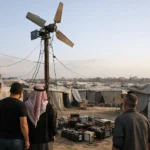


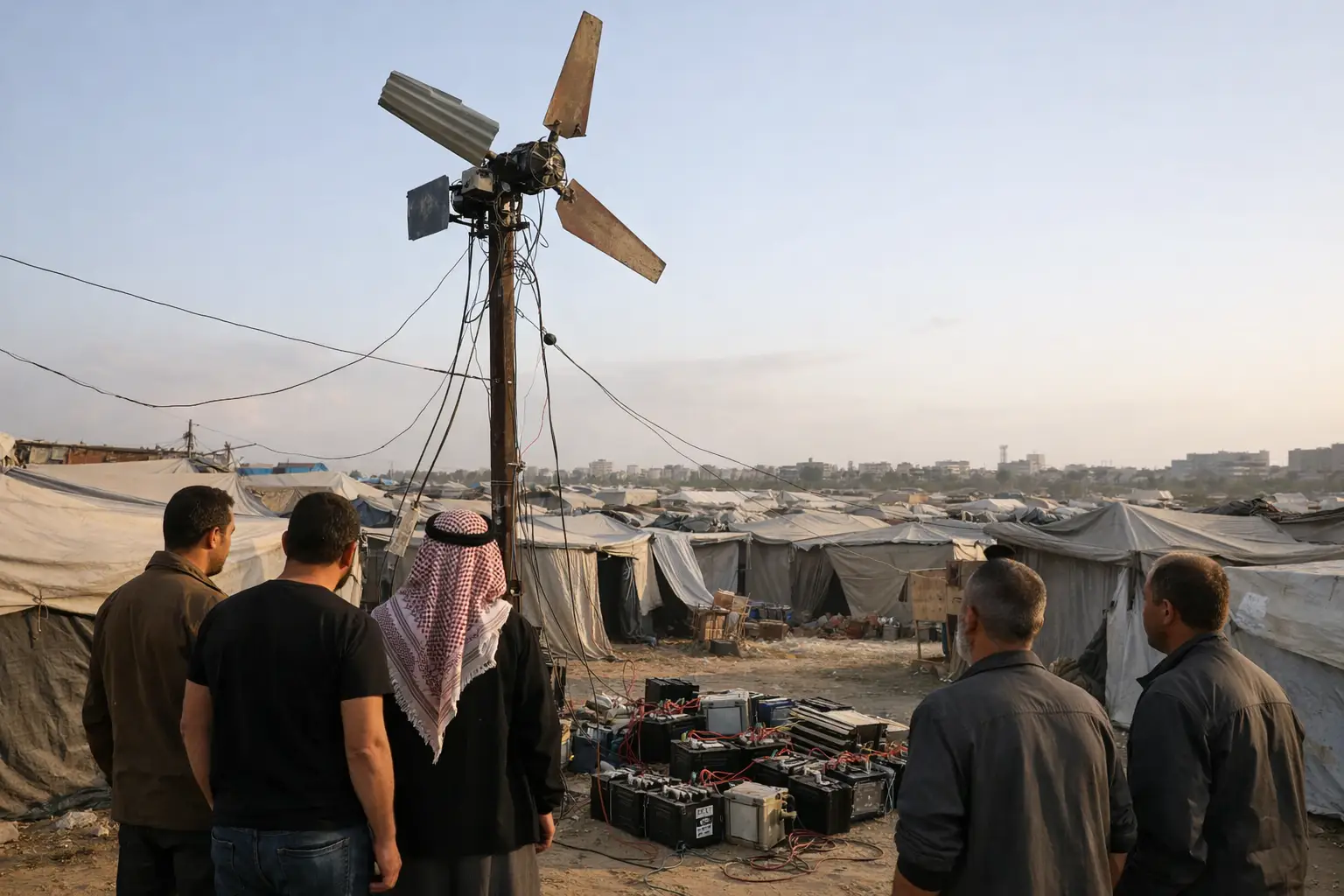
Over the tents of a crowded displacement camp in Gaza, improvised wind turbines turn in the coastal air. Built from scrap metal and pieces recovered from the debris, the small devices capture the sea breeze above shelters where families live with little or no connection to the enclave’s damaged electricity network.
The work is led in the southern city of Khan Yunis by Kamal Al-Dabary, a former engineering student who has applied his technical training to an urgent problem facing displaced Palestinians. In a camp shaped by overcrowding and scarcity, his homemade turbines are a practical response to a basic need: access to power in an environment where conventional infrastructure has been shattered.
The project illustrates how survival in Gaza increasingly depends on improvisation. Materials that would otherwise remain part of the wreckage are being turned into equipment capable of generating electricity, however limited. In a territory where the power grid has been severely disrupted, any independent source of energy can carry significance for families trying to maintain daily life inside temporary shelters.
The turbines also point to the broader challenge facing humanitarian operations in the occupied Palestinian territory. The UN Office for the Coordination of Humanitarian Affairs tracks the impact of the crisis on essential services, including the systems that support water, health care and communications. In that context, locally built power sources do not replace a functioning grid, but they show how residents are adapting while formal services remain unreliable or inaccessible.
For the displaced families gathered in Khan Yunis, the sight of blades turning above the tents has become more than a technical experiment. It is a visible example of resourcefulness under pressure, using wind and salvage to restore a measure of autonomy. The electricity produced by these homemade machines is modest, but in a camp cut off from stable power, even a small current can represent a meaningful form of resilience.