







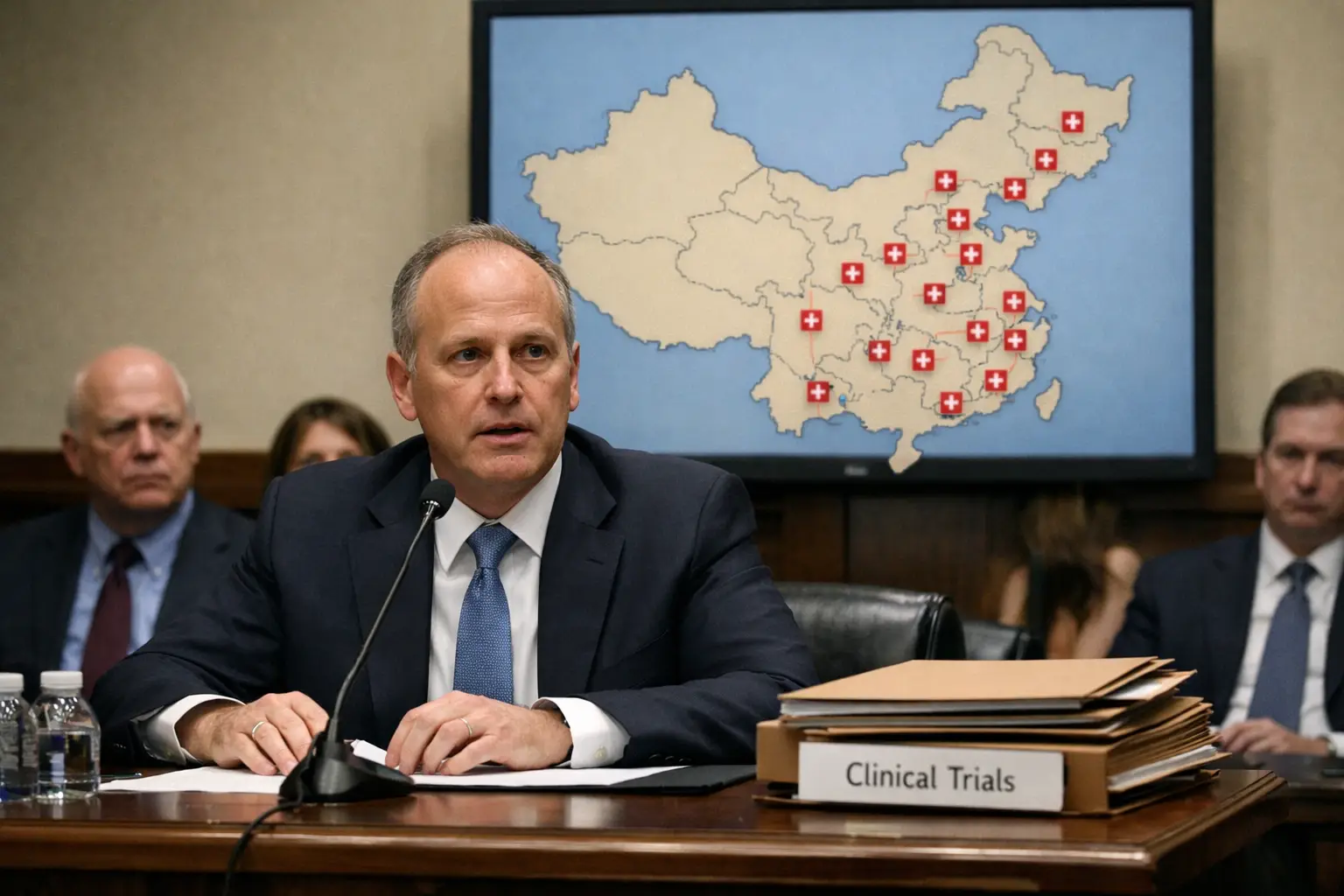
Major pharmaceutical companies have told a congressional committee that they do not intend to open new clinical trial sites in the Xinjiang region of China or at hospitals affiliated with the Chinese military. The disclosures place new limits around research activity in one of the world’s most important markets for drug development, where access to patients and medical infrastructure has made clinical trials a central part of the global pharmaceutical pipeline.
The information was made public by the House Select Committee on the Chinese Communist Party, which opened inquiries last June into Merck, Eli Lilly, AbbVie, Pfizer and Bristol Myers Squibb. The committee’s investigation focused on concerns involving intellectual property exposure, possible links to military institutions, and the ethical standards applied at research sites in politically sensitive areas.
All five companies indicated that they would not initiate new clinical studies at sites associated with the People’s Liberation Army, the military arm of the Chinese Communist Party. The position also covers new trial activity in Xinjiang, a region that has drawn sustained scrutiny from governments and rights groups over the treatment of ethnic minorities. The companies’ responses do not, on the basis of the committee’s disclosure, detail broader changes to existing research programs or to trial activity elsewhere in China.
The issue sits at the intersection of science, national security and corporate compliance. Large drugmakers often rely on multinational trials to gather data across diverse patient populations and to support regulatory reviews in multiple jurisdictions. At the same time, research partnerships involving hospitals, data systems and advanced biomedical knowledge can raise questions when trial sites are connected to military structures or located in regions subject to heightened political concern.
For the pharmaceutical sector, the letters mark another example of how geopolitical tensions are reshaping decisions that once appeared primarily scientific or commercial. The committee’s concerns about security risks and intellectual property add pressure on companies to demonstrate tighter oversight of where trials are conducted and which institutions participate. The development does not remove China from global drug research, but it signals that some of the largest U.S. and international drugmakers are drawing clearer boundaries around trial sites considered politically or strategically sensitive.