








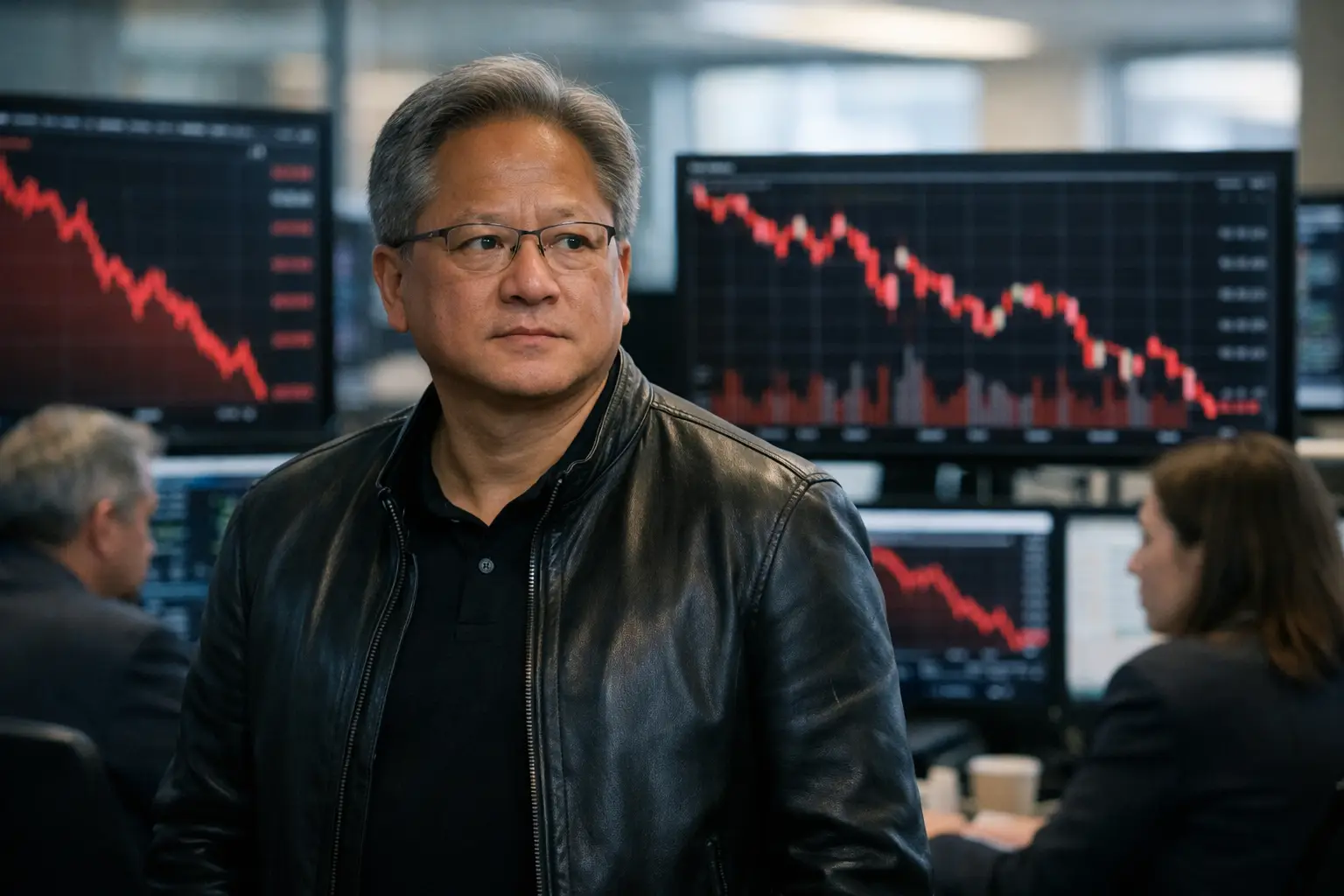
Nasdaq futures weakened Wednesday evening after shares of Nvidia fell 8% in after-hours trading, putting pressure on the technology-heavy Nasdaq-100. The move followed a report that the company’s board may consider removing chief executive Jensen Huang, a development that quickly shifted attention from regular-session trading to corporate governance at one of the market’s most closely watched companies.
The decline mattered beyond a single stock because Nvidia has become a central reference point for investor sentiment toward semiconductors and growth-oriented technology shares. A sharp fall in its after-hours price weighed on futures tied to the Nasdaq-100 and was accompanied by selling in other chipmakers. In futures trading, such moves often reflect an immediate reassessment of risk before the next regular market session begins.
Nvidia’s share performance has carried unusual influence across the stock market because of the company’s position in advanced computing and chips used in artificial intelligence infrastructure. That prominence means questions about leadership can have a wider effect than they might at a more narrowly followed company. Investors generally treat uncertainty at the top of a major technology supplier as relevant not only to strategy, but also to customer confidence, capital spending expectations and sector valuations.
The report concerning Huang introduced an element of governance risk into a stock already central to the broader technology trade. No additional confirmed details were available in the initial market reaction, but the scale of the after-hours decline showed how sensitive traders remain to any sign of instability at Nvidia. The company’s moves can also influence passive funds and exchange-traded products that track large-cap technology indexes, increasing the potential market impact when the shares swing sharply outside normal hours.
Futures do not determine the next session’s close, and after-hours trading can be more volatile because liquidity is generally thinner than during the regular day. Even so, the reaction underscored Nvidia’s role as a bellwether for chip stocks and for risk appetite in technology shares. The next regular session will show whether the pressure remains concentrated in Nvidia and related semiconductor names or broadens further across the Nasdaq-linked market.