







The contest over artificial intelligence has moved beyond laboratory benchmarks into national security, industrial policy and global rule-setting. In Washington, the case for close cooperation with China on AI controls remains constrained by a basic political problem: any shared regime would depend on transparency, verification and confidence between two governments already locked in strategic competition. That makes governance of artificial intelligence one of the most difficult files in the broader United States–China relationship.
The White House has placed AI at the center of its technology and security agenda. President Joe Biden’s 2023 executive order directed federal agencies to address safety testing, privacy, federal procurement and national security risks, while the National Institute of Standards and Technology has developed risk-management guidance for AI systems. Washington has also restricted China’s access to some advanced semiconductors and chipmaking tools, treating computing power as a strategic asset rather than a purely commercial input.
Beijing has also moved to regulate parts of the sector. The Cyberspace Administration of China has issued rules covering generative AI services, reflecting the Chinese state’s interest in controlling information systems as well as supporting domestic technology champions. Those measures show that both governments see AI as too important to leave entirely to markets. They do not, however, resolve the central concern for Washington: whether any bilateral control mechanism could be monitored and enforced in a system where military, commercial and state priorities often overlap.
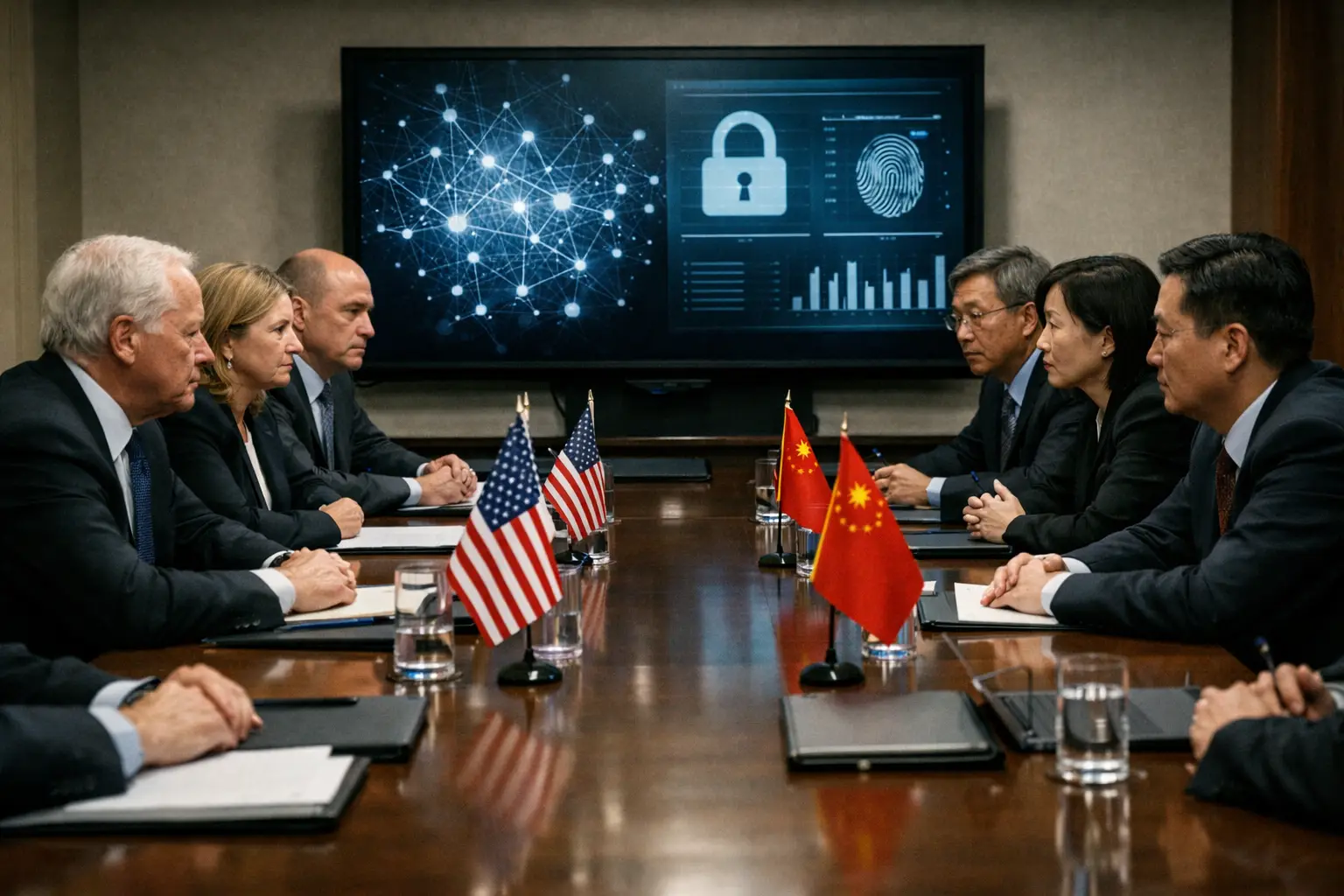
Diplomacy has not disappeared. The two governments have created channels to discuss AI risks, including official talks held in Geneva in 2024 under the broader effort to stabilize relations. Such contacts can reduce misunderstanding, clarify red lines and keep communication open during crises. But limited dialogue is different from a robust control architecture. A serious agreement would require shared definitions, access to relevant information and credible consequences for violations. Those are demanding conditions even among close partners, and far harder between strategic rivals.
The practical result is that Washington is likely to keep emphasizing domestic capability, allied coordination and technical standards rather than relying on a sweeping bargain with Beijing. Cooperation may still be possible on narrow issues such as crisis communication or common safety language. For now, however, the AI race is being shaped less by trust than by verification concerns, security priorities and competition for technological advantage.