









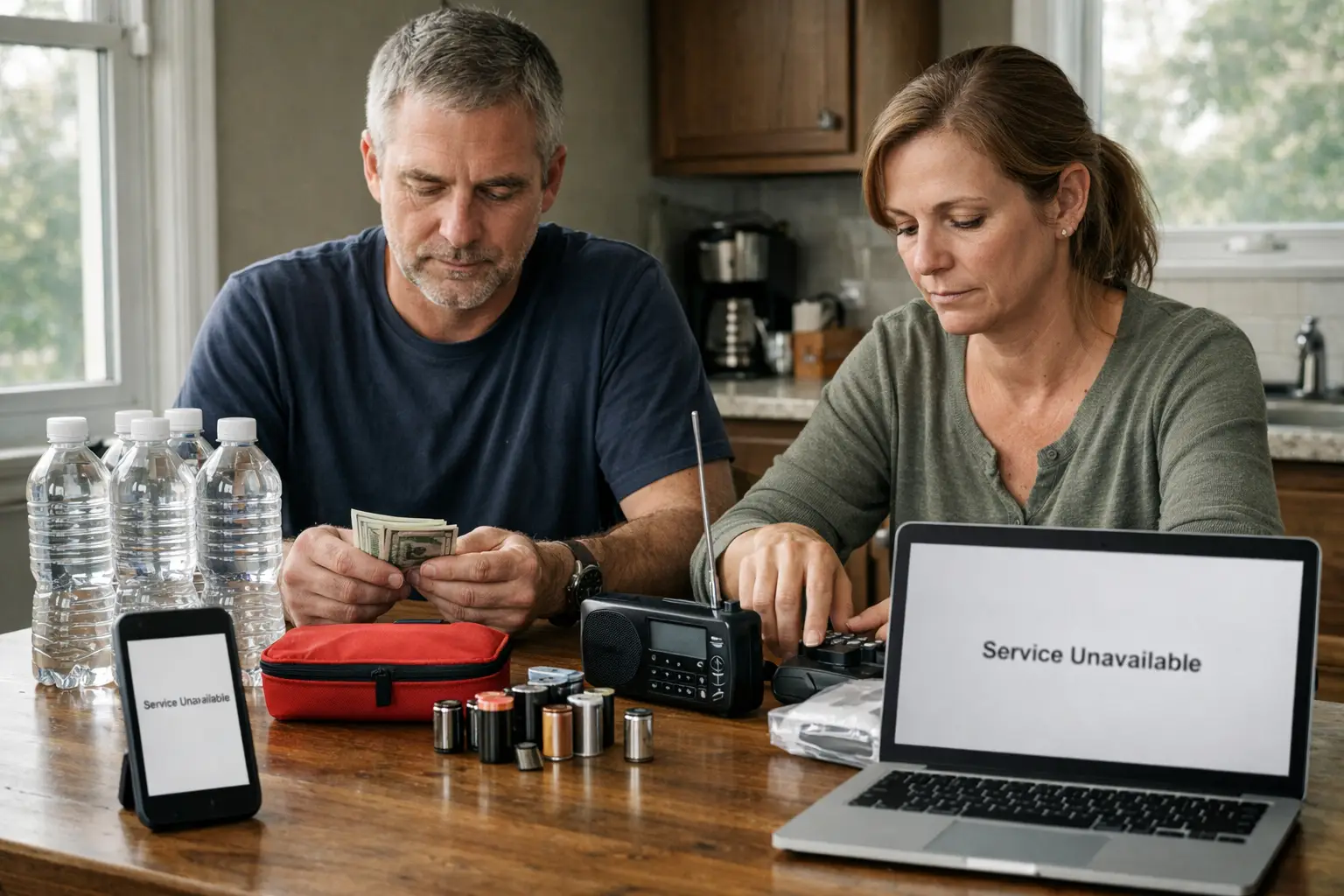
America’s digital unease is beginning to show up in practical household decisions. Concerns over technology failures are prompting some people in the United States to keep more physical cash and basic supplies available, reflecting a broader desire to be less exposed when digital systems fail. The behavior is not being framed as a rejection of modern services, but as a response to uncertainty about how resilient essential systems are when outages occur.
The trend points to a growing gap between daily reliance on connected infrastructure and public confidence in the explanations offered when disruptions happen. Electronic payments, online banking, mobile communications and digital access to services have become routine parts of economic life. When those systems are interrupted, even temporarily, households can face immediate problems: paying for purchases, reaching services, or making decisions with limited information. In that context, holding cash can become a buffer rather than a symbolic gesture.
A key factor behind the shift is the perceived lack of clear, consistent guidance from political leaders and public authorities at a global level. For some households, uncertainty itself is enough to encourage preparation. The concern is less about a single outage than about the possibility that multiple systems could be affected at once, leaving individuals dependent on limited communication and local resources. That perception has made preparedness a more mainstream conversation, especially among people who normally rely almost entirely on digital tools.
Official emergency planning has long encouraged households to think about basic continuity during disruptions. The Federal Emergency Management Agency provides guidance on emergency kits, while cash is often discussed as a practical option when card terminals, banking apps or networks are unavailable. The renewed attention to these measures underlines how technological resilience is now a consumer issue as much as an infrastructure issue. It also places pressure on companies and public institutions to communicate quickly and plainly when failures occur.
For businesses, the public reaction is a reminder that trust in digital systems depends not only on uptime, but also on transparency. For policymakers, it highlights the importance of preparedness messaging that avoids alarm while giving people usable information. As outages remain part of a highly connected economy, the households choosing to keep cash and supplies on hand are signaling a simple concern: convenience is valuable, but continuity matters when systems stop working.